


The main Playwright alternatives are Katalon Studio, Selenium, Cypress, WebdriverIO, Puppeteer, TestCafe, Nightwatch.js, and Robot Framework. This guide covers why teams look beyond Playwright, when each tool fits better, the trade-offs, and what each costs, as of November 2026.
The main Playwright alternatives are Katalon Studio for low-code testing across web, mobile, API, and desktop, Selenium for Ruby, real Safari, and existing WebDriver grids, Cypress for JavaScript front-end teams, and WebdriverIO or Nightwatch.js for JavaScript teams that also test native mobile apps. Puppeteer, TestCafe, and Robot Framework cover narrower needs: Chrome and Firefox automation, a simple Node.js setup, and readable keyword-driven tests.
Playwright itself is a strong framework, so the right choice among alternatives to Playwright depends on what it doesn't do for your team. This guide covers the common reasons teams look elsewhere, a comparison of eight tools as of November 2026, when each one fits better than Playwright, and what each costs.
Why teams look for a Playwright alternative

Playwright is an open-source framework from Microsoft, licensed under Apache 2.0. As of November 2026, the current release is Playwright 1.65. It drives Chromium, Firefox, and WebKit through one API, works in TypeScript, JavaScript, Python, Java, and .NET, and ships Playwright Test with parallel workers, sharding, Codegen, UI Mode, and Trace Viewer, plus Planner, Generator, and Healer test agents and an MCP server, where you bring the AI client and model. For a code-first web team, that's a lot of capability at no license cost.
Teams that move away from Playwright, or add a second tool next to it, usually do so for one of these reasons:
- Team skills. Playwright is code first. Its Codegen recorder generates code, but someone still has to read, structure, and maintain it. QA teams with manual testers who don't code often end up waiting on engineers. Playwright's test agents can draft and fix tests, but you still set up the AI client and model and review the code they write.
- Language. Playwright officially supports five languages, but not Ruby, and its full test runner, Playwright Test, is for TypeScript and JavaScript. Python, Java, and .NET teams pair the library with pytest, JUnit, or NUnit, and Kotlin or Groovy teams can use Playwright for Java.
- Native mobile apps. Playwright emulates mobile browsers by setting the viewport, user agent, and touch. As of November 2026, its Android support is experimental and covers Chrome for Android and Android WebView, not native app UI. There is no iOS app support.
- Desktop apps. Windows desktop applications are out of scope, and Electron support is experimental.
- Low-code or keyword-driven needs. Some teams want tests that business analysts or manual testers can read and edit without learning a programming language.
- Enterprise reporting. Playwright's HTML, JSON, and JUnit reports and traces describe one run. Run history across teams, flaky-test trends, and links from tests to requirements come from tools you add and maintain.
None of these mean Playwright is the wrong choice. They mean it fits some teams better than others.
Playwright alternatives at a glance
The table compares Playwright and eight alternatives as of November 2026, from each project's own site and documentation and the Katalon pricing page.
Tool | Test authoring | Languages | Browsers | Mobile apps | Desktop apps | Cost |
|---|---|---|---|---|---|---|
Playwright | Code, plus Codegen recorder | TypeScript, JavaScript, Python, Java, .NET | Chromium, Firefox, WebKit, plus branded Chrome and Edge | Mobile browser emulation; Android experimental | Electron experimental | Free, open source |
Katalon Studio | Record, keywords, or code | Groovy, Java | Chrome, Firefox, Edge, Safari (on macOS) | Native and hybrid Android and iOS | Windows, on Professional and Enterprise | Free plan; Professional $1,800 per seat per year; Enterprise custom |
Selenium | Code | Java, Python, C#, Ruby, JavaScript (Kotlin via Java) | Chrome, Firefox, Edge, Safari | Through Appium | No | Free, open source |
Cypress | Code | JavaScript, TypeScript | Chrome-family, Firefox; WebKit experimental | No (viewport only) | No | Free app; Cloud free tier, paid from $67 a month |
WebdriverIO | Code | JavaScript, TypeScript | All major browsers over WebDriver and WebDriver BiDi | iOS, Android, and Flutter through Appium | Electron and Tauri | Free, open source |
Puppeteer | Code (library, not a test runner) | JavaScript, TypeScript | Chrome, Firefox | No | No | Free, open source |
TestCafe | Code | JavaScript, TypeScript | Chrome, Firefox, Safari, Edge, Opera | Mobile browsers only | No | Free, open source |
Nightwatch.js | Code | JavaScript, TypeScript | All major browsers over W3C WebDriver | Native iOS and Android | No | Free, open source |
Robot Framework | Keywords | Keyword syntax, with Python libraries | Chromium, Firefox, WebKit through Browser library | Through AppiumLibrary | Through community libraries | Free, open source |
The 8 best Playwright alternatives
1. Katalon Studio

Katalon Studio is a test automation IDE for web, mobile, API, and Windows desktop testing. You can record a test, build it from built-in keywords, or write it in Groovy or Java, and switch between the keyword view and the script view of the same test case. A project holds test cases, an Object Repository, data files, and test suites in one place, so you don't assemble a runner, assertions, or reporting yourself.
When it beats Playwright:
- Mixed-skill teams. Manual testers record and edit keyword tests, and engineers add logic in code, in the same project.
- More than the browser. Native and hybrid Android and iOS apps, REST and SOAP APIs, and web tests live side by side. Windows desktop testing, including a native Windows recorder, is on a paid plan (Professional or Enterprise).
- Maintenance help built in, on paid plans. AI self-healing retries alternative locators automatically during runs when the UI changes, and the Katalon AI Assistant generates and explains scripts from natural language. Playwright's Healer agent patches failing tests too, but you bring the AI client and model. Both Katalon features are on Professional and Enterprise, where you can also use your own AI provider key.
Trade-offs: scripting is Groovy and Java only, so a TypeScript or Python team gives up its language. Parallel execution and BDD with Cucumber need a paid plan. Command-line and CI runs need the Katalon Runtime Engine (KRE) add-on and a paid plan, and cloud browsers and real devices come from TestCloud, a paid add-on that works with any Studio plan, including Free.
Cost, as of November 2026: Katalon Studio has a Free plan for local authoring, record and playback, and local runs. Professional is $1,800 per seat per year, billed annually (about $150 a month), Enterprise is custom, and there's a 30-day free trial. KRE and TestCloud are add-ons; see pricing. Katalon is rated 4.5 on G2.
For a feature-by-feature view, see Katalon Studio vs Playwright.
2. Selenium

Selenium drives browsers over the W3C WebDriver protocol, with official bindings for Java, Python, C#, Ruby, and JavaScript (Kotlin uses the Java bindings). Selenium Grid spreads runs across machines you host. As of November 2026, the current release is Selenium 4.52.
When it beats Playwright:
- Language choice. Ruby teams have an official binding, and Selenium's bindings have the longest history in Java and C# shops, with years of examples, page-object libraries, and grid tooling.
- Real Safari and stock Firefox. Tests run through each vendor's own driver, including safaridriver on macOS, where Playwright tests the WebKit engine and a patched Firefox build.
- Ecosystem. Many existing suites, cloud grids, and tools are built on WebDriver, and Appium extends the same model to mobile apps.
Trade-offs: Selenium is a browser automation library, not a full test framework. You choose and wire up the runner, assertions, waits, and reporting, and poorly handled waits are a common source of flaky tests. Playwright's auto-waiting and Trace Viewer give you more out of the box.
Cost: free and open source. For a head-to-head view, see Playwright vs Selenium.
3. Cypress
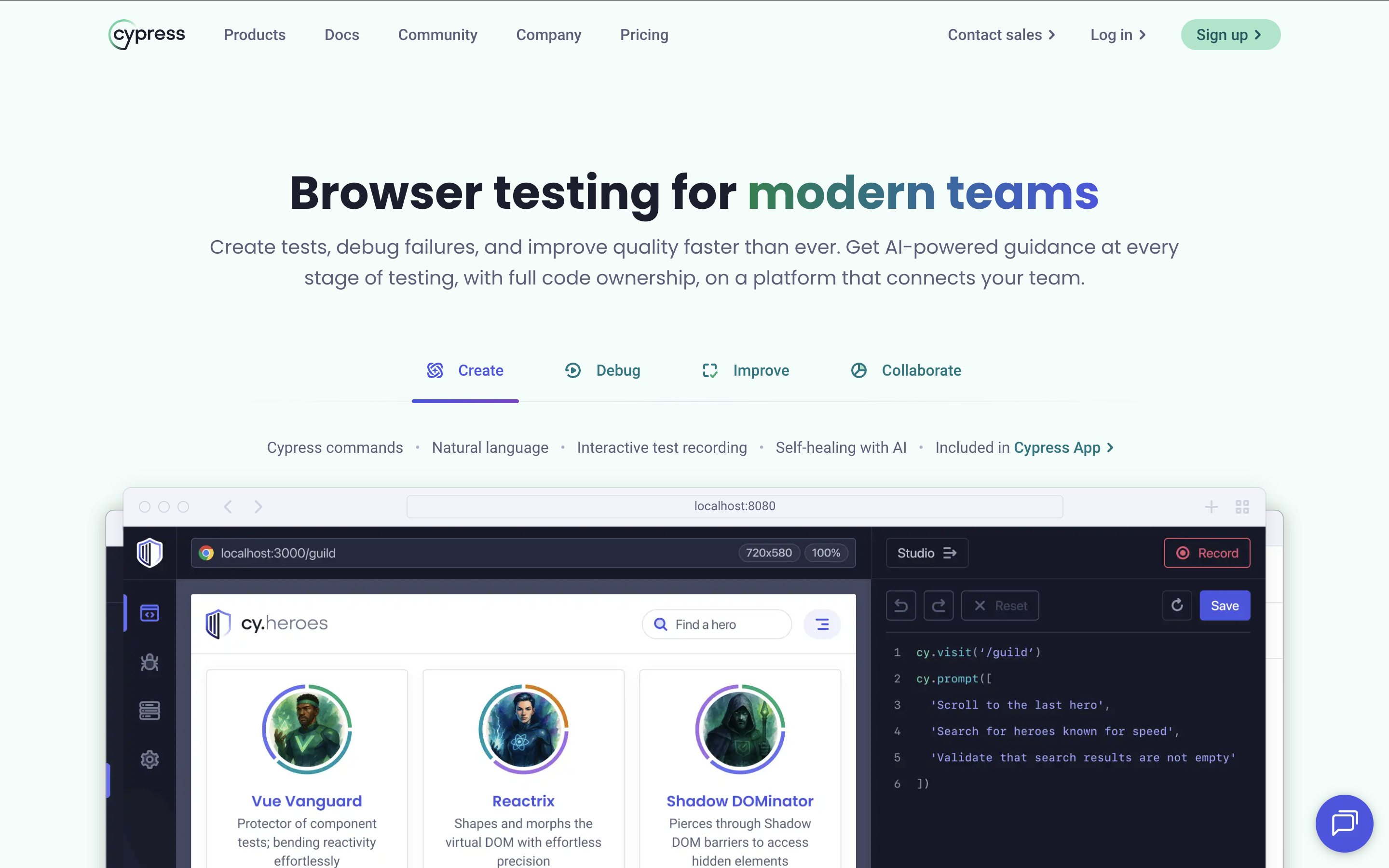
Cypress is a JavaScript end-to-end and component testing tool that runs your test code inside the browser, in the same run loop as the application. The app is free and MIT-licensed. Cypress 16.0.0 shipped in September 2026, and 16.3.0 is the latest release as of November 2026.
When it beats Playwright:
- Front-end developer experience. The interactive runner shows each command against a live view of the app, with time-travel snapshots, which many front-end teams find easy to debug.
- Component testing for React, Vue, Angular, and other frameworks, in the same tool as end-to-end tests.
Trade-offs: JavaScript and TypeScript only, WebKit support is experimental, and native mobile apps are out of scope. Cypress 16 needs Node.js 22, 24, or 26 and later.
Cost, as of November 2026: the Cypress app is free. Cypress Cloud has a free Starter plan that includes parallelization for up to 500 test results a month, then Team at $67 a month and Business at $267 a month, billed annually, and a custom Enterprise plan.
For more detail, see Playwright vs Cypress. If you're moving off Cypress instead, see our guide to Cypress alternatives.
4. WebdriverIO

WebdriverIO is an open-source Node.js test framework under the OpenJS Foundation. Version 10 automates browsers over WebDriver and WebDriver BiDi, mobile apps (iOS, Android, and Flutter) through Appium, and desktop apps built with Electron or Tauri. It also supports component and visual testing.
When it beats Playwright:
- Native mobile in JavaScript. A TypeScript team can test Android and iOS apps without switching to another framework or language.
- Desktop apps. Electron and Tauri apps are in scope, where Playwright's Electron support is experimental.
- Standards-based control over WebDriver and WebDriver BiDi, across all major browsers.
Trade-offs: you'll find fewer published examples for edge cases than for Playwright, and stable mobile tests still need Appium experience.
Cost: free and open source. All features are free.
5. Puppeteer
Puppeteer is a JavaScript library from the Chrome team that controls Chrome or Firefox over the Chrome DevTools Protocol or WebDriver BiDi. As of November 2026 it's on major version 25. Playwright's API will feel familiar to anyone moving from Puppeteer.
When it beats Playwright:
- Chrome-first automation that isn't mainly testing, such as scraping, screenshots, PDF generation, and performance traces, where a small library is all you need.
- Direct DevTools access when you want low-level control of Chrome.
Trade-offs: Puppeteer is a library, not a test framework. There is no built-in test runner, assertions, retries, or reporting, so you pair it with Jest or Mocha. It has no WebKit or Safari support and no mobile or desktop app coverage.
Cost: free and open source.
6. TestCafe

TestCafe is a free, open-source end-to-end framework from DevExpress. It doesn't use WebDriver or browser drivers, installs with a single npm package, and runs tests in JavaScript or TypeScript. DevExpress also sells TestCafe Studio, a separate desktop recorder app.
When it beats Playwright:
- Simple setup for a small Node.js project, with built-in waits for elements and page loads.
- Browser reach across Chrome, Firefox, Safari, Edge, and Opera, including remote and mobile browsers.
Trade-offs: TestCafe is maintained (3.7.7 as of November 2026); check its release history against your planning horizon. Multiple-window tests are limited to Chrome and Firefox.
Cost: the framework is free and open source; TestCafe Studio is a separate commercial product, licensed per user, with a 30-day free trial.
7. Nightwatch.js
Nightwatch.js is an open-source Node.js framework maintained by BrowserStack and licensed under MIT. Version 3.16.0 runs over W3C WebDriver and covers web, native iOS and Android apps, API, accessibility (through axe), visual, and component tests.
When it beats Playwright:
- Native mobile apps in the same JavaScript framework as your web tests.
- Built-in accessibility checks and API testing alongside end-to-end tests.
- WebDriver-based runs that work with existing Selenium grids and cloud device providers.
Trade-offs: you'll find fewer published examples for edge cases than for Playwright, and WebDriver-based runs don't give you Playwright's browser contexts or Trace Viewer.
Cost: free and open source.
8. Robot Framework
Robot Framework is an open-source, keyword-driven automation framework implemented in Python and supported by the non-profit Robot Framework Foundation. It's on major version 7. Tests are readable keyword steps in .robot files, and libraries add web, mobile, and API reach.
One detail matters here: Robot Framework's Browser library is powered by Playwright. It drives Chromium, Firefox, and WebKit through Playwright under the hood. So choosing Robot Framework with Browser library doesn't replace Playwright's engine; it replaces how you write tests. SeleniumLibrary is the other main web option, AppiumLibrary covers mobile apps, and community libraries cover Windows desktop apps.
When it beats Playwright:
- Readable tests that business analysts, manual testers, and RPA teams can follow.
- Python teams that want keyword-driven tests with Python libraries behind them.
Trade-offs: you assemble libraries and tools yourself, parallel runs usually go through Pabot, a community tool, and debugging means working through both the keyword layer and the library underneath.
Cost: free and open source, with no license cost.
How to choose a Playwright alternative
Start with who writes and maintains the tests, then what you test, then the language your team uses:
- Mixed-skill QA team, or web plus mobile, API, and desktop apps: Katalon Studio.
- Ruby teams, or teams that need real Safari or an existing WebDriver grid: Selenium.
- JavaScript front-end team that values in-browser debugging and component tests: Cypress.
- JavaScript team that also needs native mobile apps: WebdriverIO or Nightwatch.js.
- Chrome or Firefox automation that isn't mainly testing: Puppeteer.
- Small Node.js project with a simple setup: TestCafe.
- Readable keyword-driven tests on Python, with Playwright underneath: Robot Framework with Browser library.
Before you commit, rebuild three or four of your most important flows in your top two candidates. Compare setup time, run time in CI, and how long it takes to fix a test after you change a locator on purpose.
Free Playwright alternatives
Selenium, WebdriverIO, Puppeteer, TestCafe, Nightwatch.js, and Robot Framework are free and open source, and the Cypress app is free too. Your costs are the infrastructure you run them on and the engineering time to build reporting, parallel runs, and maintenance around them. Cypress Cloud adds a free Starter tier with paid plans above it.
Katalon Studio has a Free plan for local authoring, record and playback, and local runs. Desktop testing, AI self-healing, parallel execution, and BDD need a paid plan (Professional or Enterprise), and CI runs need the KRE add-on and a paid plan.
Already on Playwright? You may not need to switch
If your Playwright suite works and the gap is reporting or test management, you can keep it. Katalon True can manage and report Playwright tests next to Katalon results through Katalon TestOps: connect your Playwright repository, or keep running Playwright in your own CI and upload results with the Katalon Playwright reporter. As of November 2026, platform-triggered runs support TypeScript projects in Chrome or headless Chrome on Windows and Linux, and the reporter route covers Firefox and WebKit runs.
Some teams also split the work: engineers keep Playwright for fast web checks, and testers use Katalon Studio for mobile, desktop, and keyword-driven regression suites. The Katalon Studio vs Playwright comparison covers that setup in more detail.
Verdict: which Playwright alternative is right for you?
For a code-first team testing web apps in TypeScript or Python, Playwright is hard to beat, and the best move may be to stay. Look elsewhere when the gap is real: Katalon Studio when testers who don't code need to build automation, or when you test mobile, API, and Windows desktop apps in one place; Selenium for Ruby, real Safari, or an existing WebDriver grid; Cypress for front-end developer experience; and WebdriverIO or Nightwatch.js for native mobile in JavaScript. Puppeteer, TestCafe, and Robot Framework fit narrower needs.
If your team needs low-code testing across web, mobile, API, and desktop, try Katalon Studio's Free plan or its 30-day free trial against your own app.
Frequently asked questions
It depends on why you are moving. Katalon Studio suits mixed-skill teams that test web, mobile, API, and desktop apps. Selenium suits Ruby teams and teams that need real Safari or an existing WebDriver grid. Cypress suits JavaScript front-end teams, and WebdriverIO or Nightwatch.js suit JavaScript teams that also test native mobile apps.
Yes. As of November 2026, Selenium, WebdriverIO, Puppeteer, TestCafe, Nightwatch.js, and Robot Framework are free and open source, and the Cypress app is free. You pay in infrastructure and engineering time instead. Katalon Studio has a Free plan for local authoring, record and playback, and local runs, with paid plans for more.
Yes. Katalon Studio lets testers record tests or build them from keywords, then switch to Groovy or Java when they need more control. Robot Framework offers readable keyword syntax with Python libraries behind it. Both suit teams where not everyone writes code, though Robot Framework's libraries and tooling are assembled by your team.
Yes, through its Browser library, which is powered by Playwright and drives Chromium, Firefox, and WebKit. Robot Framework adds a keyword-driven layer on top, so tests read as plain steps. SeleniumLibrary is the other main web library. Choosing Robot Framework changes how you write tests, not necessarily the browser engine.
Not native ones, as of November 2026. Playwright emulates mobile browsers, and its Android support is experimental and limited to Chrome for Android and WebView. Electron support is also experimental. For native mobile apps, look at Katalon Studio, WebdriverIO, or Nightwatch.js; for Windows desktop apps, Katalon Studio on a paid plan.
Yes. Katalon Studio doesn't run Playwright scripts, but Katalon True can manage and report Playwright tests through Katalon TestOps. You can connect a Playwright repository, or keep running Playwright in your own CI and upload results with the Katalon Playwright reporter. Some teams keep both and report them in one place.




Test everything. Ship with confidence.
From generating test cases to spotting failures, Katalon's AI works across your entire pipeline, automatically.
