


The best Perfecto alternative depends on what you test and how you pay. This guide compares 12 device and browser clouds as of November 2026, from Katalon TestCloud with Katalon Studio to BrowserStack, Sauce Labs, TestMu AI, mobile device clouds, and a self-hosted grid, with dated prices and when to choose each.
The best Perfecto alternative depends on what you test and how you want to pay: BrowserStack, Sauce Labs, and TestMu AI (formerly LambdaTest) are the closest like-for-like device and browser clouds, while Katalon TestCloud, paired with Katalon Studio, suits teams that want to author tests and run them on cloud browsers and real devices in one workflow. For mobile apps only, look at Kobiton, HeadSpin, pCloudy, AWS Device Farm, or Firebase Test Lab, and for a license-free route, Selenium Grid on your own machines.
This guide compares 12 Perfecto alternatives as of November 2026, grouped by the job they do, with prices taken from each vendor's own site.
What is Perfecto?
Perfecto is a testing cloud owned by Perforce. As of November 2026, Perforce describes it as a cloud-based continuous testing platform for web, mobile, and desktop applications. It gives teams real iOS and Android devices, emulators and simulators, and desktop browsers in one cloud, and runs Appium, Selenium, and other framework tests against them.
Perforce now positions Perfecto around AI. Perfecto AI covers test creation, execution, maintenance, and root cause analysis from a natural-language interface, and Perforce says one AI-generated test can run across iOS, Android, web, and desktop. Perfecto's focus is large enterprises, with enterprise deployment options and support.
Perfecto pricing
As of November 2026, Perforce does not publish Perfecto prices. Its site asks you to build a quote or contact sales.
That quote-only model is one reason teams compare alternatives: many of the clouds below publish self-serve prices, so you can estimate cost before you talk to sales.
Why teams look for a Perfecto alternative
Common reasons to compare Perfecto with other clouds include:
- Cost visibility. Quote-only pricing makes it hard to compare costs or start small. Several alternatives publish monthly or per-minute prices.
- A narrower need. Some teams only test Android and iOS apps, or only need a few browsers in CI, and pay for an enterprise platform they don't fully use.
- Device availability. On any shared device cloud, popular devices can be busy at peak times. Teams with tight release windows compare how each vendor handles private or dedicated devices.
- Authoring and execution in one place. Teams that also need to build and maintain tests look at options that pair authoring with cloud execution.
- Control. Some teams want to run tests on their own machines, or need a private setup for applications behind a firewall.
What to look for in a Perfecto alternative
Before you compare tools, decide what matters most to your team:
- Coverage: real iOS and Android devices, emulators and simulators, desktop browsers, or all of them?
- Framework support: will it run your existing Appium, Selenium, Playwright, Espresso, or XCUITest tests without a rewrite?
- Pricing model: per user, per parallel test, per device minute, or by quote?
- Private access: can it reach staging environments behind your firewall?
- Device options: shared public devices, dedicated private devices, or on-premises?
- Debugging: video, logs, network and performance data for failed runs?
Cloud browser and device grids
1. Katalon TestCloud (with Katalon Studio)

Best for: teams that want to build tests and run them on cloud browsers and real devices without maintaining a device lab.
Katalon TestCloud runs automated and live tests in parallel on cloud browsers and real devices. It covers Chrome, Firefox, Safari, and Edge on Windows and macOS, and real iOS and Android devices for both live testing and automated runs. Device features include network throttling, GPS and IP location, biometric simulation, and camera injection for QR and barcode flows. A private tunnel and IP allowlisting let TestCloud reach staging sites behind your firewall.
TestCloud pairs with Katalon Studio, Katalon's test automation IDE. In Studio you can record tests, build them from keywords, or write them in Groovy or Java for web, mobile, API, and (on paid plans) Windows desktop applications. Web and mobile suites can then run on TestCloud. According to the TestCloud page, you can also bring Playwright, Selenium, and Appium tests. On a paid plan (Professional or Enterprise), Studio includes AI self-healing, which retries alternative locators when the UI changes, and AI analysis of failure root causes.
Runs can be triggered from CI with a Katalon Runtime Engine (KRE) add-on ($1,399 per license per year) on a paid plan (the Free plan has no command-line or CI execution), and results can be sent to Katalon TestOps for reporting. If tests need to stay inside your own infrastructure, KRE runs the same suites on your own machines.
To be candid about the trade-off: BrowserStack (35,000+ real devices) and TestMu AI (50,000+) advertise larger device catalogs, as of November 2026. If you need to validate on a long list of older device and OS combinations, check that TestCloud covers them before you commit. Studio can also run tests on Selenium Grid, BrowserStack, Sauce Labs, and TestMu AI through remote execution, so you aren't locked into one cloud.
Pricing (as of November 2026): TestCloud is a paid add-on that works with any Studio plan, including Free, at $1,519 per session per year for cloud browsers or real devices; see Katalon pricing for current terms. TestCloud also has its own free trial. Studio has a Free plan, Professional at $1,800 per seat per year (about $150 a month, billed annually), and a custom Enterprise plan, with a 30-day free trial.
Best fit: teams that want authoring, cloud execution, and reporting from one vendor, especially teams that mix testers who code with testers who don't.
2. BrowserStack
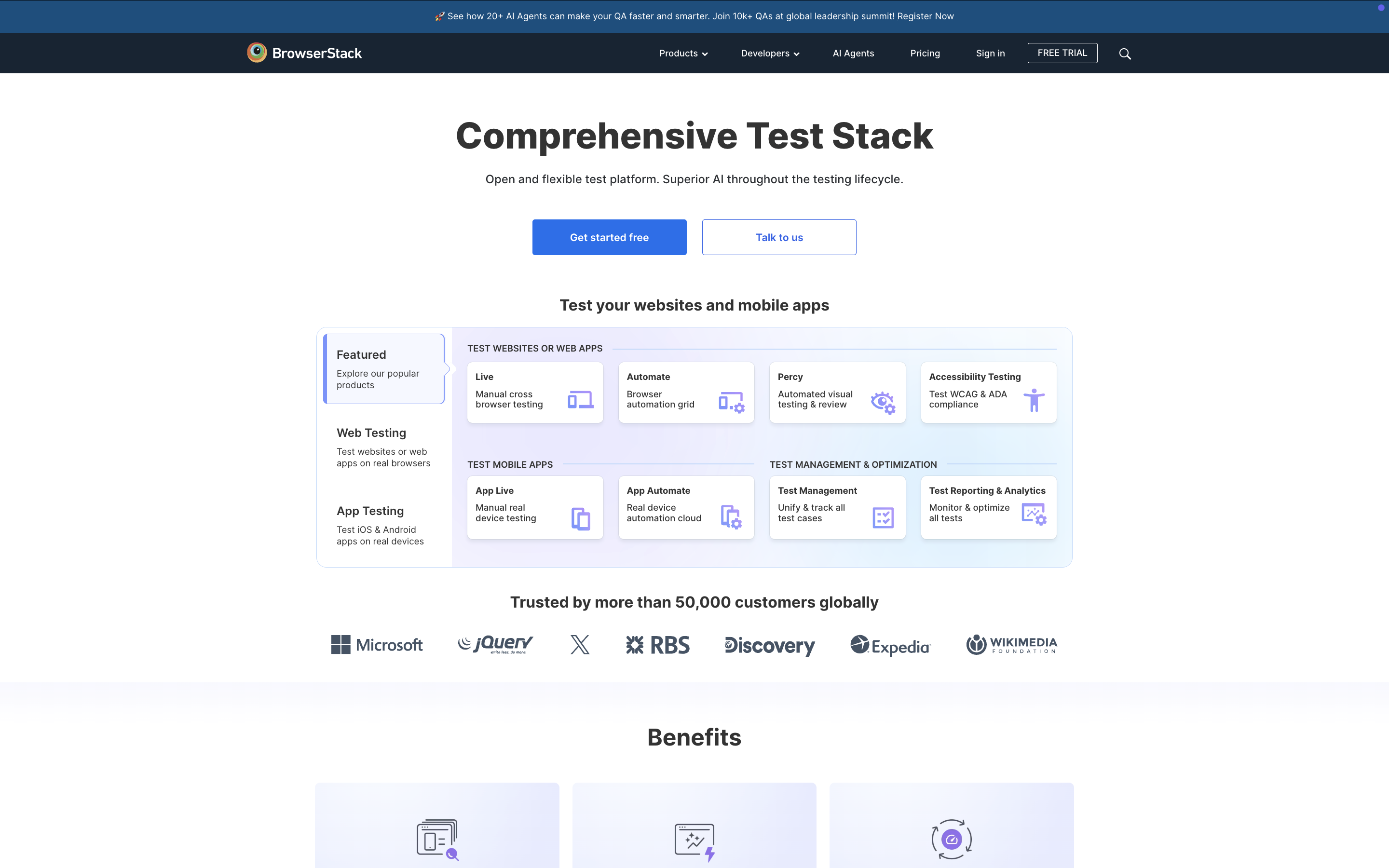
Best for: teams that want a large self-serve device and browser cloud with separately priced products.
BrowserStack is a cloud platform for testing websites and mobile apps on real browsers and devices. As of November 2026, it says it offers 35,000+ real devices. Live, Automate, App Live, App Automate, Percy visual testing, Low Code Automation, and Test Management are sold as separate products, and BrowserStack also sells AI agents across them.
Pricing (as of November 2026): Live from $12.50 a month on the Freelancer plan, or $29 a month for the Desktop plan, and Automate from $99 a month per parallel test (Desktop) or $175 (Desktop and Mobile), all billed annually. A Team Ultimate pack bundles 15 products from $375 a month.
Best fit: teams that want a large catalog and self-serve pricing. For a deeper look at BrowserStack and its own competitors, see our list of BrowserStack alternatives.
3. Sauce Labs
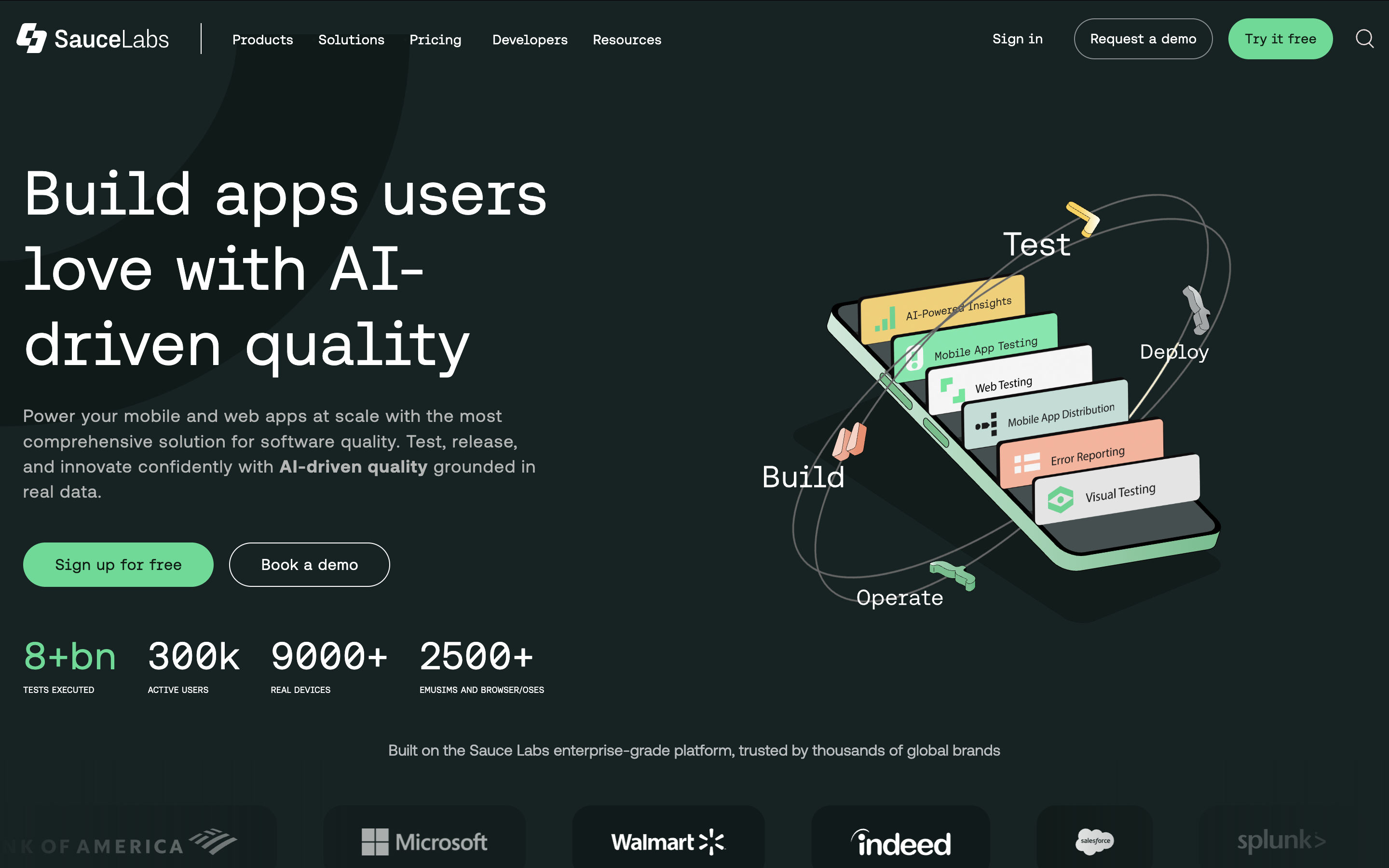
Best for: enterprise teams that want a large real device and browser cloud, with AI test authoring on Enterprise plans.
Sauce Labs is a long-established cloud testing platform. It runs Selenium, Appium, Playwright, and Cypress tests on desktop browsers, virtual devices, and real devices. As of November 2026, its site lists Sauce AI for Test Authoring, which turns intent described in plain language into test cases, and Sauce AI for Insights for test analytics and failure analysis. Both are on Enterprise plans.
Pricing (as of November 2026): Live Testing from $39 a month billed annually ($49 month to month), Virtual Device Cloud from $149 a month ($199), Real Device Cloud from $199 a month ($249), and Enterprise by quote.
Best fit: enterprises with established automation frameworks that want a close match to Perfecto's mix of real and virtual devices. See our Katalon vs Sauce Labs comparison for detail.
4. TestMu AI (formerly LambdaTest)
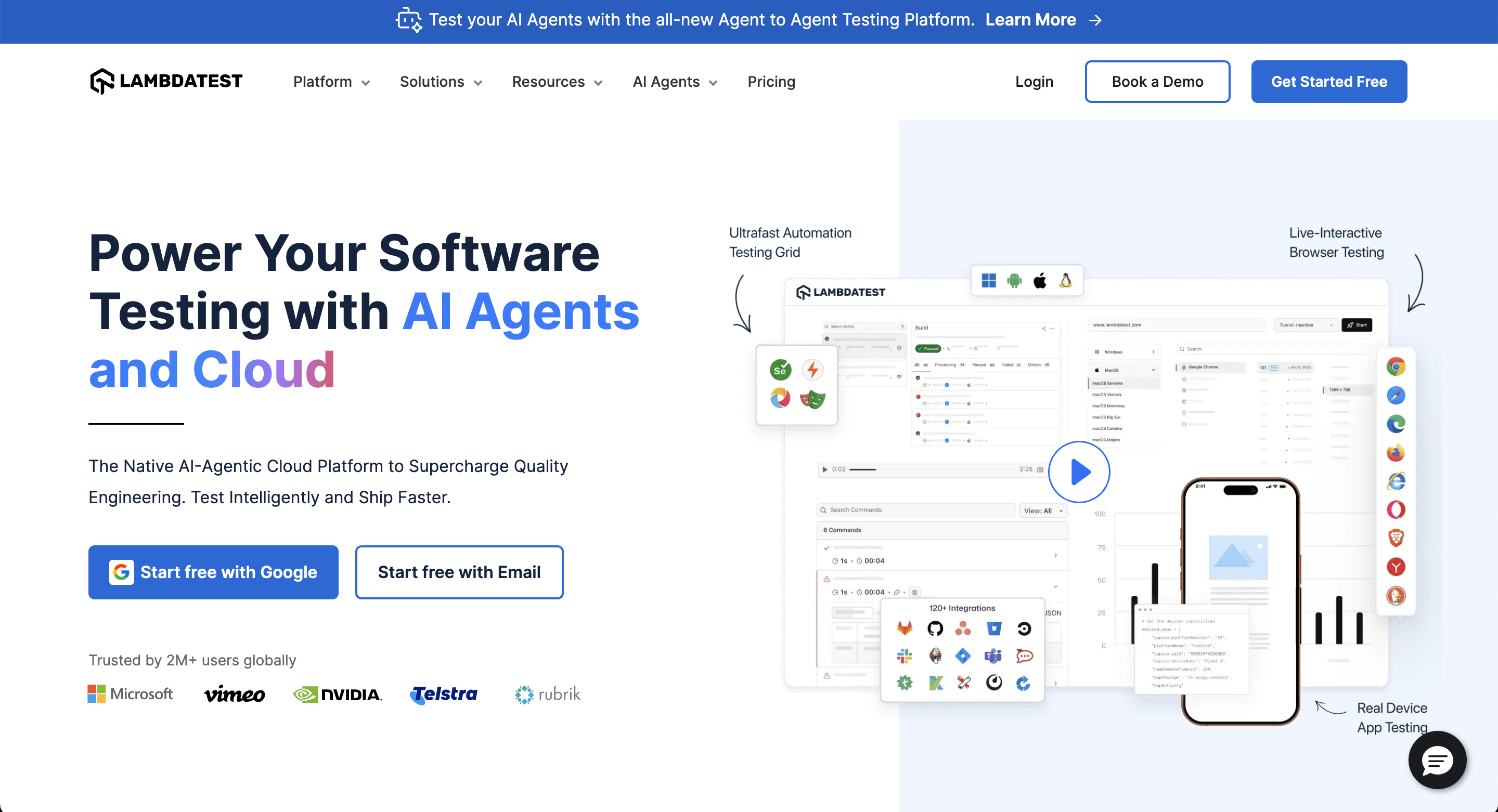
Best for: teams that want a free plan, low automation entry prices, and fast parallel execution.
LambdaTest renamed itself TestMu AI in January 2026, and lambdatest.com now redirects to testmuai.com. It offers live and automated testing on cloud browsers, a real device cloud, and HyperExecute for orchestrating fast parallel runs. KaneAI creates tests from plain-language instructions, and Test Manager handles test case management.
Pricing (as of November 2026): a free plan, Virtual Live from $15 a month, web automation from $29 a month, Real Device Plus Live from $39 a month, and real device automation from $199 a month, all billed annually.
Best fit: teams whose main constraint is execution cost and parallel capacity, and teams that want AI authoring from the same vendor as their grid.
5. BitBar
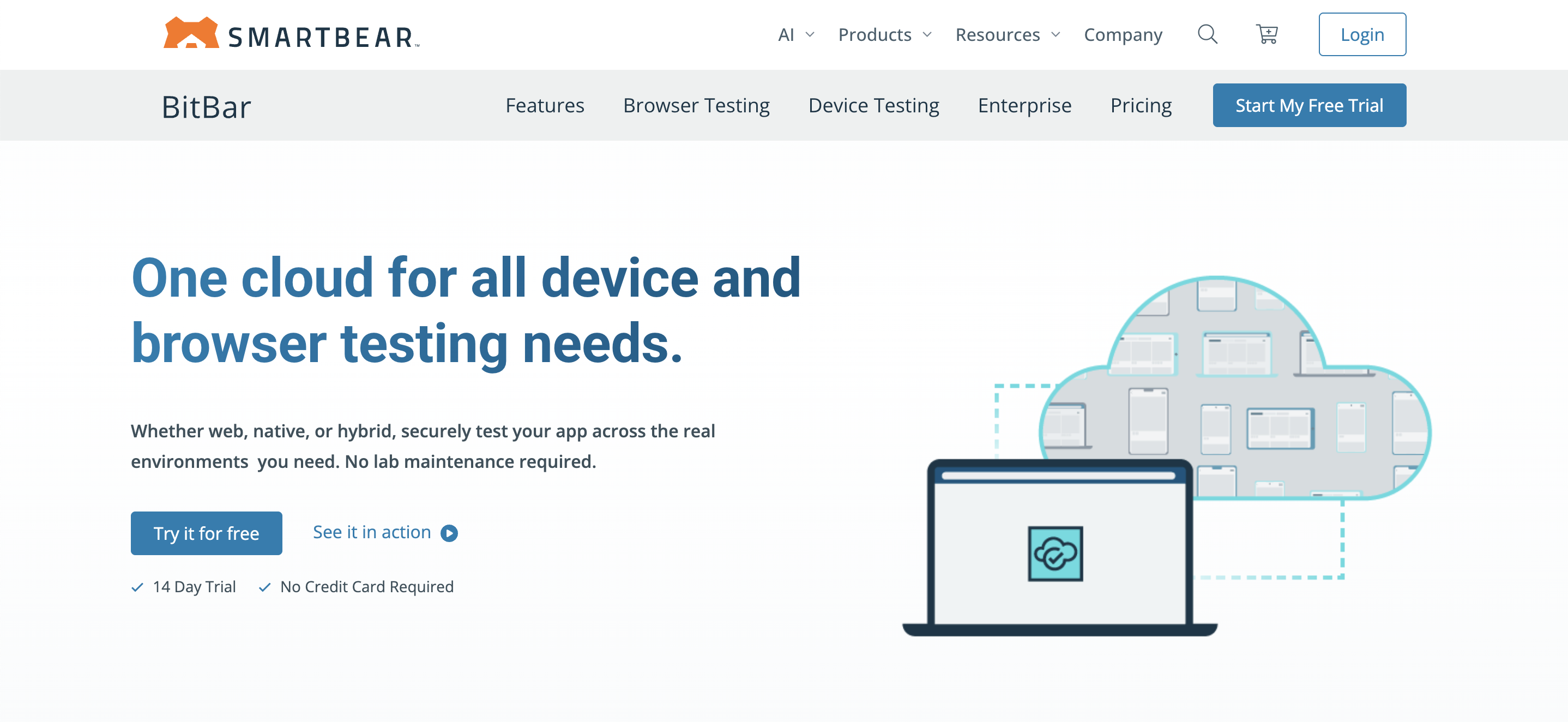
Best for: teams already using SmartBear tools that want one cloud for devices and browsers.
BitBar is SmartBear's device and browser cloud, which SmartBear describes as one cloud for all device and browser testing. It runs manual and automated tests on real Android and iOS devices and desktop browsers. It sits alongside SmartBear tools such as TestComplete and Zephyr.
Pricing (as of November 2026): BitBar lists Live Testing, Unlimited, and Enterprise plans without published prices. A 14-day free trial is available.
Best fit: SmartBear customers who want their device cloud from the same vendor.
6. TestingBot
Best for: smaller teams that want a low-cost grid with real devices and simple pricing.
TestingBot is a cloud for manual and automated web and app testing. As of November 2026, it says it offers 6,100+ browsers and devices, including physical iOS and Android devices, and supports Selenium, Appium, Playwright, Puppeteer, Cypress, XCUITest, Espresso, and Maestro. Local testing, geolocation, and network throttling are included.
Pricing (as of November 2026): Live from €20 a month and Automated from €50 a month (1,000 minutes), billed annually and excluding VAT. Pay-as-you-go minutes start at €60 for 1,000 minutes.
Best fit: small teams and agencies that want real devices without an enterprise contract.
Mobile device clouds
7. Kobiton
Best for: mobile teams that want real device testing with predictable monthly minutes.
Kobiton is a real device cloud focused on mobile apps, with manual and automated testing on iOS and Android devices.
Pricing (as of November 2026): Startup from $83 a month (500 minutes) and Accelerate from $399 a month (3,000 minutes), both billed monthly, Scale at $9,000 a year, and Enterprise by quote. A free trial is available.
Best fit: mobile-first teams that don't need desktop browser coverage and want published prices.
8. HeadSpin
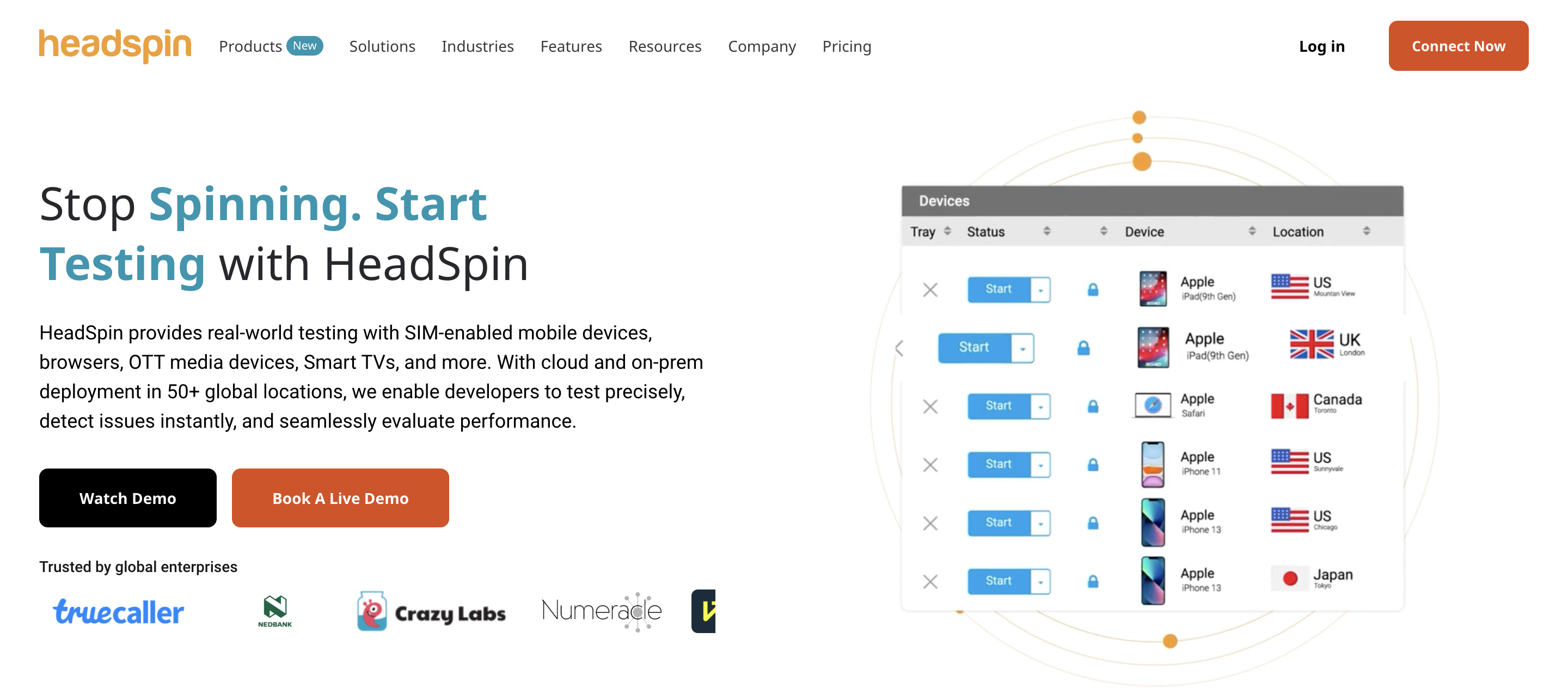
Best for: teams that need to test mobile app performance across real devices, networks, and locations.
HeadSpin describes itself as a real device testing platform for mobile, web, and OTT. As of November 2026, it offers SIM-enabled devices in 50+ locations, in its cloud or on-premises, with a focus on performance and network conditions alongside functional results.
Pricing: by quote (as of November 2026).
Best fit: teams in streaming, telecom, or other sectors where network conditions, location, and performance matter as much as pass and fail results.
9. pCloudy
Best for: teams that want a mobile device cloud with public, private, or on-premises deployment.
pCloudy is a real device cloud for mobile app and web testing. As of November 2026, it says it offers 5,000+ real devices and browsers, with public cloud, private cloud, or on-premises deployment. Its AI agents, including Qpilot.AI, cover test creation and self-healing.
Pricing: check pCloudy's site for current plans (we could not verify prices in November 2026).
Best fit: teams that need device access in a private or on-premises setup.
10. AWS Device Farm
Best for: teams already on AWS that want to pay per device minute.
AWS Device Farm runs automated and manual tests on real Android and iOS devices hosted by AWS, and fits into AWS-based pipelines. It also offers desktop browser testing, billed per instance minute.
Pricing (as of November 2026): $0.17 per device minute pay as you go, after a one-time free trial (currently 1,000 device minutes as a limited-time offer; normally 250). Unmetered testing starts at $250 a month per device slot. Desktop browser testing costs $0.005 per instance minute.
Best fit: AWS teams with occasional or bursty mobile test runs, where per-minute billing beats a monthly plan.
11. Firebase Test Lab
Best for: Android and iOS app teams that want a low-cost way to run tests on Google-hosted devices.
Firebase Test Lab runs your app tests on physical and virtual devices in Google data centers, and integrates with Android Studio, the Firebase console, and the gcloud command line.
Pricing (as of November 2026): the free Spark plan allows 5 test runs a day on physical devices and 10 on virtual devices. On the Blaze plan, the first 30 minutes a day on physical devices and 60 on virtual devices are free, then $5 an hour per physical device and $1 an hour per virtual device.
Best fit: app developers who want device coverage in CI at a low cost.
Self-hosted option
12. Selenium Grid
Best for: teams with DevOps capacity that want parallel browser testing at no license cost.
Selenium Grid is the open-source way to run WebDriver tests remotely and in parallel on machines you control. Grid 4 has official Docker images and a Helm chart for Kubernetes. You decide the browser versions, operating systems, and hardware, and data stays inside your network.
You get full control and no per-parallel fees, but you build and maintain the infrastructure, and your coverage is limited to the browsers and devices you host. For mobile apps, teams pair Appium with their own device lab; if you are weighing Appium itself, see our list of Appium alternatives.
Pricing: free and open source; you pay for the infrastructure.
Best fit: large teams with high test volumes and strict data rules, where cloud pricing is hard to justify.
Perfecto vs BrowserStack, Sauce Labs, and Kobiton
These three come up most often in head-to-head searches:
- Perfecto vs BrowserStack: both cover real devices and desktop browsers. BrowserStack publishes self-serve prices and sells each product separately; Perfecto is quote only and sells one enterprise platform with Perfecto AI.
- Perfecto vs Sauce Labs: the closest match on enterprise focus. Both offer real and virtual devices and AI features; Sauce Labs puts its AI on Enterprise plans. Sauce Labs publishes entry prices; Perfecto does not.
- Perfecto vs Kobiton: Kobiton is mobile only, with published monthly plans. Perfecto also covers web and desktop testing, including Windows environments.
Perfecto alternatives compared
The table summarizes each option as of November 2026. Prices are starting list prices from each vendor's site, billed annually unless noted, and change often, so check before you buy.
Tool | Type | Real mobile devices | Desktop browsers | Starting price (as of November 2026) |
|---|---|---|---|---|
Perfecto (for reference) | Enterprise testing cloud | Yes | Yes | Quote |
Katalon TestCloud with Katalon Studio | Cloud grid plus test automation IDE | Yes, iOS and Android | Yes | TestCloud $1,519 per session per year; Studio Professional $1,800 per seat per year (pricing) |
BrowserStack | Cloud grid | Yes | Yes | Live from $12.50 a month; Automate from $99 a month |
Sauce Labs | Cloud grid | Yes | Yes | Live from $39 a month |
TestMu AI (formerly LambdaTest) | Cloud grid | Yes | Yes | Free plan; Virtual Live from $15 a month |
BitBar | Cloud grid | Yes | Yes | Not published; 14-day trial |
TestingBot | Cloud grid | Yes | Yes | Live from €20 a month |
Kobiton | Mobile device cloud | Yes | No | $83 a month, billed monthly |
HeadSpin | Mobile, web, and OTT device cloud | Yes | Web testing (not detailed) | Quote |
pCloudy | Mobile device cloud | Yes | Yes | Not verified |
AWS Device Farm | Mobile device cloud (plus desktop browsers) | Yes | Yes | $0.17 per device minute |
Firebase Test Lab | Mobile device cloud | Yes | No | Free Spark quota; Blaze $5 an hour per physical device after free daily minutes |
Selenium Grid | Open-source self-hosted grid | Only devices you host | Browsers you host | Free, plus infrastructure |
How to choose a Perfecto alternative
Match the option to the problem you are solving:
- Stay with Perfecto if you need web, mobile, and desktop in one enterprise cloud, value its AI features and support, and the quote works for your volume.
- Choose BrowserStack, Sauce Labs, or TestMu AI for the closest like-for-like cloud. TestMu AI has a free plan and the lowest automation entry price of the three ($29 a month against $99 for BrowserStack Automate, as of November 2026); Sauce Labs suits enterprises that want more controls and support.
- Choose BitBar or TestingBot if you want a smaller vendor or one that fits your SmartBear stack.
- Choose Kobiton, HeadSpin, pCloudy, AWS Device Farm, or Firebase Test Lab if you only test mobile apps. HeadSpin leans toward performance, AWS and Firebase toward pay-per-use.
- Choose Selenium Grid if license cost or data control is the constraint and you have the engineering time to run your own infrastructure.
- Choose Katalon TestCloud with Katalon Studio if you want to build and run tests with one vendor, have a team that mixes coders and testers who don't code, or need web, mobile, API, and desktop tests in one project, with cloud execution for web and mobile when you need it.
For a wider list beyond device clouds, see our guide to mobile app testing tools.
Whichever you pick, run a short trial with your own test suite, including a test that reaches a staging site, before you commit.
Frequently asked questions
It depends on your need. As of November 2026, BrowserStack, Sauce Labs, and TestMu AI (formerly LambdaTest) are the closest device and browser clouds, Kobiton and AWS Device Farm suit mobile-only teams, and Selenium Grid is free if you host it. Katalon TestCloud with Katalon Studio suits teams that want authoring and cloud execution together.
Perfecto, from Perforce, gives teams real iOS and Android devices, emulators, and simulators in the cloud for manual and automated mobile app testing. It runs Appium and other framework tests, and adds Perfecto AI for test creation, maintenance, and root cause analysis. It also covers web and desktop testing.
As of November 2026, Perforce does not publish Perfecto prices. You build a quote on its site or contact sales, so you can't estimate cost before a sales conversation. Alternatives with published prices include BrowserStack Live from $12.50 a month, Sauce Labs Live from $39 a month, and AWS Device Farm at $0.17 per device minute.
Sauce Labs competes most directly with BrowserStack, TestMu AI (formerly LambdaTest), and Perfecto, which all run tests on cloud browsers and real devices. Mobile-focused rivals include Kobiton, HeadSpin, pCloudy, AWS Device Farm, and Firebase Test Lab. Katalon TestCloud with Katalon Studio competes for teams that want test authoring and cloud execution from one vendor.
Appium is the standard open-source framework for cross-platform mobile automation, so "better" depends on your team. Espresso and XCUITest often run faster for single-platform native tests, while Katalon Studio adds recording and keyword-based authoring on top of Appium. Most clouds in this list, including Perfecto, run Appium tests, so your framework choice and your cloud choice are separate decisions.
Yes. LambdaTest renamed itself TestMu AI in January 2026, and lambdatest.com now redirects to testmuai.com. The company still offers its cloud browser grid, real device cloud, and HyperExecute, and has added KaneAI for AI test authoring and Test Manager for test case management. Older Perfecto comparisons still use the LambdaTest name.

Test everything. Ship with confidence.
From generating test cases to spotting failures, Katalon's AI works across your entire pipeline, automatically.
