.svg)


The interest in API testing has been tremendously increasing over the last five years, according to Google Trends. This trend reflects the paradigm shift toward Web-based and mobile applications and decoupling the backend services and frontend user interfaces.
API testing is a type of testing that involves verifying and validating APIs and Web services. Unlike traditional testing, which focuses on functionality on the GUI interacted by end users, API testing checks APIs used by developers and occurs at the middle layer of the software (e.g., headless or GUI-less components, usually invisible to end-users). In a typical Web or mobile app, Web APIs connect different components, especially between the view or user interface layer and the Web server. This makes applying automation to API testing an attractive choice in modern software testing. (Learn more API Testing Introduction)
To implement API testing successfully, teams must have a good set of tools that match specific requirements. However, this is a challenging task, according to our survey of more than 2,200 software professionals. Part of the problem is that a chosen tool seems to be suitable at first; but troubles arrive when it is integrated with the existing tools and processes in the long run.
To help you decide which tools work best for your API automation tests, this article presents a review and comparison of three popular tools for API testing: SoapUI, Postman, and Katalon Studio. SoapUI and Postman specialize in API testing, while Katalon provides a complete solution for API, Web, desktop, and mobile app testing.
Download Katalon Studio for free
1. SoapUI

SoapUI is widely cited as a top choice when it comes to API testing. It is a headless functional testing tool specifically designed for API testing. SoapUI supports both REST and SOAP services. API automation testers can either use open-source or pro versions. The pro edition has a user-friendly interface and several advanced features such as assertion wizard, form editor, and SQL query builder. SoapUI is a tool of ReadyAPI suite, offered by SmartBear.
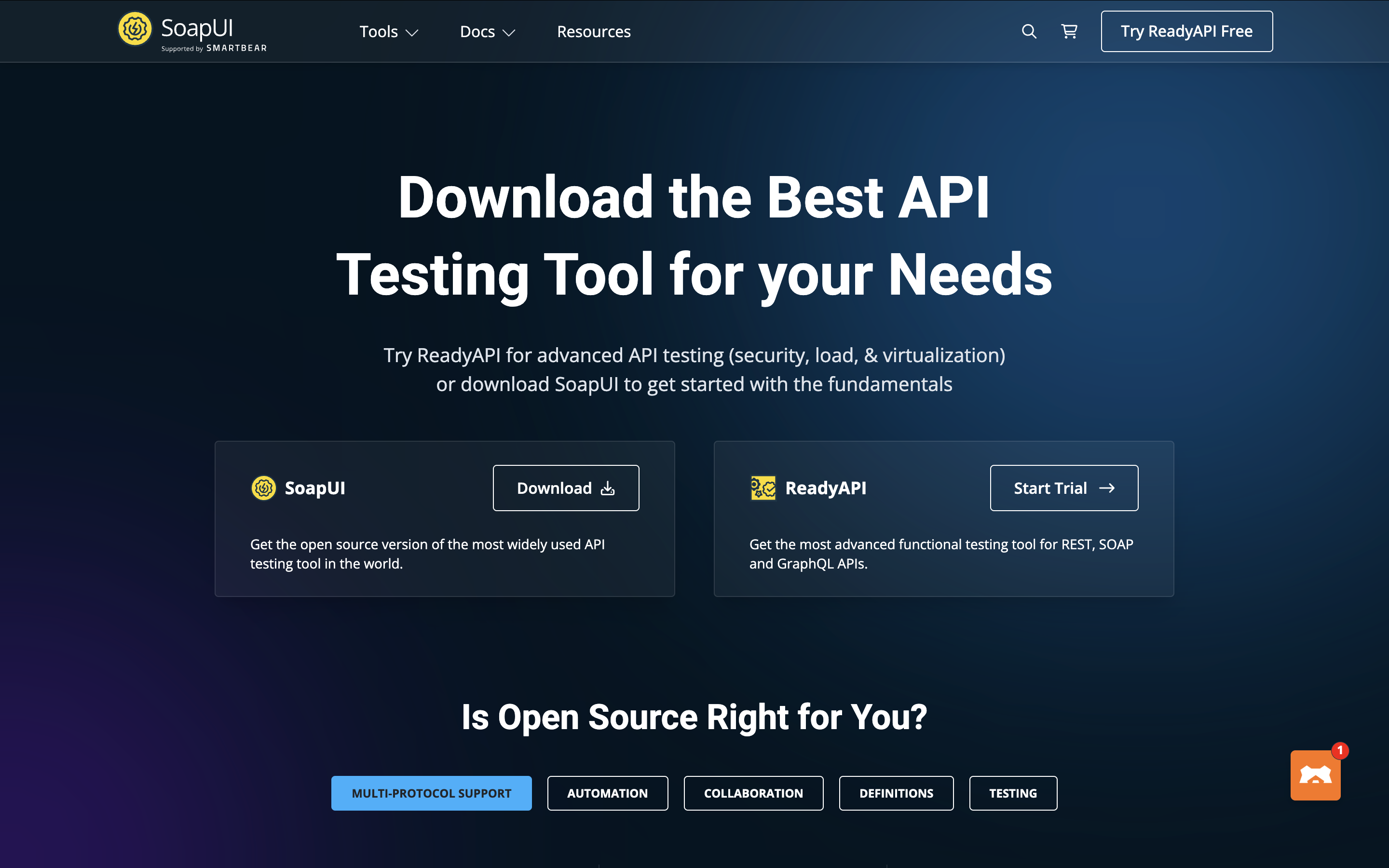
The tool provides many advanced features for API testing, including
- Generates tests easily using drag and drop, point-and-click
- Powerful data-driven testing with data from files and databases
- Scripts can be reused easily
- Mocks services with RESTful mocking
- Asynchronous testing
SoapUI is distributed as Open-source and Pro versions ($659/year for medium and large teams).
Visit SoapUI Website | G2 Reviews
📚Read more: Top 3 SoapUI Alternatives
2. Postman

Postman emerged as a popular automation tool for API testing after having only been known as a browser extension for API validation. Postman can be installed as a browser extension or a desktop application on Mac, Linux, and Windows. It is used not only by automation testers for API tests but also by developers for developing and validating APIs. It has evolved, in fact, as an environment to develop and test APIs. Some notable features include:
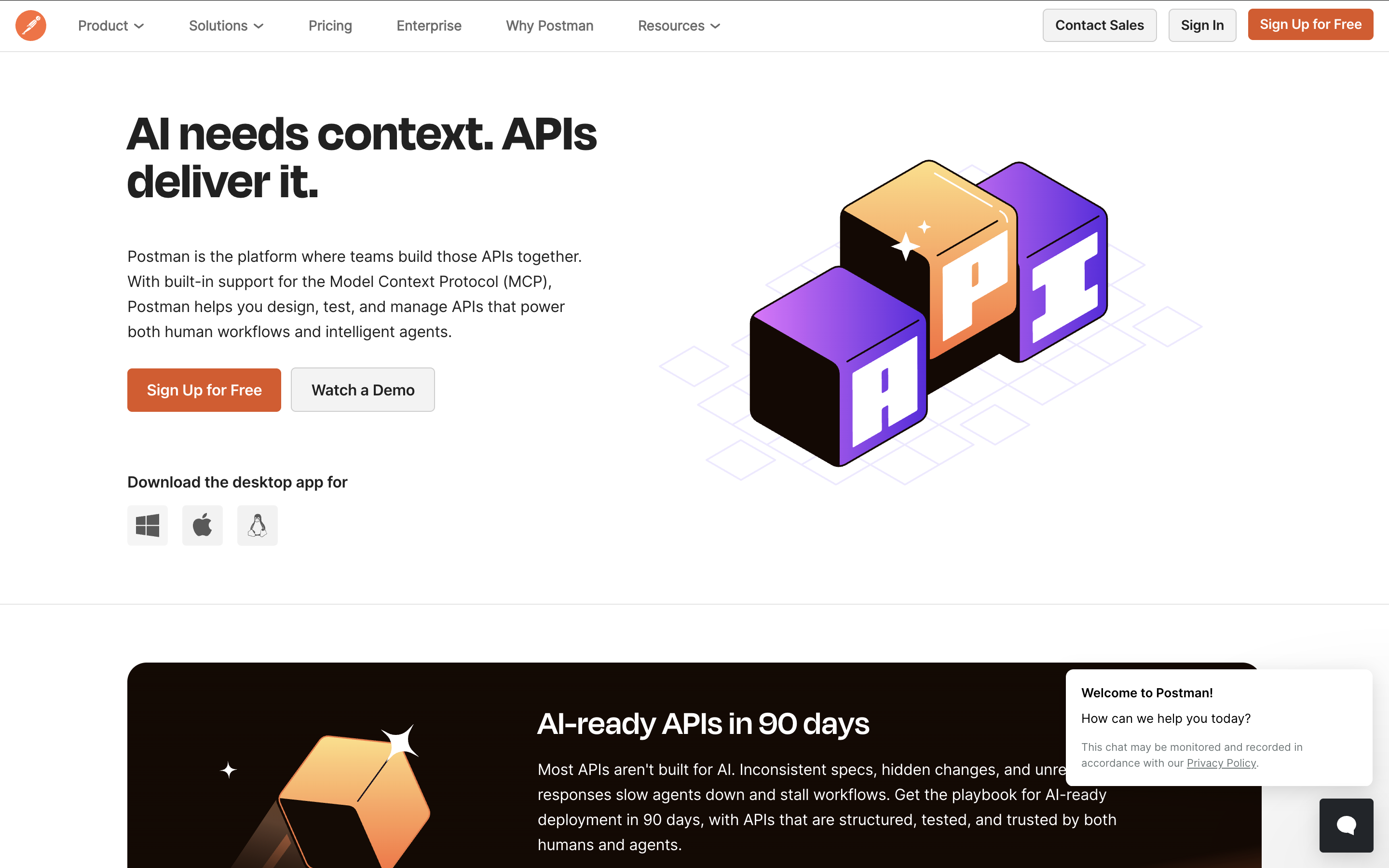
- A comprehensive feature set for designing, debugging, testing, documenting, and publishing APIs
- Supports both automated and exploratory testing
- A friendly and easy-to-use user interface
- Accepts Swagger and RAML API formats
Postman is affordable as the product is offered in three editions: Postman (free), Postman Pro ($29/month), and Postman Enterprise ($99/month).
Visit Postman Website | G2 Reviews
3. Katalon Studio

Katalon Studio is an integrated environment to generate and execute API, Web-based GUI, desktop and mobile apps automation tests. It has a rich feature set for these types of testing and supports multiple platforms including Windows, Mac OS, and Linux. By integrating Selenium and Appium engines with all needed components, built-in keywords, and templates, Katalon provides a unique environment for both testers and developers to perform API and Web automation tests. Some notable highlights of the tool are:
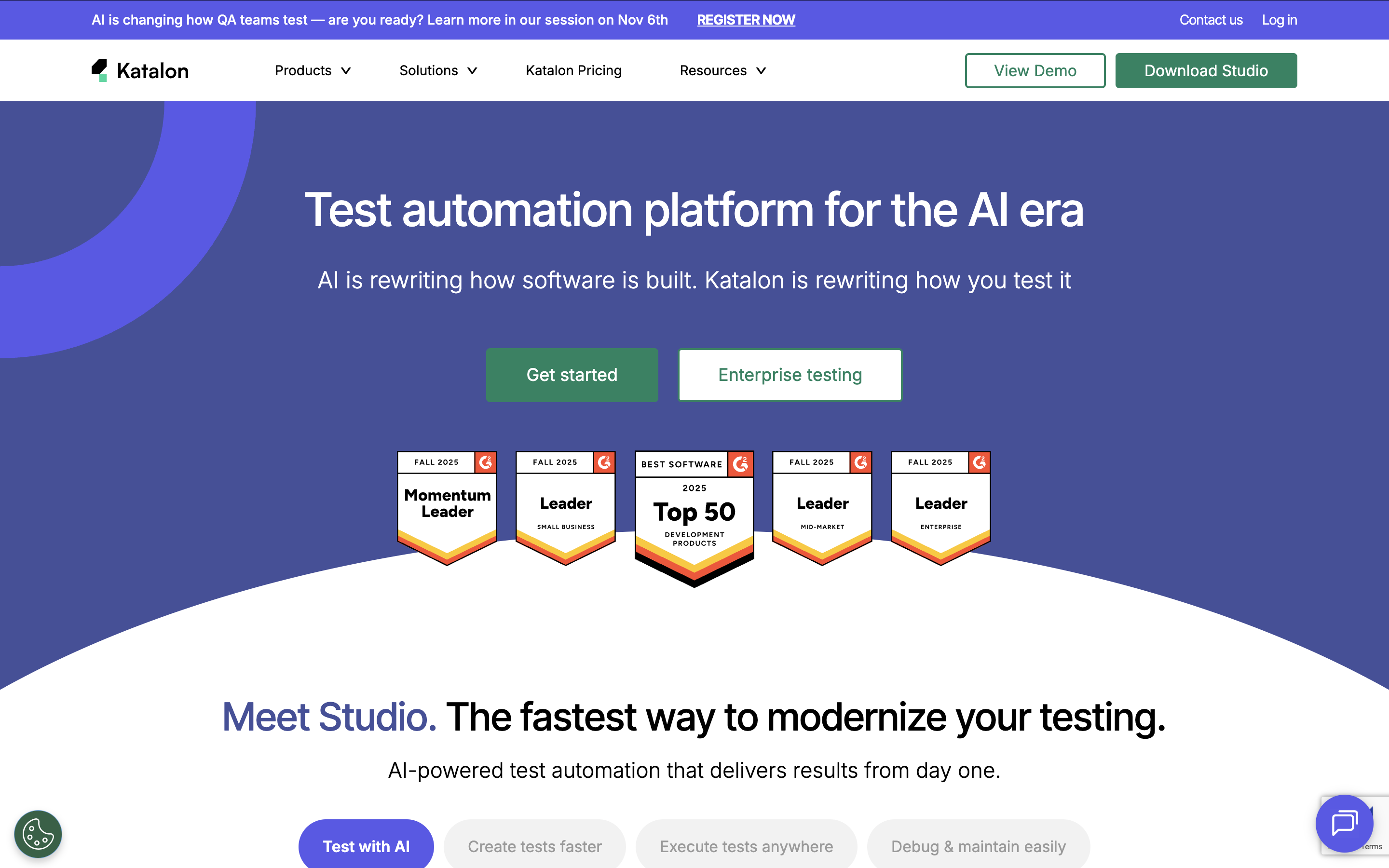
- Handles API, Web, desktop, and mobile tests across platforms
- Allows testers and developers to collaborate and share test cases easily
- Hundreds of built-in keywords for creating test cases
- Supports AssertJ to create fluent assertions using the BDD style
- Seamless integration with other ALM tools for CI/DevOps practices
Visit Katalon Website | Pricing | G2 Reviews
Download Katalon Studio for free
Comparing SoapUI vs Postman, Katalon
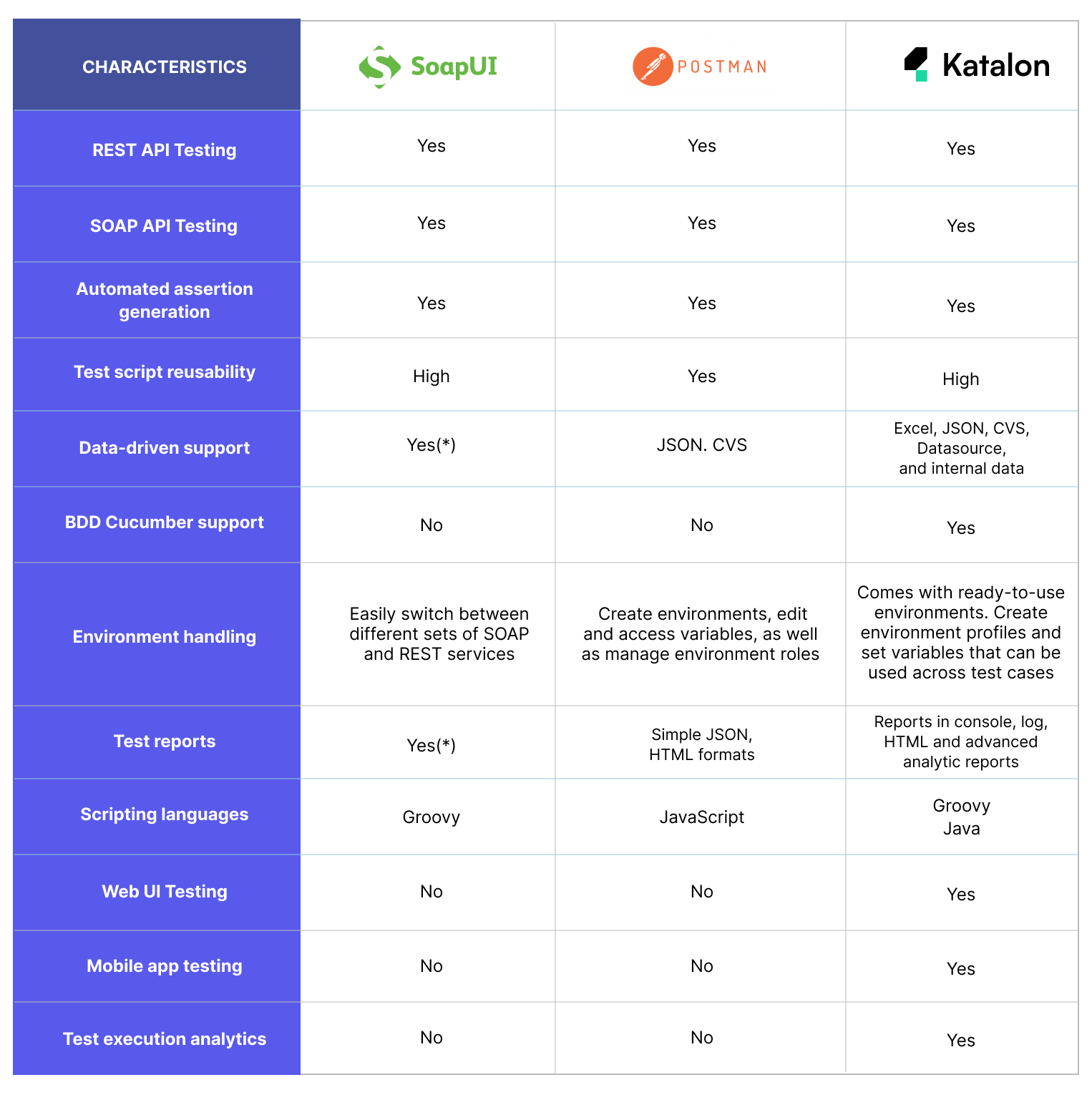
REST and SOAP are the dominant API types, accounting for more than 95% of all API/Web services according to the State of API Integration Report. Katalon and SoapUI support both REST and SOAP APIs while Postman handles only REST requests. It should be noted that the overwhelming majority of API implementations (83%) follow the REST protocol.
Automated assertion generation: this capability involves analyzing APIs and generating assertions automatically. It is expected to save time from manually generating assertions for APIs. All three tools provide basic functions for generating assertion scripts based on some predefined templates or rules.
BDD Cucumber support: this capability allows test cases to be written in natural languages, which helps improve the collaboration between technical staff and business stakeholders. This is a Katalon’s distinct feature not seen in the other tools.
Test reports: all three tools provide capabilities for reporting API test results. Postman generates reports in JSON and HTML formats; Katalon reports results and logs in different forms such as console report, log, HTML, and analytics via Katalon Analytics. For SoapUI, the capability to produce detailed test reports is in the commercial edition.
Scripting languages: all tools support languages based on Java.
Web UI and Mobile app testing: in developing a multi-platform application, the team performs Web UI and mobile app tests besides testing APIs. So, supporting these types of test is an advantage of Katalon over Postman and SoapUI, as it allows developers and testers use the same tool, share and collaborate on the same test artifacts.
Test execution analytics: test exaction logs and results from Katalon can be automatically exported to Katalon Analytics, allowing teams to analyze, diagnose, and report bugs.
Summary
This article provides a review of 3 popular and promising tools for API test automation by comparing SoapUI vs Postman and Katalon. Each tool has its own pros and cons, but they are widely used by developers and testers for their API testing.
📚Read more: Top API Testing Tools You Should Consider For Your Team
A successful implementation of DevOps practices requires using many tools for configuration management, integration, testing, and deployment. It is crucial that the tools must be easily and smoothly integrated into a complete DevOps toolchain to allow developers, testers, and other stakeholders to collaborate. Integrated test automation tools that handle API, Web UI, and mobile testing needs may have an advantage over specialized tools like Postman and Apache JMeter in a successful DevOps implementation.

|
