


Katalon vs PractiTest, compared where testers ask the most: reporting and dashboards, traceability from story to defect, how each one integrates with Jira, AI, test execution, and pricing as of November 2026.
Katalon vs PractiTest comes down to scope: PractiTest is a standalone test management tool where testers run manual tests and automation results are collected, while Katalon TestOps, as part of Katalon True, also executes automated tests and can run manual test cases with AI. If you want a dedicated, tester-priced management layer over the automation you already have, PractiTest fits; if you want management, manual test execution with AI, and automation in one place, Katalon is the closer match.
Both tools cover requirements, test cases, runs, defects, dashboards, and a two-way Jira integration, so the choice rarely turns on a checklist. This comparison looks at the questions teams ask most: which has better reporting and traceability, how PractiTest integrates with Jira compared with Katalon TestOps, and what each one costs. PractiTest facts are from practitest.com as of November 2026.
Katalon vs PractiTest at a glance
Area (as of November 2026) | PractiTest | Katalon TestOps (Katalon True) |
|---|---|---|
What it is | Standalone test management: requirements, test library, test sets and runs, issues | Test management and manual testing, with automation in Katalon Studio and execution on TestCloud or Katalon Runtime Engine (KRE) |
Reporting | Daily Status view, live dashboards, scheduled reports, embeddable dashboards that need no login, PDF or Excel export | Live Monitor, Release Health, and Analytics and Trends dashboards; flaky test and defect analysis; requirement coverage |
Traceability | User stories to tests to runs to defects, forward and backward | Requirements to test cases to runs to defects, with coverage per release |
Jira | Real-time two-way sync of requirements and issues; Jira sprints become Milestones; panel inside Jira; Jira Cloud, and Jira Data Center on Corporate | Real-time sync of projects, releases, requirements, and defects, plus sprints when a board is selected; the Katalon app for Jira shows linked tests and results |
AI | PractiTest AI (SmartFox): Adaptive Test Generator, Duplication Guardian, Execution Strategist; Project Assistant; Test Value Score and MCP server on Corporate | AI Test Runner runs manual test cases step by step; AI drafts test cases, investigates failures, and drafts defects for review |
Runs automated tests? | Not by itself: testers run manual tests in Test Sets and Runs; automation results come in through the REST API or FireCracker, and xBot schedules and triggers your own runs | Yes: automated tests with Katalon Studio, KRE, and TestCloud; manual test cases can also run with the AI Test Runner |
Price | Team $47 per user per month on yearly billing; Corporate by quote, 10-license minimum | TestOps $800, True Manual $900, True Automation (with Studio) $2,500 per seat per year; see Katalon pricing; Studio Free, Professional $1,800 |
Reporting and dashboards
Reporting is where PractiTest puts much of its effort. Its product page describes a Daily Status view covering execution status, coverage, defects, and automation, plus stakeholder reports you can schedule, live dashboards you can share or embed in other tools without a login, and export to PDF or Excel. Dashboards drill down from a metric to the run, the test, and the requirement behind it. PractiTest also lists a Release Readiness Index, a composite score on each Milestone built from coverage, execution, and remaining defect risk signals.
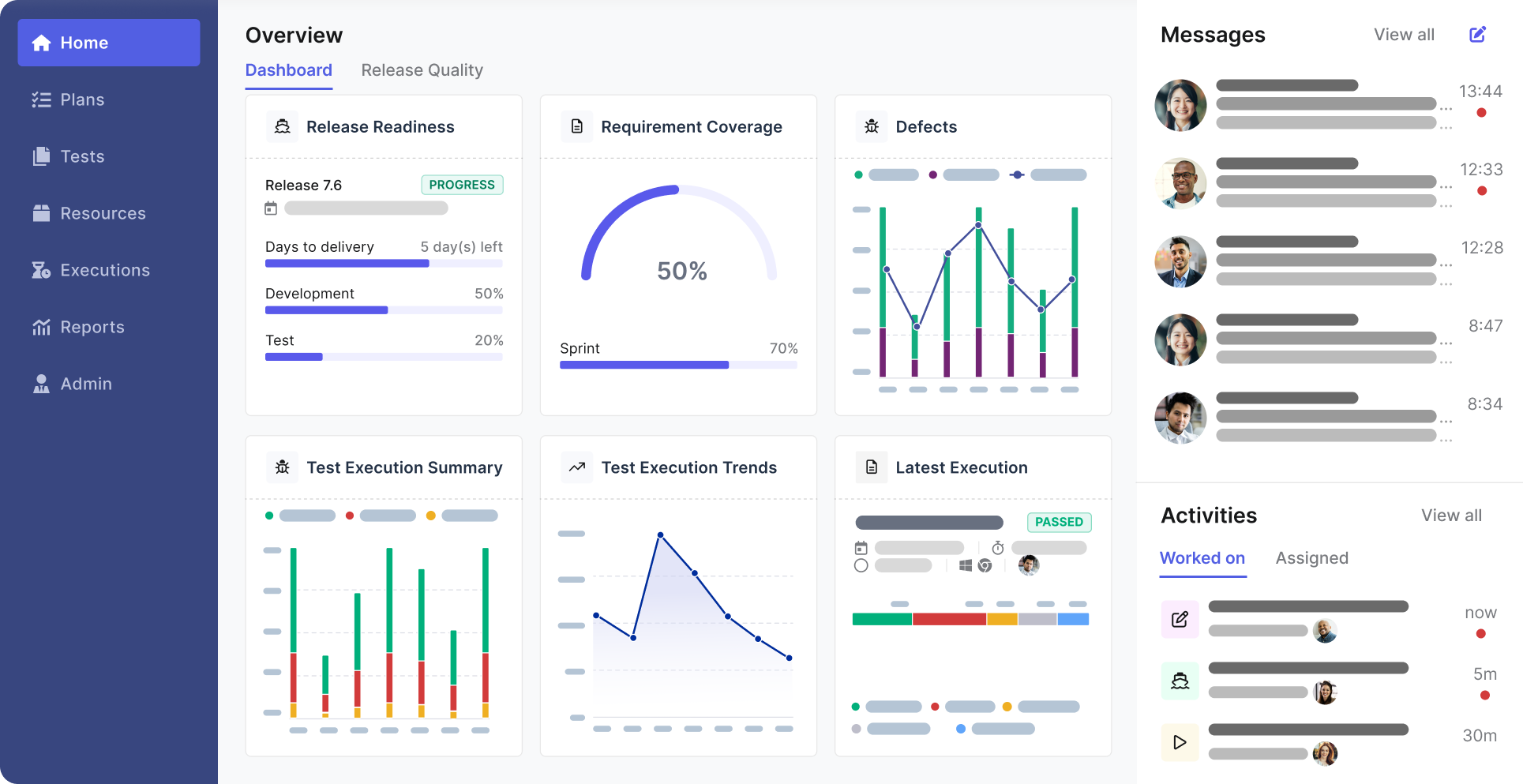
Katalon TestOps organizes reporting around releases and test health. Live Monitor shows runs as they happen, Release Health shows whether a release is ready, and Analytics and Trends tracks results over time. Within those you can analyze results, runs, and test case status, find flaky tests, review defects, and check requirement coverage. TestOps also uses AI for reporting and insight, turning coverage, execution results, and defect trends into steps that test leads and managers can act on.
The difference is mostly where the data comes from. PractiTest reports on whatever you feed it: manual runs in PractiTest and automation results pushed in from your frameworks. Katalon TestOps reports on manual runs, Katalon Studio runs, and results uploaded from other frameworks, so automated execution data arrives without a separate integration to maintain when you also use Studio.
Which has better reporting and traceability? If your priority is sharing status with people outside QA, PractiTest's scheduled reports and login-free embedded dashboards are a strong fit. If your priority is diagnosing why runs fail, Katalon's flaky test analysis and AI failure investigation go further into the results themselves. Traceability depth is similar; the difference is whether automated results land in the same chain, covered next.
Traceability from requirement to defect
Both tools trace the full chain. PractiTest describes traceability from user stories to tests to runs to defects, forward and backward, with impact analysis. Requirements can come from Jira or Azure DevOps or be written in PractiTest, and its tag-based filters let you slice the test library and runs by any combination of attributes.
Katalon TestOps links requirements synced from Jira or Azure DevOps to test cases, runs, and defects, and shows requirement coverage per release. Manual test cases keep steps and version history, runs belong to a release, test cases have owners, and each result is recorded as pass, fail, or blocked with evidence attached. When a manual step fails, you can report the defect to Jira from that step, so the defect carries the link back to the test and the requirement.
In practice, traceability depth is similar. The practical question is whether your automated results land in the same chain. In PractiTest, that depends on your API or FireCracker setup. In Katalon, Studio runs connect to TestOps directly, and the AI Test Runner adds a screenshot and an AI log for every manual step it executes.
How does PractiTest integrate with Jira?
PractiTest's Jira integration offers real-time two-way sync between PractiTest and Jira. Requirements and issues sync with their comments, attachments, and fields. Jira sprints sync into PractiTest Milestones, so release readiness is tracked against the sprint scope. A PractiTest panel inside Jira shows test status on the issue, and defects reported from a test run land in Jira with execution details, environment data, and linked test cases. It works with Jira Cloud through the Atlassian Marketplace, and with Jira Data Center on the Corporate plan.
One detail matters for budgets: PractiTest prices its Jira integration per tester, not for every Jira user. Jira test management plugins that live inside Jira usually bill on your whole Jira user tier, so a standalone tool with per-tester pricing can cost less for teams with many developers and few testers. The Corporate plan adds multiple two-way issue integrations, for teams that track defects in more than one tracker.
How Katalon TestOps integrates with Jira
Katalon TestOps syncs projects, releases, requirements, and defects from Jira Cloud or Jira Data Center in real time, plus sprints when a board is selected. You can report a defect to Jira from a failed result or manual step, and the Katalon app for Jira shows linked test cases and results on the Jira issue. In Jira Cloud, the Katalon app for Jira can also draft test cases from an issue for you to accept or reject.
Like PractiTest, Katalon TestOps is a standalone tool with Jira sync rather than an app inside Jira, so testers work in TestOps and developers keep working in Jira. If you want everything inside Jira, compare Jira test management plugins instead; our list of test management tools for Jira covers them.
AI features
As of November 2026, PractiTest's AI page lists four capabilities, three of which it groups under SmartFox AI:
- Adaptive Test Generator drafts test cases and steps from user stories and existing project context, for you to review and refine.
- Duplication Guardian flags similar tests and issues before you add duplicates.
- Execution Strategist uses a Test Value Score based on test history and project activity to help you prioritize which tests to run. The Test Value Score is on the Corporate plan.
- Project Assistant answers plain-English questions about results, coverage, and risk, and can turn answers into filters.
On the Corporate plan, PractiTest also offers an MCP server, so tools such as Claude or ChatGPT can query project data and create tests.
Katalon's AI in TestOps works on both sides of a run. New in TestOps, the AI Test Runner runs the manual test cases you already have, step by step, with a screenshot and an AI log for each step. You can let it run on its own or approve each step. AI also drafts manual test cases from synced Jira or Azure DevOps requirements for your team to review and save. After a run, AI failure investigation organizes the evidence and determines whether a failure is a real bug, an environment issue, or a test case problem, and AI defect drafting turns that evidence into a defect for you to review before pushing it to Jira or Azure DevOps.
The practical difference: PractiTest's AI helps you design, deduplicate, and prioritize tests, while Katalon's AI Test Runner also executes manual tests and its AI works on the results. In Katalon Studio, the Katalon AI Assistant helps write and fix automated test scripts on a paid plan (Professional or Enterprise).
Automation and test execution
PractiTest runs manual tests in its Test Sets and Runs but doesn't execute automated tests itself. Automation results come in through the REST API or FireCracker, and PractiTest lists integrations with frameworks such as Selenium, Playwright, Cypress, Cucumber, Robot Framework, and TestNG. xBot schedules and triggers your own automated runs and syncs their results. You still provide the framework, infrastructure, and upkeep for those integrations.

Katalon splits the work across named products:
- Katalon Studio authors automated web, mobile, API, and desktop tests with record and playback, keywords, or code. Desktop testing, AI self-healing, parallel execution, and BDD are on Professional and above.
- Katalon Runtime Engine (KRE) runs Studio tests from the command line and CI tools such as Jenkins, GitHub Actions, Azure DevOps, and GitLab. It is an add-on that needs a paid plan (Professional or Enterprise).
- TestCloud runs tests on cloud browsers and devices. It is an add-on that works with any Studio plan, including Free.
- Katalon TestOps schedules runs, collects results, and runs manual tests with the AI Test Runner. Results from Playwright, JUnit, and other frameworks come in through the Playwright reporter or the Katalon Report Uploader.
Together these make up Katalon True. If you already have a mature framework and only need a place to manage tests and report on results, PractiTest's model is simpler. If you want authoring, execution, and management in one place, Katalon reduces the integration work you maintain, because all three come from one vendor.
Pricing and seats
As of November 2026, PractiTest pricing is per tester. The Team plan is $47 per user per month on yearly billing, shown as $5,640 for 12 months for a 10-tester pack, and each license includes 5 comment users for people who only need to comment. The Corporate plan is quote only, billed yearly with a minimum of 10 licenses, and adds 10 comment users per license, advanced security, multiple two-way issue integrations, and MCP integration. A free trial is available.
As of November 2026, Katalon TestOps is $800 per seat per year, True Manual (TestOps plus TestCloud sessions) is $900, and True Automation (Studio and TestOps) is $2,500 per seat per year, all billed annually, with free Platform Viewer licenses for read-only users; see Katalon pricing. For automation, Katalon Studio is Free, Professional is $1,800 per seat per year (about $150 a month), billed annually, and Enterprise is custom. There's a 30-day free trial. KRE ($1,399 per license per year) and TestCloud ($1,519 per session per year) are add-ons. With Katalon, cost depends on which products you combine, so price the full set you would use, including Studio seats and execution add-ons, rather than TestOps alone.
When you compare quotes, count three groups separately: testers who create and run tests, stakeholders who only view or comment, and machines or cloud sessions that run automation. PractiTest's price covers only the first two, because automated execution happens in your own tools.
Moving from PractiTest to Katalon TestOps
There is no direct PractiTest importer in Katalon TestOps, so test cases move by CSV. Export your tests from PractiTest, then in Katalon TestOps go to Tests > Test Cases > Create > Import Test Cases. TestOps maps CSV columns to its fields automatically, you can adjust the mapping and preview before import, and requirement links to a connected Jira or Azure DevOps project can come across. Katalon recommends batches of about 500 test cases per file (Katalon CSV import docs).
A practical order:
- Connect Jira to TestOps first, so requirements are in place before test cases arrive.
- Import a sample of about 50 cases to check how steps, custom fields, and tags map.
- Import the rest in batches of about 500 cases per file.
- Rebuild dashboards and saved reports, since those don't move.
- Keep run history in PractiTest as a read-only record for audits.
Which should you choose?
Choose PractiTest if:
- You already have stable automation frameworks and want a standalone management layer over them.
- Stakeholder reporting is a top priority, especially scheduled reports and embeddable dashboards that need no login.
- You want comment users included with each license, and a Release Readiness Index that scores each Jira sprint synced as a Milestone.
Choose Katalon TestOps (and Katalon True) if:
- You want test management and execution from one vendor, with Katalon Studio, KRE, and TestCloud behind TestOps.
- Manual testing takes a large share of your cycle and you want the AI Test Runner to execute existing manual test cases with evidence per step.
- You want failure investigation that separates real bugs from environment and test case problems before defects reach Jira.
Both are credible choices, and both trace requirements to defects with a two-way Jira connection. The decision depends on whether you need a place to manage testing or a place to manage and run it. For more options, see our guide to TestRail alternatives, our list of best test management tools, or the head-to-head Katalon vs qTest.
Frequently asked questions
It depends on scope. PractiTest is a standalone management tool with strong stakeholder reporting, but it doesn't execute automated tests. Katalon TestOps manages tests and, with Katalon Studio, KRE, TestCloud, and the AI Test Runner, also executes them. For one vendor across management and execution, Katalon is the closer fit; for a management layer over existing automation, PractiTest is simpler.
PractiTest offers real-time two-way sync with Jira Cloud, and with Jira Data Center on its Corporate plan. Requirements and issues sync with comments, attachments, and fields, Jira sprints become Milestones, and a panel inside Jira shows test status. Defects reported from a run land in Jira with execution details. As of November 2026, it is priced per tester.
Both trace requirements to tests, runs, and defects. PractiTest stands out for sharing: scheduled reports, live dashboards you can embed without a login, and PDF or Excel export. Katalon TestOps stands out for diagnosis: release health, flaky test analysis, and AI failure investigation that separates real bugs from environment and test case problems.
Not by itself. Testers run manual tests in PractiTest's Test Sets and Runs, automation results come in through its REST API or FireCracker, and xBot can schedule and trigger runs, which execute in your own frameworks and CI. Katalon runs automated tests with Katalon Studio, KRE, and TestCloud, and manual test cases with the AI Test Runner.
As of November 2026, the PractiTest Team plan is $47 per user per month on yearly billing, with 5 comment users per license and a free trial. The Corporate plan is quote only, billed yearly, and needs at least 10 licenses. Katalon TestOps is $800 per seat per year, and True Automation, which adds Katalon Studio, is $2,500 per seat per year.
Yes, by CSV. Export test cases from PractiTest, then use Import Test Cases in Katalon TestOps, which maps CSV columns to fields and lets you adjust the mapping and preview first. Katalon recommends about 500 cases per file. Connect Jira first so requirement links come across, and rebuild dashboards in TestOps.

Test everything. Ship with confidence.
From generating test cases to spotting failures, Katalon's AI works across your entire pipeline, automatically.
