.svg)


.png)

Every test team has asked the same question at some point: “Should we automate this, or just test it manually?” The answer is rarely black and white.
That’s why a Manual vs. Automation Decision Matrix exists to bring clarity to the chaos. It helps teams understand the lifecycle of a test case, its complexity, how often it runs, and the value it adds to product stability.
With a decision matrix, you can make more informed, ROI-driven decisions.
In this article, you’ll learn:
- What a Manual vs. Automation Decision Matrix is and why it matters
- How to score tests based on frequency, risk, and repeatability
- When to keep things manual for better UX coverage
- How to avoid automating yourself into technical debt
Let’s get into it.
The Constant “Should We Automate This?” Question
Every QA team has felt it: you wrap up a test cycle and someone asks, “Should we automate this?” Then the cycle repeats, someone makes a list, the team debates it, a few test cases make the cut, the rest stay manual.
A month later, the same question comes back with a new list, a new debate, and new uncertainty.
It happens in scrums, sprint reviews, and planning calls. The automation pressure keeps rising, especially when deadlines tighten or when leadership wants more test coverage with fewer regressions. But the clarity never quite matches the urgency.
This is where a Manual vs. Automation Decision Matrix becomes a game changer. It gives teams a shared language to evaluate test cases more systematically. It helps you weigh repeatability, business risk, and complexity without turning every test review into a guessing game.
Instead of constantly debating, you get a framework that delivers consistent, confident decisions across teams, projects, and release cycles.
Why it’s so hard to decide
Choosing what to automate involves business value, system stability, timing, and readiness to own maintenance. That is why your manual vs. automation decision matrix matters so much.
QA teams often fall into familiar traps:
- Automating high‑effort, low‑return tests. These might be technically elegant but rarely move the needle.
- Ignoring automation candidates because “we’re too busy.” These remain manual forever and keep dragging down speed and quality.
- Re‑automating unstable features again and again. When the underlying feature is still in flux, automation becomes a maintenance burden.
It is not a lack of skill or will that causes these issues. It is the lack of a system—a clear framework that helps you weigh trade‑offs swiftly and consistently. With a decision matrix in place, you move from indecision to a repeatable process.
The Decision Matrix: A Calm, Clear Way to Think
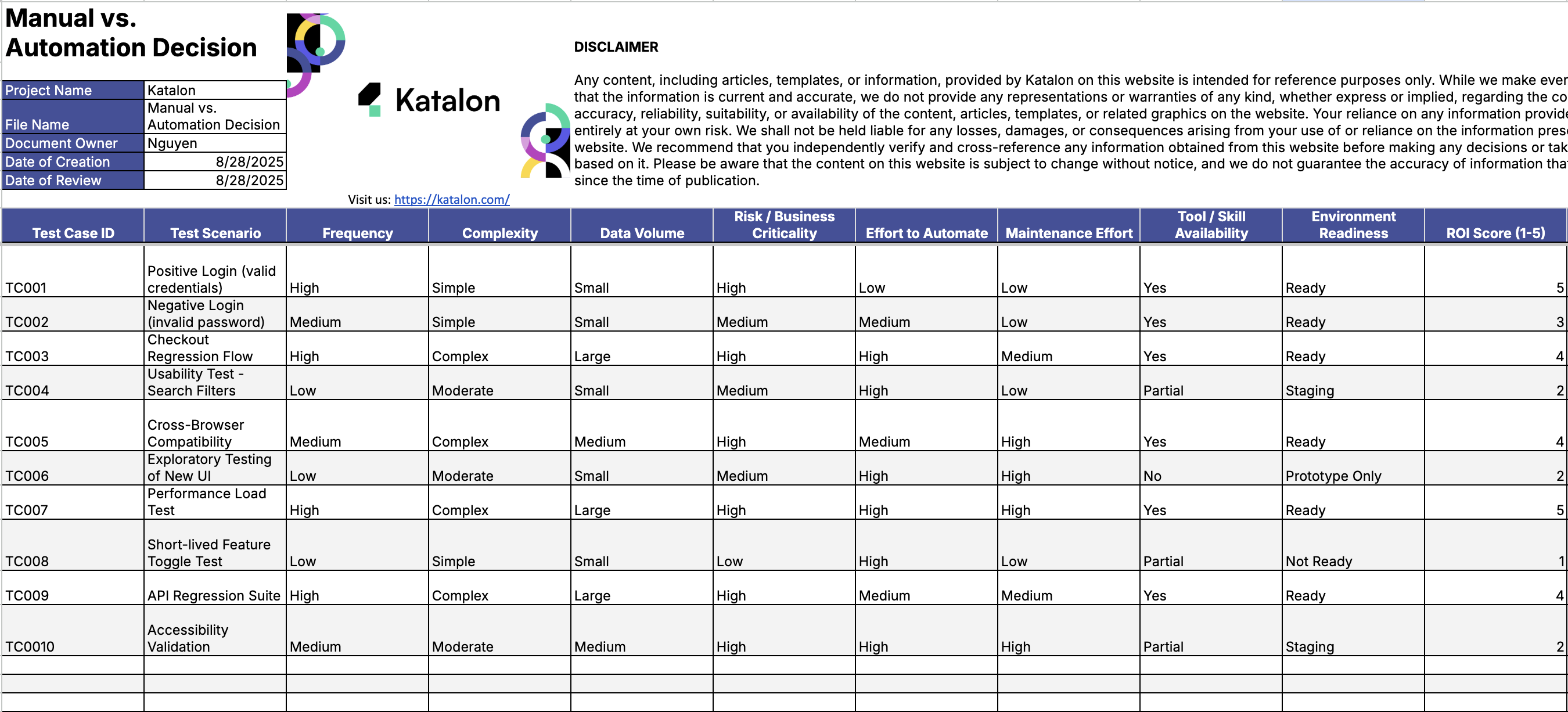
The manual vs. automation decision matrix is not just a spreadsheet. It is a thinking tool. Instead of debating every test in isolation, you can structure the conversation around what matters most.
This framework does not make decisions for you. It sharpens them. It removes subjectivity by guiding your team through shared criteria and language. When applied consistently, it turns fuzzy judgment into confident direction.
Here is a quick look at what the matrix helps you assess:
- Frequency — How often is this test executed? Daily? Per release?
- Complexity — Can this be automated with confidence, or does it rely on unstable elements?
- Risk or Business Criticality — What would break if this test fails or misses a defect?
- ROI and Priority — What does automation save you in time, effort, or coverage?
The matrix doesn’t turn your project into a numbers game. What it offers is clarity. Instead of opinions, you now have criteria. Instead of silos, you now have alignment.
How to Use the Matrix (Step by Step)
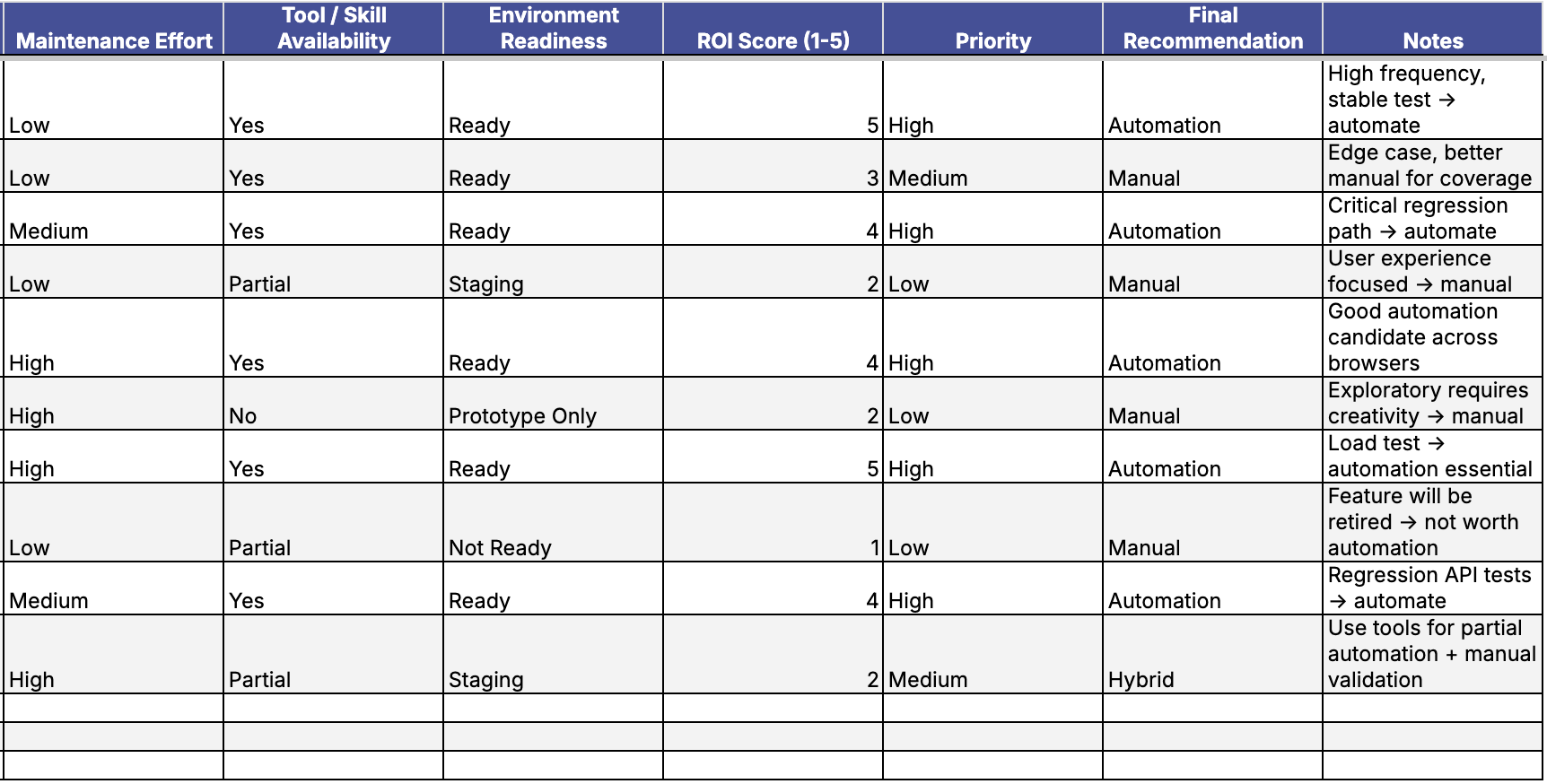
This is where the manual vs. automation decision matrix becomes more than theory. It becomes a workflow. You can apply it to your test cases starting today.
Step 1: List your core test cases. Start with your regression suite, smoke tests, or high-touch manual flows. These are the areas that matter most to product stability.
Step 2: Score each test. For each case, assign a score across five criteria — frequency, complexity, risk, ROI, and business priority. Use a consistent scale like 1 to 5.
Step 3: Check your ROI and Priority. These two fields drive your recommendation. If both are high, automation makes sense. If low, keep it manual or consider skipping.
Step 4: Mark your recommendation. Choose one of three clear outcomes: Manual, Automation, or Hybrid. Hybrid works well for long flows with partial stability.
Step 5: Write a quick reason. One sentence is enough. “Login is stable and runs every day — automate.” That note gives future-you context when you revisit the matrix in three months.
Let’s compare a quick example:
- TC001 – Login Validation: High frequency, low complexity, high business risk. ✅ Automate.
- TC004 – Profile Avatar Upload: Low frequency, UI-heavy, low risk. ✅ Keep Manual.
Once you complete the matrix once, future decisions become lightning-fast. No more back-and-forths. Just clarity, consistency, and progress.
The three columns that matter most
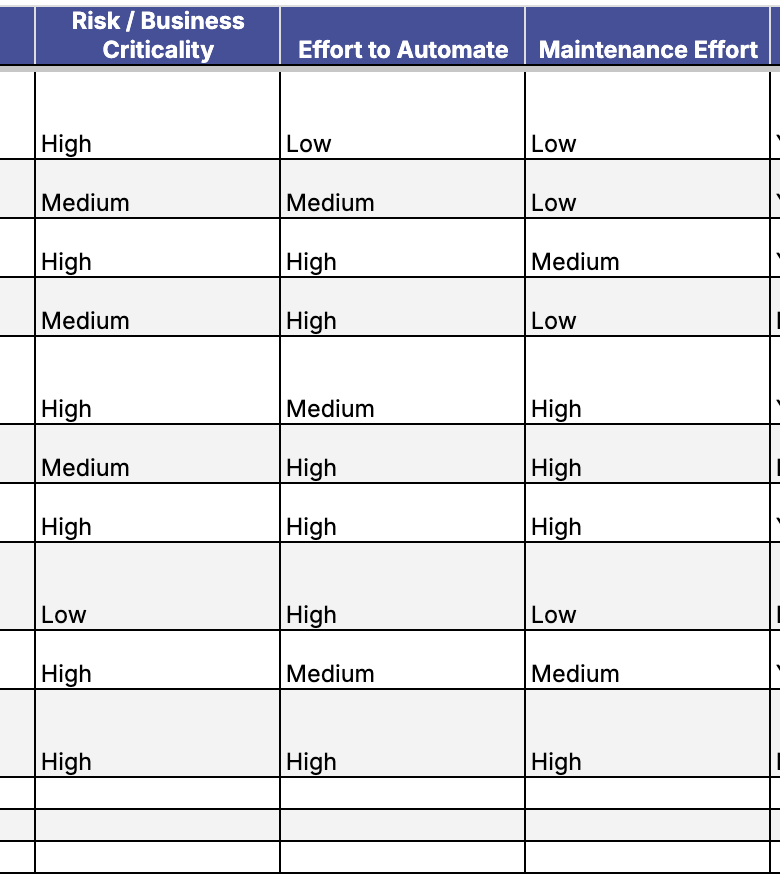
Every part of the manual vs. automation decision matrix adds value. But three columns drive the biggest impact. These are where your focus should go first.
Risk or Business Criticality
This is the “why” behind every automation choice. Even a simple test like login becomes top priority if the business cannot function without it.
Common mistake: undervaluing risk because the test looks easy.
Why it matters: if it fails and no one catches it, customers feel it. Revenue feels it. You feel it.
Effort to Automate
This is the invisible time sink. A test might be valuable, but if it takes three days to automate and the ROI is unclear, you might be better off keeping it manual.
Common mistake: automating everything “because we can.”
Why it matters: automation is a resource investment. Spend it wisely.
Maintenance Effort
This is the one teams often skip in planning. But it is the silent ROI killer.
Common mistake: ignoring script upkeep when under delivery pressure.
Why it matters: your savings disappear if the test fails every sprint and needs fixing.
The takeaway is simple. Focus on impact, not quantity. Let these three columns guide your judgment before you look at anything else.
Common mistakes when making the decision
Even with experience, test automation decisions are easy to get wrong. That’s why the manual vs. automation decision matrix is designed to expose these mistakes early.
| Mistake | Severity | Why it matters |
|---|---|---|
| Automating unstable features | High | Causes constant failures, wastes hours. |
| Keeping repetitive tests manual | High | Drains tester time, low ROI. |
| Ignoring data volume and setup complexity | Medium | Test may fail from poor environment prep. |
| Over-indexing on frequency alone | Low-Medium | High frequency ≠ good automation candidate. |
The goal of the matrix is simple. Make these mistakes visible before they impact your delivery or your team’s trust in automation.
How to keep it useful without “constant reviews”
No QA team wants to spend hours reviewing the same automation list every sprint. The good news is, the manual vs. automation decision matrix does not need daily attention to stay effective. It only needs clarity and timely touchpoints.
Here’s how to keep it working without adding review overhead:
- Revisit it after major releases or when workflows shift. Product behavior changes, and so should test priorities. A quick review post-release keeps the matrix aligned.
- Assign clear ownership. Let one QA own each module’s matrix entries. This keeps accountability tight and updates easy.
- Use it as a living decision log. Each entry becomes a reference point when new testers join or when past decisions are questioned.
Usefulness is not about frequency. It comes from creating shared understanding and consistent decision logic — and that’s exactly what the matrix is built for.
Final Thought: Freedom from Decision Fatigue
You do not need to start from zero every time someone asks, “Should we automate this?” The manual vs. automation decision matrix gives you a calm, structured way to think. It replaces last-minute debates with clarity you can trust.
Once your matrix is filled, every future conversation becomes faster, smarter, and less stressful. You gain more time to focus on testing value, product quality, and team momentum.
Download the Manual vs Automation Decision Matrix and take one decision off your plate.
Similar Resources
|
