


The main Tricentis alternatives are Katalon True, ACCELQ, Leapwork, Worksoft Certify, Testsigma, and more. Compare them by the Tricentis product you're replacing, and see when staying on Tricentis makes sense.
The main Tricentis alternatives are Katalon True (Katalon Studio for automation and Katalon TestOps for test management), ACCELQ, Leapwork, Worksoft Certify, Testsigma, TestComplete, Ranorex Studio, mabl, UiPath Test Cloud, Panaya, and Playwright. The right one depends on which Tricentis product you're replacing: Tosca for automation, qTest for test management, or both.
This guide sorts the options by that question, compares them in one table as of November 2026, and covers when staying on Tricentis is the better call. Competitor details come from each vendor's own site, as of November 2026.
Why teams look for Tricentis alternatives
Tricentis Tosca is a capable enterprise tool. It combines codeless, model-based test automation with AI agents that build tests from plain-language descriptions, and it has purpose-built support for packaged apps such as SAP Fiori, Oracle Fusion, Salesforce, Workday, and ServiceNow. Tricentis also sells qTest for test management, NeoLoad for performance testing, and Testim for custom web, mobile, and Salesforce apps.
Teams still look at Tosca alternatives, usually for one of these reasons:
- Cost. Licensing and infrastructure can be hard to justify for smaller teams or for suites that are mostly web and API tests.
- Skills fit. Model-based, codeless authoring suits business testers. Engineering-led teams often want code they can review, branch, and run in their own pipelines.
- Lock-in. Tosca test cases live in Tosca's model, so moving them to another tool means rebuilding rather than exporting.
- Footprint. Tosca Commander and its classic agents run on Windows, although Tricentis now also offers cloud execution and browser-based authoring.
- Consolidation. Some teams want automation, test management, and execution from fewer vendors, or a lighter mix of code and codeless authoring.
Which Tricentis product are you replacing?
"Tricentis alternative" can mean several things, so start here:
- Replacing Tosca (test automation): look at automation tools such as Katalon Studio, ACCELQ, Leapwork, Worksoft Certify, Testsigma, TestComplete, Ranorex Studio, and mabl, or at Playwright if your team writes code.
- Replacing qTest (test management): look at test management tools. Katalon TestOps is the Katalon product for this job: it manages manual and automated testing, test runs, defects, and release readiness in one place.
- Replacing both: a platform that covers automation and management together, such as Katalon True (Studio plus TestOps), ACCELQ, or Panaya for ERP-heavy teams.
- Replacing NeoLoad (performance testing): this list focuses on functional testing. Of the tools here, Leapwork has a load testing product (Leapwork Go), ACCELQ lists shift-left performance testing, and UiPath Test Cloud runs stress, spike, and endurance tests that reuse your functional suites.
- What about Testim? Testim is a Tricentis product (Tricentis Testim), so it isn't an alternative to Tricentis and isn't on this list.
How to choose a Tricentis alternative
Weigh each option against what Tosca or qTest does for you today:
- Application coverage: does it test everything you test now: web, API, mobile, desktop, and packaged apps such as SAP, Oracle, or Salesforce?
- Authoring model: can business testers work without code while engineers still script where they need to?
- Maintenance: how does it handle UI changes? Look at object repositories, self-healing, and how changes get approved.
- Execution: can it run in your CI pipeline, in parallel, and on the browsers and devices you need, on-premises or in the cloud?
- Test management: does it replace qTest, integrate with it, or leave you running both?
- Cost and exit: is pricing public, and how hard would it be to move your tests out later?
Tricentis alternatives compared
The table summarizes each tool as of November 2026, based on each vendor's own site.
Tool | Replaces | Application coverage | Authoring | Best fit |
|---|---|---|---|---|
Katalon True (Katalon Studio, Katalon TestOps) | Tosca and qTest | Web, mobile, API, Windows desktop | No-code, low-code, or Groovy and Java code, with AI assistance | Mixed-skill teams that want automation and test management from one vendor |
ACCELQ | Tosca and qTest | Web, mobile, API, desktop, mainframe, SAP, Salesforce, Oracle, Workday | Codeless with AI | Enterprises testing packaged apps and APIs without code |
Leapwork | Tosca | Web, desktop, API, SAP, Dynamics 365 | No-code visual flows with AI agents | Business process tests across several apps |
Worksoft (Certify) | Tosca | SAP, Oracle, Salesforce, Workday, ServiceNow, web, desktop, mainframe | Codeless business process automation | ERP-centric companies where functional experts own testing |
Testsigma | Tosca | Web, mobile, API, Salesforce, Windows desktop, SAP | Plain-English tests with AI agents (Atto) | Cloud-first teams that want AI-assisted authoring |
TestComplete (SmartBear) | Tosca | Desktop, web, iOS, Android | Codeless or script | On-premises or regulated teams with desktop apps |
Ranorex Studio | Tosca | Desktop, web, mobile | Low-code or full code | Teams focused on Windows desktop GUIs |
mabl | Tosca | Web, native iOS and Android, API | Low-code with AI agents | SaaS teams testing in CI/CD |
UiPath Test Cloud | Tosca and qTest | Web, desktop, mobile, API, mainframe, SAP, Oracle, Workday, Salesforce | Agentic testing tied to UiPath automation | Companies already running UiPath |
Panaya | Tosca and qTest (for ERP) | SAP, Oracle, Salesforce | Change impact analysis, test management, and automation | ERP upgrade and change projects |
Playwright | Tosca (web only) | Web (Chromium, Firefox, WebKit) | Code: TypeScript, Python, Java, .NET | Engineering-led teams testing modern web apps |
1. Katalon True: Katalon Studio and Katalon TestOps

Katalon True is Katalon's set of testing products. For Tricentis buyers, two of them map directly to what you use today:
- Katalon Studio for Tosca-style automation. Studio is a test automation IDE for web, mobile, API, and desktop testing. Testers can record tests, build them from keywords, or write Groovy and Java code, and switch between those views in the same test case. UI elements live once in an Object Repository, so a UI change is fixed in one place.
- Katalon TestOps for qTest-style test management. TestOps manages manual and automated testing: reusable test cases with steps and expected results, test runs assigned to testers, defects raised with evidence attached, requirement traceability, and release readiness from live run data. Its AI Test Runner executes manual test cases with human approval at each step.
Execution is handled by separate add-ons: Katalon Runtime Engine (KRE) runs Studio tests from the command line and in CI tools such as Jenkins, GitHub Actions, Azure DevOps, and GitLab, and TestCloud runs them on cloud browsers and devices. Katalon TrueTest, also part of Katalon True, shows how real users move through your product and where coverage is missing. It complements automation rather than replacing Tosca.
Key features:
- Web, mobile, and API testing on every Studio plan; Windows desktop testing on Professional and above
- No-code, low-code, and full-code authoring in one project, so business testers and engineers share tests
- AI self-healing that repairs broken locators during a run and reports what changed for your approval (Professional and above)
- Katalon AI Assistant, which generates, explains, and fixes scripts from natural language, on a paid plan (Professional or Enterprise), using Katalon's AI service or your own provider API key (OpenAI, Azure OpenAI, Google Gemini, AWS Bedrock); organization-wide bring your own AI provider is on Enterprise
- Git integrations (GitHub, GitLab, Bitbucket, Azure Repos) on every plan, plus Jira, Azure DevOps, Slack, qTest, TestRail, and Rally on a paid plan (Professional or Enterprise), so you can replace Tosca first and keep qTest for a while
- On-premises deployment and hybrid licensing on the Enterprise plan
Pros:
- One vendor for automation, test management, and execution, with each product bought as you need it
- Engineers can write code where code helps, unlike fully codeless tools
- Public Studio pricing and a Free plan to evaluate with your own app
Cons:
- No model-based testing like Tosca's, so tests are rebuilt rather than converted
- Teams whose regression suites run mostly on SAP GUI or other packaged ERP screens should prove coverage in a trial first; Tosca and Worksoft are built around those apps
- CI execution (KRE) and cloud execution (TestCloud) are add-ons
Pricing (as of November 2026): Katalon Studio has a Free plan. Professional costs $1,800 per seat per year, billed annually (about $150 a month), and Enterprise is custom. You can start with a 30-day free trial. KRE (command-line and CI runs, not included on Free) and TestCloud (works with any Studio plan, including Free) are add-ons. For TestOps and the other Katalon True products, see the pricing page or talk to sales.
For a head-to-head, see Katalon vs Tricentis.
2. ACCELQ
ACCELQ is a codeless, AI-based quality platform. ACCELQ Unified covers web, API, mobile, desktop, mainframe, and manual testing, with separate Automate Web, Automate Mobile, Automate API, and ACCELQ Manual products. Its site lists support for Salesforce, SAP, Oracle, Workday, ServiceNow, Microsoft Dynamics, and other packaged apps.
Key features:
- Codeless automation built around business processes
- Autopilot and AI-based record and playback
- API testing for REST, SOAP, Kafka, message queues, and microservices
- ACCELQ Manual for test management and planning
Pros:
- Broad packaged-app coverage, close to Tosca's
- Automation and test management on one platform
Cons:
- Codeless by design, so engineers who prefer to script tests in their own IDE have less direct control
- No public pricing as of November 2026
Best fit: enterprises replacing both Tosca and qTest that test many packaged apps.
3. Leapwork
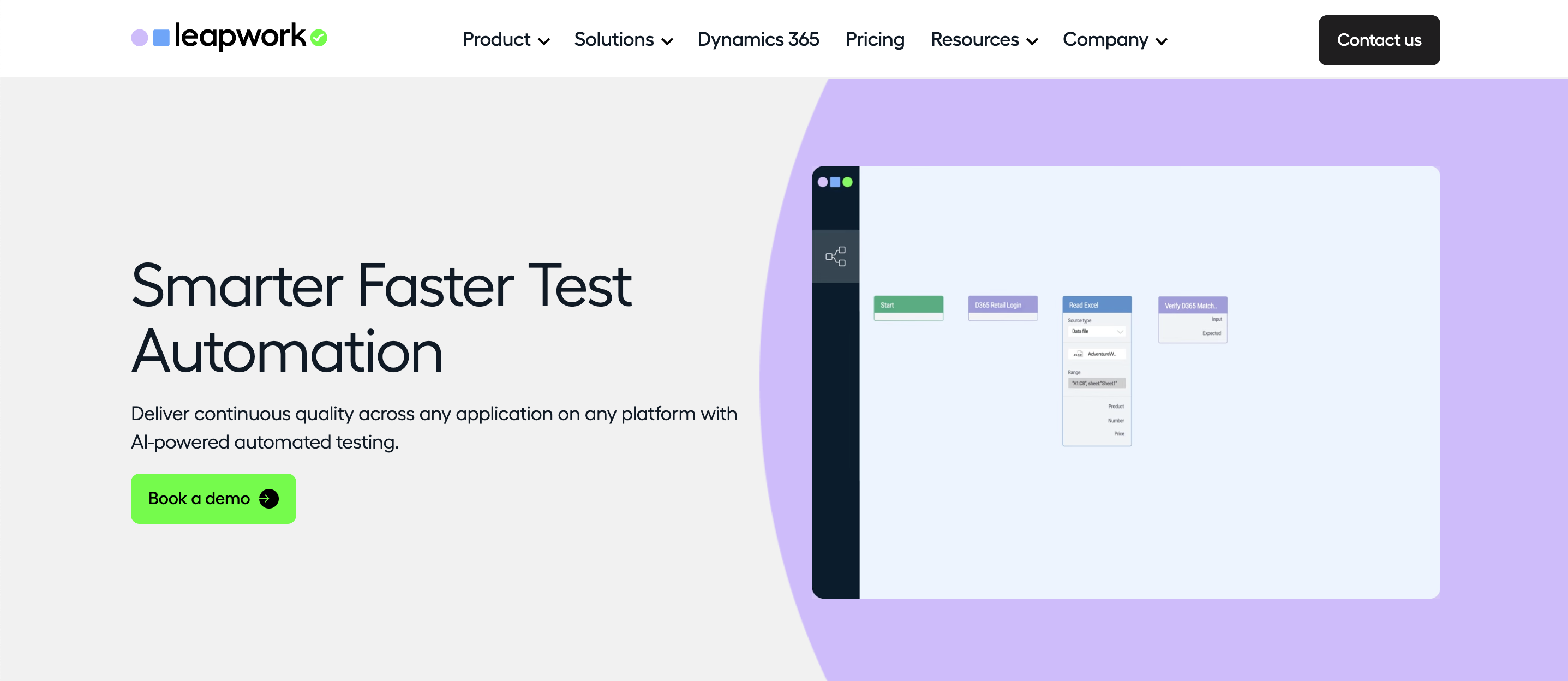
Leapwork is a no-code visual test automation platform. Tests are built as flowcharts you can see and edit. Its product line now includes Leapwork Play (AI-assisted Playwright testing for web apps), Leapwork Flow (end-to-end processes across apps such as Dynamics 365, SAP, and desktop warehouse apps), and Leapwork Go (performance and load testing).
Key features:
- Visual, no-code flows for web, desktop, API, SAP, and Dynamics 365
- AI agents that build flows from prompts, with self-healing when the app changes
- People review and approve AI-suggested changes before they apply
- Role-based access, test data masking, and audit logs
Pros:
- Easy for non-technical testers to start with
- Covers process tests that cross several applications
Cons:
- Less control than code for complex logic
- No public pricing as of November 2026
Best fit: business process testing across web, desktop, and ERP apps by teams with few developers.
4. Worksoft Certify
Worksoft focuses on business process testing for enterprise applications. Its core product, Worksoft Certify, provides codeless automation of end-to-end processes that functional experts can build and maintain. Its site lists SAP, Salesforce, ServiceNow, Workday, Oracle, Microsoft Dynamics, IBM Maximo, and UKG, plus web, desktop, and mainframe apps.
Key features across the Worksoft platform:
- Codeless, reusable process automation in Certify
- Self-healing (Adaptive Automation) in Certify
- Business Capture module that records processes as users run them
- Continuous Testing Manager for scheduling and unattended runs
- Impact module for change-based test selection on SAP
Pros:
- Built for ERP testing, which is where Tosca is strongest
- Functional experts can own tests without developers
Cons:
- Narrower fit for custom web or mobile apps
- No public pricing as of November 2026
Best fit: SAP- or Oracle-centric companies that want a Tosca-class ERP tool from another vendor.
5. Testsigma
Testsigma is a cloud test automation platform where tests are written in plain English. Its AI coworker, Atto, uses a set of AI agents to plan, write, run, heal, and analyze tests, and a person approves tests before they ship.
Key features:
- Web, native and hybrid mobile (including Flutter), and API testing (REST, SOAP, GraphQL)
- Salesforce testing, plus Windows desktop and SAP listed in its FAQ
- Parallel runs triggered from GitHub Actions, Jenkins, Azure DevOps, or CircleCI
- Real device cloud, plus integrations with third-party device labs
Pros:
- Low barrier for manual testers moving into automation
- Hosted option, so there's no execution infrastructure to run unless you choose on-premises
Cons:
- Cloud-first by default; on-premises and hybrid deployment are Enterprise options, as of November 2026
- Tests are written in plain English first, and engineers extend them with custom code, which is a different workflow from a code-first framework
Pricing: paid plans scale with parallel runs and seats, with a free trial and a custom Enterprise plan, as of November 2026.
Best fit: cloud-first teams that want AI-assisted authoring across web, mobile, and API.
6. TestComplete
TestComplete, from SmartBear, automates UI tests for desktop, web, and mobile (iOS and Android) apps. SmartBear positions it for on-premises and regulated environments that need audit-ready automation, including web tests behind a firewall.
Key features:
- Codeless keyword-driven tests or scripts
- Object recognition for complex desktop apps, including legacy ones
- Self-healing, AI test data generation, OCR, and AI visual testing
- Integrations with Jenkins, Jira, Git, GitHub Actions, and Azure DevOps
Pros:
- Strong desktop coverage
- Runs on-premises, which suits restricted networks
Cons:
- Authoring runs as a Windows desktop app, per SmartBear's system requirements
- Less suited to packaged ERP process testing than Tosca or Worksoft
Best fit: teams with large desktop suites that need on-premises automation. If you're weighing TestComplete itself, see our TestComplete alternatives guide.
7. Ranorex Studio
Ranorex Studio tests desktop, web, and mobile apps from one tool, with both full-code and low-code approaches. Ranorex is now part of Sembi.
Key features:
- Desktop, web, and mobile GUI testing
- Recorder plus full-code editing
- Object repository for reusable UI elements
Pros:
- Long track record with Windows desktop applications
- Low-code and code in one tool
Cons:
- No test management of its own, so you still need a tool like qTest or TestOps
- No public pricing as of November 2026
Pricing: a 14-day free trial with full access, as of November 2026.
Best fit: teams whose main need is Windows desktop GUI automation.
8. mabl
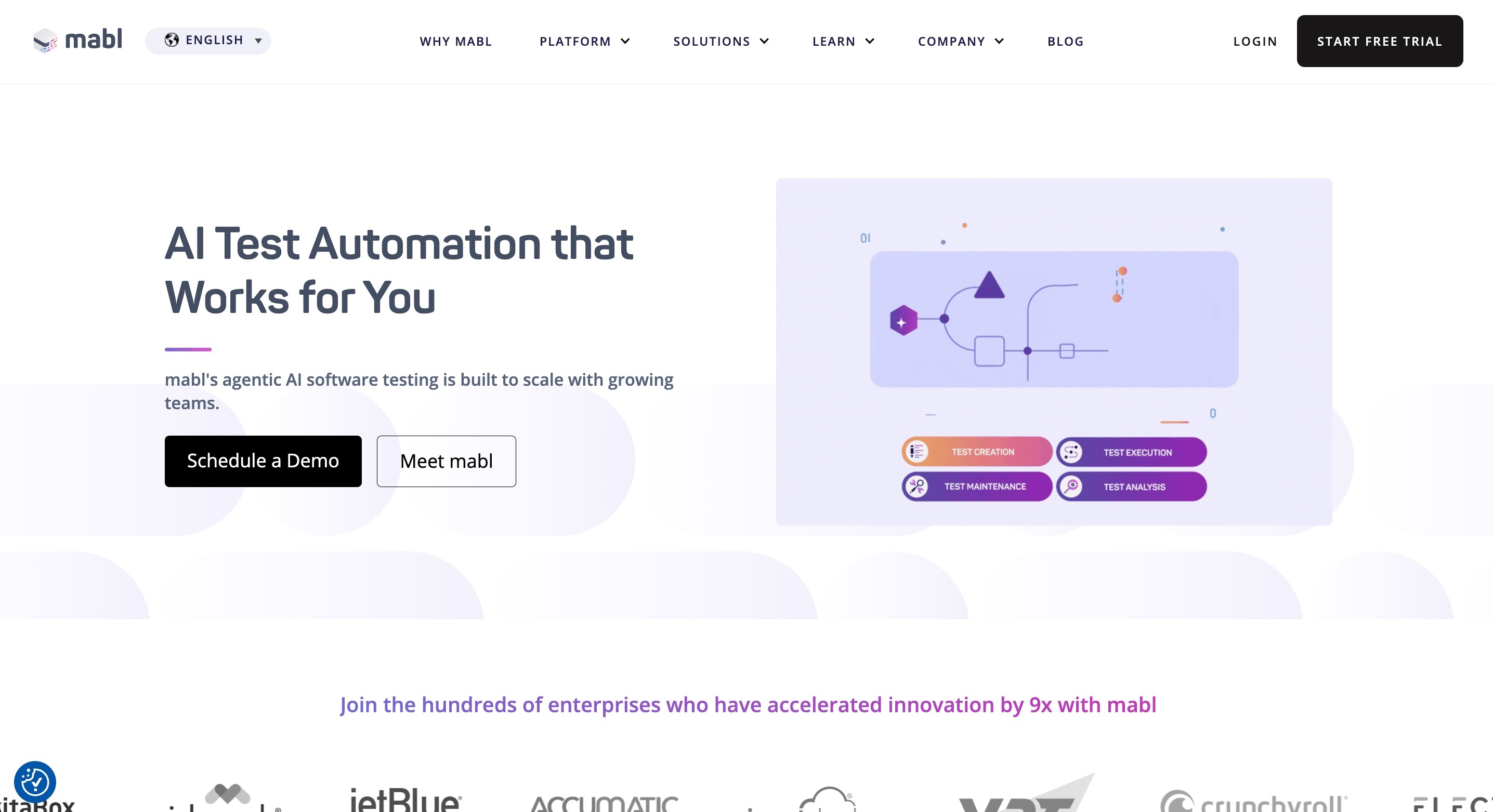
mabl is a low-code testing platform built around AI agents that create, run, analyze, and maintain tests. It covers web, native iOS and Android apps, and APIs, including importing Postman collections.
Key features:
- Agentic test creation and maintenance, with teams in control
- Web, native mobile, and API testing
- Testing for AI apps with dynamic outputs
- Built for CI/CD pipelines
Pros:
- Fast setup for SaaS teams
- Covers web, mobile, and API in one place
Cons:
- No desktop app testing
- Not built for SAP or other packaged ERP apps
Best fit: SaaS product teams testing in CI/CD, not ERP programs.
9. UiPath Test Cloud
UiPath Test Cloud (formerly UiPath Test Suite) is UiPath's agentic testing product. AI helps write tests and generate test data, the Healing Agent repairs broken selectors and UI changes at run time, and Test Manager plans tests, triages defects, and reports status, with QA teams in control. It's offered as SaaS or self-hosted, and its SAP testing covers S/4HANA, ECC, Fiori, and SAP GUI. UiPath also lists desktop, web, mobile, API, mainframe, Oracle, Workday, and Salesforce testing.
Key features:
- AI-assisted test authoring and test data generation
- Self-healing through the Healing Agent
- Test Manager for planning, defect triage, and reporting
- Performance testing (stress, spike, endurance) and SaaS or on-premises deployment
- Ties into UiPath's automation and orchestration platform
Pros:
- A natural fit if your company already runs UiPath automation
- Covers both automation and test management
Cons:
- Strongest inside the UiPath ecosystem; heavier for teams that only need testing
- No public pricing as of November 2026
Best fit: companies with an existing UiPath investment.
10. Panaya
Panaya is an agentic platform for testing enterprise applications through change. It combines change impact analysis, test management, test automation, and custom code correction for SAP, Oracle, and Salesforce. It's a common comparison for Tosca on SAP projects, alongside Tricentis LiveCompare.
Key features:
- Change impact analysis that shows what an upgrade or transport affects
- Test management and automation in one platform
- Self-healing automation built from manual tests
Pros:
- Focused on ERP upgrades and change, where risk-based test scope matters most
- Helps scope testing before you automate it
Cons:
- Narrow fit outside SAP, Oracle, and Salesforce
- No public pricing as of November 2026
Best fit: ERP teams running upgrades or frequent change, comparing against Tosca plus LiveCompare.
11. Playwright

Playwright is a free, open-source web testing framework from Microsoft. Playwright Test drives Chromium, Firefox, and WebKit with auto-waiting, web-first assertions, tracing, and parallel runs, and you write tests in TypeScript, Python, Java, or .NET. It also ships a CLI and an MCP server for AI agents.
Here's a short Playwright script in Python that opens a page, prints its title, and takes a screenshot:
from playwright.sync_api import sync_playwright

with sync_playwright() as p:
    browser = p.chromium.launch(headless=False)
    page = browser.new_page()
    page.goto("https://katalon.com")
    print("Page title:", page.title())
    page.screenshot(path="katalon_home.png")
    browser.close()
Set headless=True to run it in CI.
Tosca vs Playwright: which fits?
They solve different problems. Tosca is a codeless, model-based platform for business testers that covers web, API, and packaged apps such as SAP. Playwright is a code library for engineers that covers web apps only. Moving from Tosca to Playwright means rebuilding tests as code, and adding your own test management, reporting, and anything outside the browser.
Pros:
- Free, with no license cost
- Fast, reliable runs with auto-waiting and parallelism built in
Cons:
- Web only: no desktop, native mobile, or SAP GUI
- Needs engineers who code, plus a separate test management tool
Best fit: engineering-led teams testing modern web apps.
Which Tricentis alternative should you choose?
There's no single answer, so match the tool to your team:
- Stay on Tricentis if most of your testing runs against SAP or other packaged apps, your business testers depend on model-based authoring, and the license cost is accepted. Tosca's packaged-app depth is hard to match.
- Choose Worksoft Certify or Panaya if you want another ERP-focused vendor: Worksoft for codeless process automation, Panaya for change impact and upgrade testing.
- Choose ACCELQ or Leapwork if you want codeless automation across packaged and custom apps, with ACCELQ also covering test management.
- Choose Testsigma or mabl if you're a cloud-first team that wants AI agents to write and maintain tests (mabl doesn't cover desktop apps).
- Choose TestComplete or Ranorex Studio if your hardest problem is Windows desktop automation.
- Choose Playwright if your engineers code and your apps are web only.
- Choose Katalon True if you have a mix of business testers and engineers, test web, mobile, API, and desktop, and want automation (Katalon Studio) and test management (Katalon TestOps) from one vendor with public Studio pricing.
Whichever you shortlist, run a proof of concept on your hardest regression flows, including any SAP or desktop screens, before you commit.
If Katalon is on your shortlist, our guide on how to migrate from Tricentis Tosca to Katalon covers what to audit, what to move first, and how to phase the change without disrupting delivery.
Frequently asked questions
The main Tosca alternatives, as of November 2026, are Katalon Studio (part of Katalon True), ACCELQ, Leapwork, Worksoft Certify, Testsigma, TestComplete, Ranorex Studio, mabl, UiPath Test Cloud, Panaya, and Playwright. ERP-heavy teams often compare Worksoft and Panaya, while mixed-skill teams testing web, mobile, API, and desktop often compare Katalon Studio, ACCELQ, and Leapwork.
Tricentis doesn't publish Tosca prices on its site, as of November 2026, so you need a quote from Tricentis. By comparison, Katalon Studio has a Free plan, Professional at $1,800 per seat per year billed annually, and custom Enterprise pricing, with a 30-day free trial. Katalon's pricing page lists current plans.
For test automation, Tricentis Tosca competes with Katalon Studio, ACCELQ, Leapwork, Worksoft, Testsigma, SmartBear TestComplete, Ranorex, mabl, and UiPath. For SAP change and testing, Panaya and Worksoft are common comparisons. For test management, qTest competes with tools such as Katalon TestOps. Testim is not a competitor: Tricentis owns it.
Not really. Selenium is a free, open-source code library for automating browsers, so engineers write tests in a programming language. Tosca is a commercial, codeless, model-based platform that business testers can use, and it covers web, API, desktop, and packaged apps such as SAP. Katalon Studio sits between them, with code and codeless authoring.
For web apps tested by engineers, yes. Playwright is free and open source, with auto-waiting, tracing, and parallel runs across Chromium, Firefox, and WebKit. It doesn't cover desktop, native mobile, or SAP GUI, and has no codeless authoring or test management, so it suits engineering-led teams rather than business testers.
Katalon TestOps is the Katalon product for test management. It manages manual and automated testing: test cases, test runs, defects with evidence, requirement traceability, and release readiness. Its AI Test Runner executes manual test cases with human approval at each step. Katalon Studio also integrates with qTest on a paid plan (Professional or Enterprise) if you keep it.




Test everything. Ship with confidence.
From generating test cases to spotting failures, Katalon's AI works across your entire pipeline, automatically.
