.svg)



If you're evaluating these two solutions, it’s likely because you're trying to understand which one aligns better with your team’s skills, processes, and long-term quality strategy. And with their contrasting philosophies, it can be hard to compare them at a glance.
In this article, we’ll break things down so you can make a confident decision. We’ll walk you through:
- Where both tools face limitations in enterprise environments
- The key strengths that set Katalon apart
- The areas where Katalon still has room to grow
- What Tricentis offers for large, highly regulated organizations
- The trade-offs that come with adopting Tricentis
- How model-based testing compares to Katalon’s hybrid automation approach
Let’s dive in.
Katalon Advantages

The Katalon Platform is one of the most complete all-in-one test automation platform if you’re looking for a solution that balances ease of use with deep technical capability. Instead of juggling multiple tools for test creation, execution, analytics, and maintenance, you get a unified ecosystem that handles web, mobile, API, and desktop testing from end to end. It’s built for teams that want to scale automation without losing control or flexibility along the way.
One thing we really appreciate about Katalon is how naturally it adapts to different skill levels. If your testers prefer codeless authoring, Katalon offers intuitive UI-driven workflows. If your engineers prefer scripting, they can write custom logic or blend code with codeless steps in the same project. This balance helps cross-functional teams move faster without compromise.
What you can achieve with Katalon:
- Automate across all major platforms: Web UI, mobile apps, APIs (REST, SOAP, GraphQL), and desktop applications.
- Use built-in testing frameworks: Data-driven testing, BDD, and reusable UI object management via the Object Repository.
- Run tests anywhere: Locally, remotely, on cloud providers, or at scale using TestCloud’s 3,000+ browser/device/OS combinations.
- Scale execution with Katalon Runtime Engine: Run parallel executions and accelerate large regression cycles.
- Integrate cleanly into CI/CD: Connect with GitHub Actions, Jenkins, Bitbucket, Azure DevOps, and other pipelines.
- Analyze results instantly: Access screenshots, videos, logs, and structured reports to speed up root-cause analysis.
AI-powered testing that elevates coverage
Katalon is also one of the first platforms to embed AI directly into the testing lifecycle that offers meaningful, practical benefits, not just buzzwords. The AI-driven capabilities simplify maintenance and expand your coverage without adding more manual work.
- Automatic test maintenance: AI detects locator changes and helps you fix test objects before they break.
- TrueTest for AI-generated regression testing: TrueTest analyzes real user behavior in production and generates regression tests automatically.
- Smart analytics in TestOps: Identify flaky tests, detect hidden risks, and pinpoint failure patterns faster.
TestOps: Visibility and control at enterprise scale
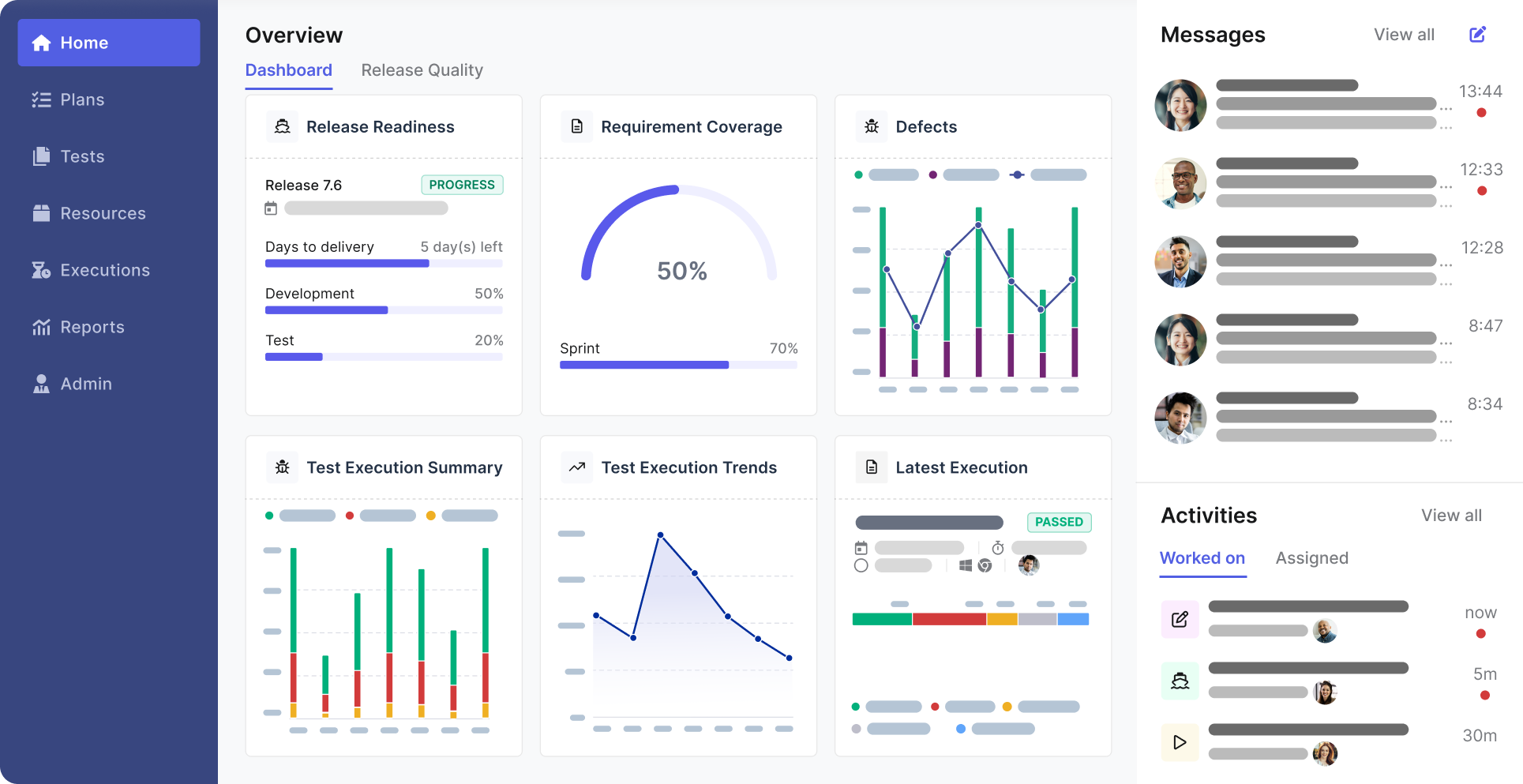
If you’ve ever struggled to keep track of hundreds or thousands of tests, TestOps will feel like a relief. It centralizes your entire testing operation so you can monitor quality trends, orchestrate executions, and maintain traceability across manual, automated, and AI-generated tests.
- End-to-end test management: Store, organize, and track every test case in one place.
- Real-time dashboards: View coverage, pass/fail rates, flaky test analytics, and requirement traceability.
- Execution orchestration: Schedule runs in CI, nightly builds, or custom event triggers.
TestCloud: On-demand execution without infrastructure overhead
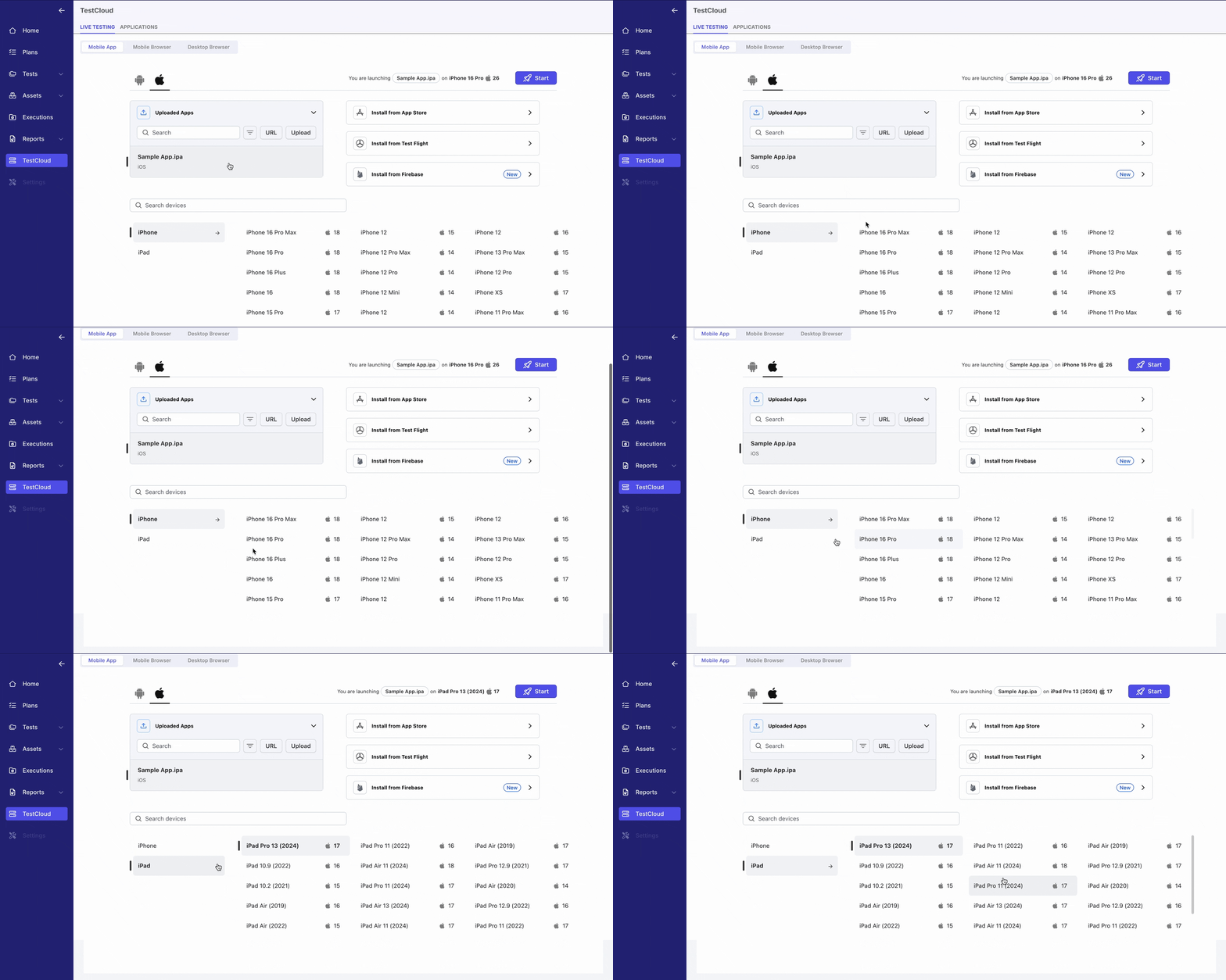
If you’re tired of maintaining device labs, TestCloud gives you instant execution environments. You can run test suites on thousands of browser-device-OS combinations without touching a single VM or emulator.
- 3,000+ real-world environments: From Chrome and Safari to Android and iOS device models.
- Flexible parallel execution: Slash regression runtime even on huge suites.
- Seamless integration: Trigger cloud runs directly from Katalon Studio or TestOps.
Put simply, the Katalon Platform offers one of the broadest and most scalable automation ecosystems available today. Whether you're managing small agile teams or enterprise-wide QA operations, Katalon gives you the tools to accelerate quality without adding complexity.
📝 Ready to see how Katalon fits your testing team? Request a personalized demo and explore the platform in action.
Katalon Gaps
While Katalon delivers a strong balance of usability and enterprise capability, it’s still important for us to acknowledge where the platform may feel limiting depending on your team’s expectations, development culture, and long-term testing strategy.
Where Katalon may fall short for some teams:
- Advanced coding still required in complex scenarios: Katalon’s low-code and keyword-driven layers already cover most of your testing needs, but sophisticated workflows and custom business logic often require some form of scripting.
- Scaling governance requires structure: TestOps provides oversight tools, but large enterprise teams still need to define naming conventions, review processes, and workspace policies to maintain consistency.
None of these gaps undermine the value Katalon brings to enterprise QA, but they do help set the right expectations. With the right implementation plan, many teams work around these limitations easily, yet it's always better to know where the boundaries are before you commit to a platform.
Tricentis Advantages
Tricentis is built for enterprises that operate in highly regulated, deeply integrated, and process-driven environments. Its strong emphasis on model-based test automation provides a structured way to scale testing without requiring large volumes of coded scripts or extensive framework work.
Where Tricentis truly shines is its ability to standardize automation across very large QA organizations. Instead of relying on individual scripting patterns or framework conventions, teams create reusable models that ensure consistency and reduce duplication. That structure can feel strict at first, but for enterprises dealing with massive systems and compliance requirements, it’s often exactly what they need.
What Tricentis brings to enterprise environments:
- Model-based automation for packaged apps: Offers deep, native automation support for SAP, Oracle, Salesforce, Workday, and other enterprise systems that are difficult to cover with traditional tools.
- Highly scalable standardization: Creates uniform automation patterns across distributed QA teams, reducing inconsistency and easing maintenance.
- Risk-based testing capabilities: Identifies high-impact areas through change-based risk analysis, helping teams test smarter and prioritize limited resources.
- Comprehensive enterprise test suite: Includes load testing, test data management, test case design, and orchestration across the Tricentis ecosystem.
- Strong compliance and audit alignment: Built with the needs of regulated industries in mind, offering traceability and documentation that support audit workflows.
- Broad integrations with ALM and ERP systems: Connects tightly with enterprise ecosystems like SAP Solution Manager, Jira, Azure DevOps, and more.
- Low-code authoring for business users: Empowers non-technical testers to contribute through model-based workflows without writing scripts.
Tricentis is ultimately best suited for teams that prioritize structure, governance, and enterprise-wide consistency. If your organization needs strong alignment with packaged systems and values a disciplined approach to automation, the platform delivers a stable, predictable foundation at scale.
Tricentis Gaps
Enterprise QA teams often highlight that Tricentis’s ecosystem requires a deep commitment, not only in licensing cost, but in how you shape your testing process. That commitment can pay dividends for large organizations with stable business workflows, but it can also slow down teams that need to adapt quickly or support fast-moving engineering pipelines.
Where Tricentis may fall short for some enterprise teams:
- Heavy reliance on model-based methodology: The strict modeling approach can feel restrictive for engineers who prefer code-centric or hybrid automation patterns.
- High total cost of ownership: Licensing, implementation, and ongoing training can significantly exceed the budget of midsize teams or organizations scaling rapidly.
- Long onboarding cycles: New users often need substantial training to become productive, which slows adoption and increases dependency on specialized Tricentis experts.
- Limited openness for custom frameworks: While integrations exist, Tosca’s ecosystem is less flexible for teams that want to blend open-source tools or build custom automation layers.
- Less suitable for rapid-release environments: Model updates and maintenance can lag behind fast-moving development cycles, especially in agile or CI/CD-heavy teams.
- Complex upgrade and environment setup: Enterprise customers frequently report that upgrades, workspace migrations, and repository management require meticulous planning and support.
- Weaker coverage for modern web frameworks: While outstanding for SAP and packaged apps, Tosca’s handling of highly dynamic, JavaScript-heavy UI frameworks may require workarounds.
These gaps don’t diminish Tricentis’s value for the right enterprise profile—they simply clarify what type of organization will benefit most. If your workflows demand speed, flexibility, or accessible onboarding for diverse QA roles, these trade-offs should be weighed carefully.
Model-Based vs Hybrid Automation
When you compare Katalon and Tricentis, the biggest philosophical difference comes down to how each platform expects you to build and maintain automated tests.
If your QA organization is debating between these two styles, it’s worth taking a step back and asking what kind of structure you want your automation program to follow. Do you prefer the predictability of model-first workflows, or do you want the freedom to shape automation around your product’s behavior and your team’s skills?
Here’s a simplified comparison to help you see the trade-offs clearly:
| Approach | How it works | Strengths | Trade-offs |
|---|---|---|---|
| Model-based (Tricentis) | QA teams build reusable models representing business processes and use them to generate automated tests. | Extremely standardized, strong for packaged apps, great for compliance-heavy enterprises. | Rigid, time-consuming to onboard, slower when adapting to fast UI or logic changes. |
| Hybrid automation (Katalon) | Combines low-code, keywords, reusable components, and scripted logic so teams can mix methods based on complexity. | Flexible, faster to adopt, adaptable to both technical and non-technical testers. | Requires governance to maintain consistency across large organizations. |
In practice, model-based testing makes the most sense for organizations with highly stable business processes, extensive packaged systems, or strict audit requirements. Meanwhile, hybrid automation serves teams that move fast, support diverse application architectures, or want to empower a broader mix of QA skill levels.
There’s no “one-size-fits-all” answer here. What matters most is choosing the approach that aligns with how your team builds software, manages change, and scales quality operations.
|
