.svg)



Choosing the right automation platform shapes how quickly your team can ship, how confidently you can scale, and how efficiently you can maintain quality across fast-changing releases. Katalon and TestSigma are two of today’s most popular contenders, each offering a different approach to how enterprise QA teams design, execute, and maintain automated tests.
Because their strengths overlap in some places and diverge sharply in others, it can be hard to understand which platform truly fits your organization’s needs. That’s why we’re breaking down the comparison in a clear, structured way. In this guide, you’ll see:
- Where Katalon delivers the strongest advantages for enterprise QA teams
- Where TestSigma provides unique value through its low-code design
- Gaps and limitations in both platforms to help you assess fit objectively
- A side-by-side comparison that highlights key differences across creation, execution, AI, analytics, and scalability
Let’s get started.
Katalon advantages as a comprehensive testing platform

When you look at Katalon from an enterprise lens, the platform feels intentionally crafted for the realities of scaling QA. Instead of stitching together multiple tools to cover creation, execution, analytics, and maintenance, you get a unified ecosystem that already knows how each part should work together. That alone removes a huge amount of operational overhead and helps your team move with far more confidence.
At the core of the platform is Katalon Studio, a powerful environment for building web, mobile, API, and desktop test cases with built-in frameworks that reduce the noise teams usually deal with. The experience becomes even stronger when paired with TestOps for management and TestCloud for execution, creating a tightly integrated workflow that feels natural the moment you start using it.
Here’s where Katalon stands out most clearly:
- End-to-end automation coverage: You can automate UI, API, mobile, and desktop testing without switching tools or maintaining isolated pipelines.
- AI-driven test maintenance: Katalon’s AI identifies locator changes automatically, reducing flaky tests and cutting maintenance time dramatically.
- TrueTest for regression intelligence: Instead of guessing what to test, TestOps analyzes production usage and generates high-impact regression scenarios grounded in real user behavior.
- Parallel and distributed execution at scale: Whether you run locally, on-prem, in the cloud, or across TestCloud’s 3,000+ environments, Katalon adapts easily to enterprise load.
- Deep CI/CD integration: You can trigger automated runs from Jenkins, GitHub Actions, Azure DevOps, or other pipelines with minimal configuration.
- Rich analytics and reporting: Centralized dashboards deliver failure trends, test coverage metrics, execution logs, screenshots, videos, and environment insights, all in one place.
- Enterprise-grade team management: Role-based access, shared repositories, versioning, and workspace-level governance support large distributed QA teams.
To help you visualize how these advantages group together, here’s a quick summary:
| Category | Strength |
|---|---|
| Test creation | Unified automation across UI, API, mobile, and desktop with built-in frameworks |
| Execution | Scalable local, remote, and cloud execution with parallelization |
| Maintenance | AI-driven locator healing and automated regression test generation |
| Management | Centralized test planning, execution orchestration, and team governance |
| Analytics | Rich dashboards, insights, and failure analytics across your entire testing lifecycle |
What makes these advantages especially compelling is how naturally they flow together. Instead of juggling fragmented workflows, you get a single platform that helps you design tests efficiently, run them at scale, and monitor the entire QA lifecycle without friction. For enterprise teams looking to grow without adding tool sprawl or process bottlenecks, Katalon offers a remarkably cohesive solution.
AI that does the heavy lifting for you
Katalon is also one of the first platforms to embed AI directly into the testing lifecycle. The AI-driven capabilities simplify maintenance and expand your coverage without adding more manual work.
- Automatic test maintenance: AI detects locator changes and helps you fix test objects before they break.
- TrueTest for AI-generated regression testing: TrueTest analyzes real user behavior in production and generates regression tests automatically.
- Smart analytics in TestOps: Identify flaky tests, detect hidden risks, and pinpoint failure patterns faster.
TestOps: Visibility and control at enterprise scale
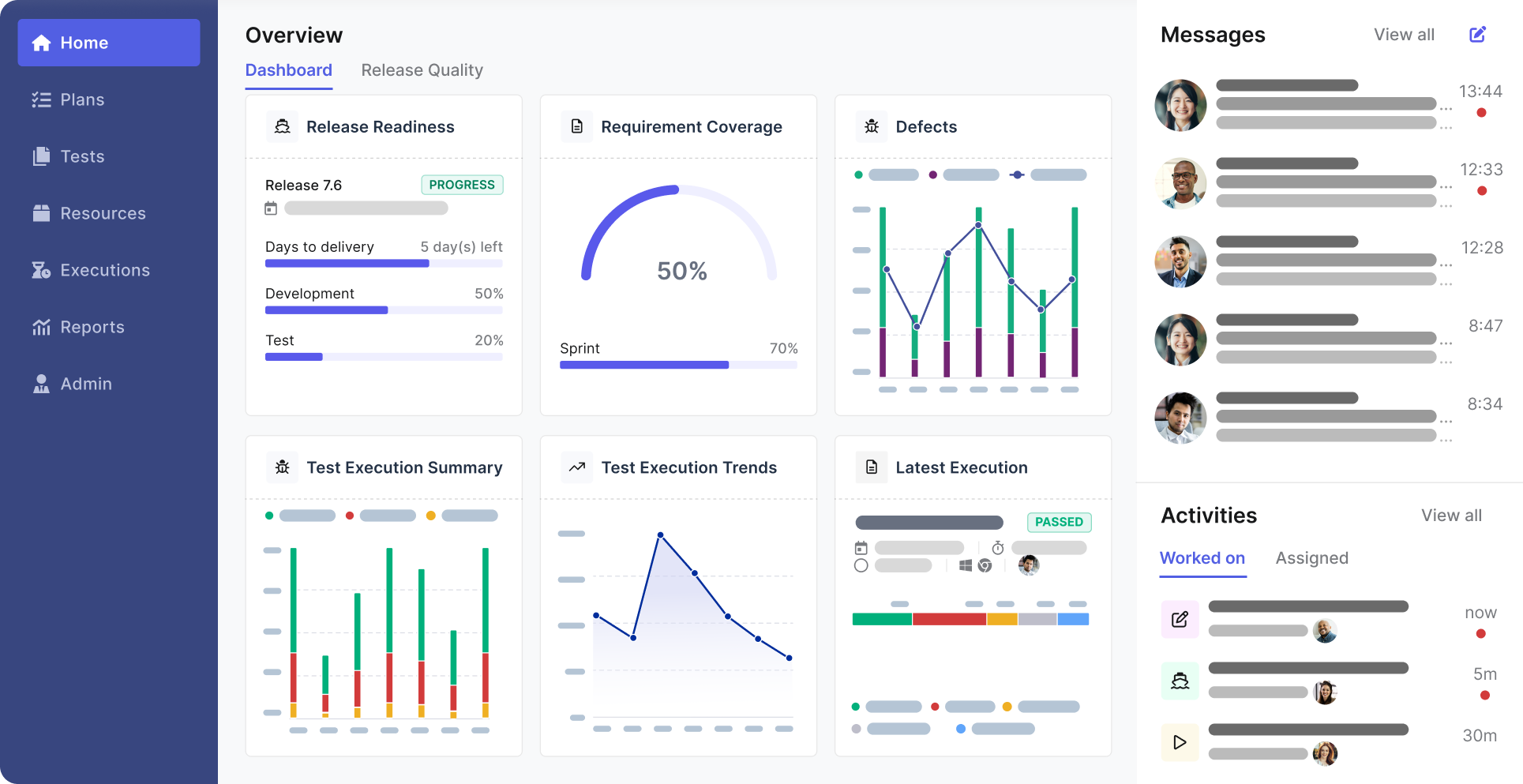
If you’ve ever struggled to keep track of hundreds or thousands of tests, TestOps will feel like a relief. It centralizes your entire testing operation so you can monitor quality trends, orchestrate executions, and maintain traceability across manual, automated, and AI-generated tests.
- End-to-end test management: Store, organize, and track every test case in one place.
- Real-time dashboards: View coverage, pass/fail rates, flaky test analytics, and requirement traceability.
- Execution orchestration: Schedule runs in CI, nightly builds, or custom event triggers.
TestCloud: On-demand execution without infrastructure overhead
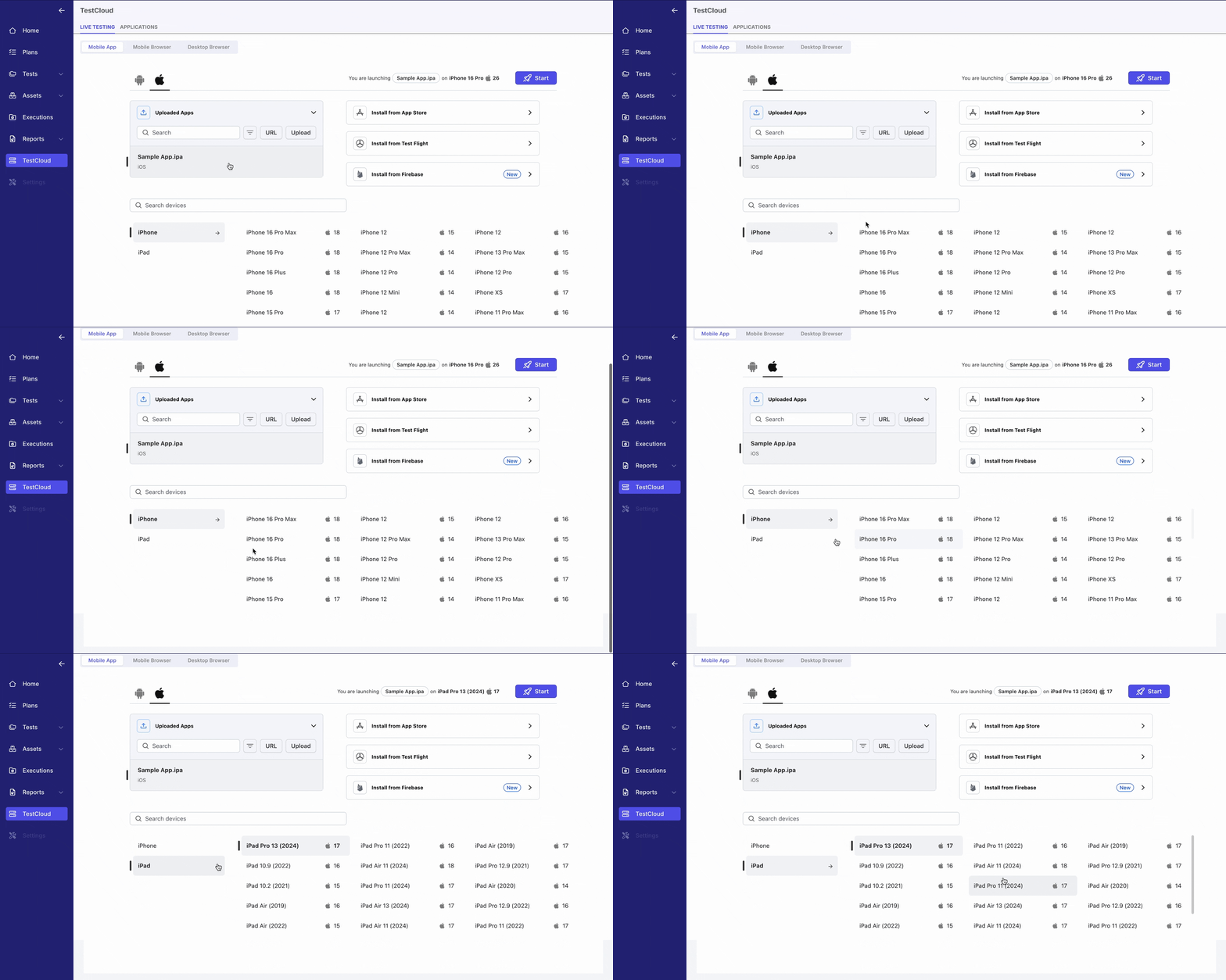
If you’re tired of maintaining device labs, TestCloud gives you instant execution environments. You can run test suites on thousands of browser-device-OS combinations without touching a single VM or emulator.
- 3,000+ real-world environments: From Chrome and Safari to Android and iOS device models.
- Flexible parallel execution: Slash regression runtime even on huge suites.
- Seamless integration: Trigger cloud runs directly from Katalon Studio or TestOps.
Put simply, the Katalon Platform offers one of the broadest and most scalable automation ecosystems available today. Whether you're managing small agile teams or enterprise-wide QA operations, Katalon gives you the tools to accelerate quality without adding complexity.
📝 Ready to see how Katalon fits your testing team? Request a personalized demo and explore the platform in action.
TestSigma advantages you should know
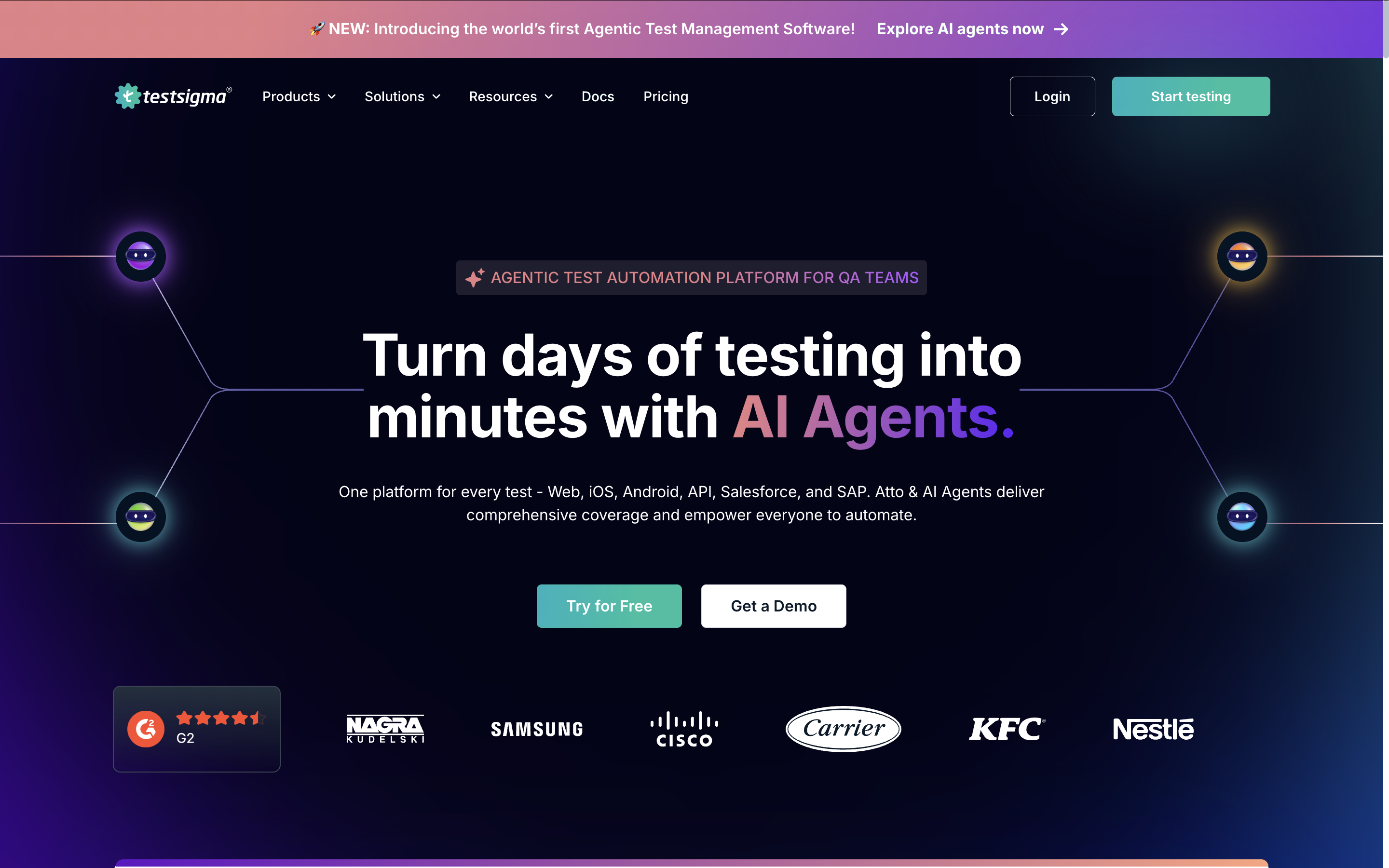
TestSigma has carved out a distinct space in the automation landscape by leaning heavily into accessibility. If you’ve ever wished your team could create automated tests without wrestling with frameworks, libraries, or code-heavy workflows, TestSigma might feel like a breath of fresh air. Its philosophy is simple: make automation approachable for every role on the QA team, not just the engineers.
The platform’s low-code design, paired with a cloud-first execution model, removes much of the setup and maintenance work that traditionally slows QA teams down. Instead of tuning environments or building custom infrastructure, you jump straight into creating tests in plain English and running them across browsers, devices, and APIs with minimal friction.
Here’s where TestSigma shines most for enterprise teams:
- Natural-language test creation: The ability to write tests using everyday English dramatically shortens onboarding time. Teams without deep technical backgrounds can contribute meaningfully within hours, not weeks.
- Cloud-native execution from day one: You don’t need complex infrastructure to start running tests at scale. TestSigma handles execution environments for you, giving your team instant access to distributed test runs.
- Unified testing for web, mobile, and APIs: Just like higher-end enterprise platforms, TestSigma supports multi-surface automation in a single workflow, allowing testers to move fluidly between different application layers.
- Extensible through custom functions: When teams need more flexibility, TestSigma allows script extensions, blending low-code simplicity with engineering-level customization.
To help you understand how these strengths map to real needs in enterprise QA, here’s a simple at-a-glance view:
| Area | Advantage |
|---|---|
| Test creation | Natural-language authoring shortens the learning curve |
| Execution | Cloud-first infrastructure enables fast scaling with minimal setup |
| Extensibility | Custom functions offer scripting flexibility when needed |
| Adoption | Ideal for teams that must scale automation quickly across mixed skill levels |
What gives TestSigma its distinctive appeal is how quickly you can get productive. You spend almost no time wrestling with tooling, and far more time creating and running tests that matter. For organizations expanding their QA function or integrating non-technical contributors into automation, TestSigma offers a clear and accessible path forward.
Katalon gaps you should know
While Katalon offers a strong, unified ecosystem, it isn’t without trade-offs. Every enterprise tool has boundaries, and understanding them upfront helps you make a much more balanced decision.
Here are the areas where Katalon may present challenges:
- Advanced customization requires technical depth: Although Katalon simplifies many workflows, teams aiming for highly specialized or deeply engineered automation patterns may find themselves writing Groovy or Java. For some QA organizations transitioning from no-code tooling, that shift takes time.
- Learning curve for newcomers: Because the platform bundles creation, execution, analytics, and cloud infrastructure, new users sometimes feel overwhelmed when navigating the full ecosystem for the first time. With the right onboarding, this levels out, but the early phase can require coaching. However, you can always join Katalon Academy to learn everything you need to know when it comes to Katalon.
- Limited suitability for pure open-source purists: Teams that strongly prioritize open-source frameworks may feel constrained by Katalon’s closed-source components, even though the platform offers extensibility and plugin development.
To help you quickly see how these considerations map to real-world QA scenarios, here’s a simple overview:
| Area | Potential gap |
|---|---|
| Customization | More complex workflows may require scripting experience |
| Adoption | New teams may need structured onboarding |
| Architecture preference | Less suited for teams seeking a fully modular open-source toolkit |
| Procurement | License planning becomes important at enterprise scale |
If we take a step back, none of these gaps diminish the platform’s enterprise value, but they do shape how you prepare your QA organization for long-term success. The more you anticipate them, the smoother your adoption curve becomes, and the more value you extract once your teams are fully operational.
TestSigma gaps you should know
TestSigma’s low-code approach is genuinely attractive, especially if you want to bring non-technical teammates into automation. That said, once you look at it through an enterprise lens, a few limitations start to matter more. These are not “stop everything” issues, but they do influence how far you can push the platform and how much control your engineering-focused teams will feel they have.
Let’s walk through the main areas you should scrutinize before betting heavily on TestSigma.
- Natural-language tests can become opaque at scale: Writing tests in plain English feels intuitive at first, but as your suite grows, it can get harder to trace exactly what each step is doing under the hood. When failures appear, engineers sometimes spend extra time mapping human-readable steps back to the underlying implementation.
- Less flexibility for deeply engineered frameworks: While you can extend TestSigma with custom functions, teams that are used to building highly tailored automation architectures may feel constrained. Structuring patterns like complex page abstractions, reusable domain libraries, or advanced data orchestration typically feels more natural in a code-first tool.
- Strong dependence on the hosted ecosystem: Because TestSigma leans into a cloud-first model, you are more tightly coupled to its platform for authoring, execution, and management. If your organization has strict data residency rules, custom security policies, or prefers hybrid setups, that dependency can become a discussion point with your security and compliance teams.
- Debugging depth for advanced issues: For straightforward UI flows, the debugging experience is usually fine. However, as scenarios become more complex—chained API calls, intricate state handling, or edge-case browser behaviors—engineers may want lower-level control, richer logs, or direct access to the automation layer than the low-code interface naturally exposes.
- Skill growth for automation engineers: If your strategy includes developing strong in-house automation engineering capabilities, a primarily low-code tool can feel limiting over time. Engineers who prefer full ownership of the stack may perceive TestSigma as a layer they cannot fully tune.
To give you a quick snapshot, here’s how these gaps typically show up in real-world enterprise environments:
| Area | Practical implication |
|---|---|
| Readability at scale | Human-readable steps can be harder to trace and refactor in very large suites |
| Framework design | Advanced automation patterns are less natural than in fully code-based frameworks |
| Infrastructure control | Cloud-centric model may clash with stricter compliance or on-prem preferences |
| Debugging and troubleshooting | Engineers may want deeper access to logs and automation layers for tricky failures |
| Team development | May not fully support long-term growth plans for a highly technical automation team |
If you’re considering TestSigma, none of this means you should walk away. Instead, it’s a prompt for you to ask: how important is deep engineering flexibility to us, and how comfortable are we with a low-code, cloud-first model as our primary automation backbone? Once you have that answer, it becomes much easier to see whether TestSigma fits your long-term QA strategy or plays a more targeted role alongside other tools.
Katalon vs TestSigma: Side-by-side comparison
Now that we’ve looked at both platforms individually, it’s much easier to see how differently they approach enterprise automation. Katalon leans into a unified, engineering-ready ecosystem with AI enhancements layered across the lifecycle, while TestSigma prioritizes immediate accessibility for mixed-skill teams through natural-language automation. Both are capable tools—but they serve different strategies, maturity levels, and scaling ambitions.
To help you evaluate them clearly, we’ve put together a side-by-side comparison covering the key decision points enterprise QA teams typically care about.
| Category | Katalon | TestSigma |
|---|---|---|
| Test creation | Hybrid script/no-script authoring with strong frameworks for UI, API, mobile, and desktop | Natural-language authoring for fast onboarding and accessible automation |
| AI capabilities | AI-driven test maintenance and regression discovery via TrueTest | Auto-healing and step recommendations, but lighter than Katalon’s AI stack |
| Execution scalability | Distributed execution across local, remote, cloud, and TestCloud’s 3,000+ environments | Cloud-first execution with simpler scaling but fewer configuration controls |
| Analytics & reporting | Comprehensive dashboards, traceability, flaky test detection, and failure analytics | Straightforward reporting with less depth in advanced insights |
| Extensibility | Highly customizable via scripting, plugins, and ecosystem integrations | Custom functions available, though not suited for highly engineered frameworks |
| Team fit | Ideal for mixed-skill teams that require power, flexibility, and enterprise governance | Great for non-technical testers and teams prioritizing fast onboarding |
| Best for | Organizations needing deep coverage, strong AI, and scalable multi-surface automation | Teams looking for low-code simplicity and quick test creation |
When you look at this comparison holistically, the distinction becomes clearer. If your QA strategy leans heavily into engineered frameworks, sophisticated workflows, or enterprise-scale reporting, Katalon offers the depth and structure you need. If your priority is enabling a broader group of testers to participate in automation quickly, TestSigma’s natural-language approach may be more aligned with your goals.
|
