.svg)




Selecting the right automation platform can shape everything from how quickly your team ships to how confidently you maintain quality across evolving releases. Katalon and TestComplete are two of the most widely adopted solutions in this space, yet they take very different approaches to how tests are created, executed, and scaled inside enterprise environments.
If you're trying to understand which platform aligns better with your organization’s goals, skill sets, and long-term QA strategy, you're in the right place. In this guide, we’ll walk you through:
- The core advantages each platform brings to enterprise QA teams
- The limitations and trade-offs you should be aware of
- Where their capabilities overlap and where they diverge sharply
- A clean, side-by-side comparison to help you make an informed choice
Let’s get started.
Katalon advantages as a comprehensive testing platform

Katalon brings a distinctly unified approach to automation, one that feels intentionally built for enterprise QA teams who need power, structure, and long-term scalability. Instead of juggling multiple disconnected tools, you step into an ecosystem where everything already speaks the same language. That cohesion alone reduces friction, especially when your team spans test engineers, analysts, and non-technical contributors.
The platform revolves around Katalon Studio for multi-channel test creation, TestOps for analytics and orchestration, and TestCloud for large-scale execution. Each component is strong on its own, but the real magic happens when they work together—your test creation, execution, and reporting live in a single, predictable flow.
Here’s where Katalon stands out most clearly:
- All-in-one automation across web, mobile, API, and desktop: You don’t need extra frameworks or plugins to achieve enterprise-level coverage. Katalon consolidates everything into one environment.
- AI-Powered Self-Healing and Stability: Locator changes and UI updates are automatically detected and corrected by AI, saving your team countless hours spent updating brittle tests and significantly reducing maintenance costs.
- Production-informed regression testing with TrueTest: Katalon analyzes actual user behavior to determine what should be tested after every deployment, helping you focus on the flows that matter most.
- Instant Cloud Scalability with TestCloud: Execute test suites immediately and reliably across 3,000+ real-world browser, OS, and device combinations without the burden of maintaining any infrastructure or device labs.
- Smooth CI/CD integration: Jenkins, Azure DevOps, GitHub Actions
- Enterprise-grade dashboards and analytics: TestOps offers deep visibility into flaky tests, failure trends, coverage gaps, and execution health across your entire testing portfolio.
- Team collaboration and governance: Shared repositories, version control, user roles, and workspace-level settings help large QA teams stay in sync.
To give you a quick overview, here’s a summary of how these strengths organize into major capability areas:
| Area | Strength |
|---|---|
| Creation | Unified authoring for web, mobile, API, and desktop with pre-built frameworks |
| Execution | Parallel and distributed runs across local, remote, and cloud environments |
| Maintenance | AI-powered locator healing and automated regression test suggestions |
| Analytics | Centralized dashboards, failure insights, and test health visibility |
These advantages point to one overarching theme: Katalon gives your team the structure and intelligence to scale automation without adding unnecessary complexity. For enterprises looking to mature their QA practices while keeping maintenance manageable, the platform offers a uniquely cohesive experience.

TestOps: Visibility and control at enterprise scale
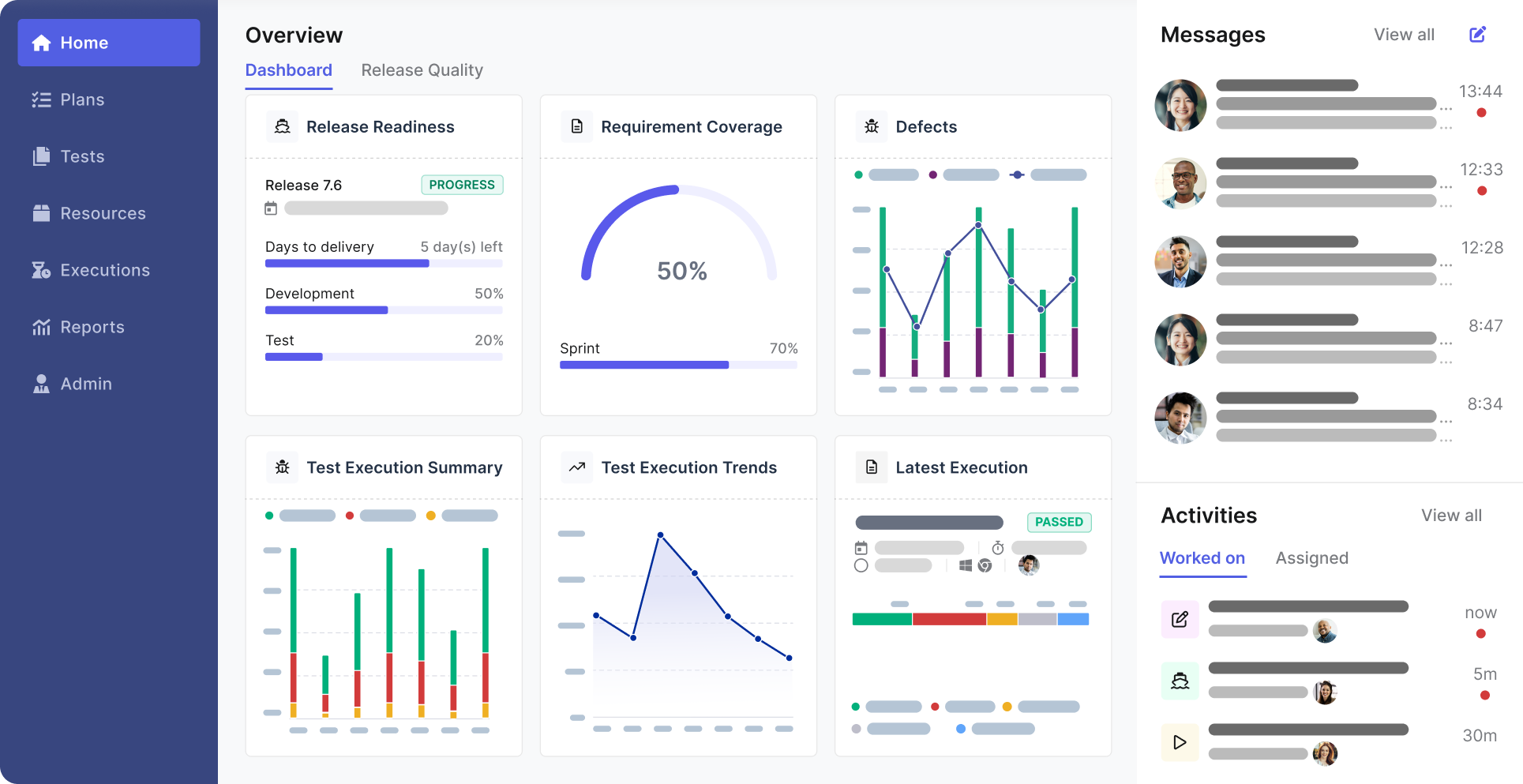
If you’ve ever struggled to keep track of hundreds or thousands of tests, TestOps will feel like a relief. It centralizes your entire testing operation so you can monitor quality trends, orchestrate executions, and maintain traceability across manual, automated, and AI-generated tests.
- End-to-end test management: Store, organize, and track every test case in one place.
- Real-time dashboards: View coverage, pass/fail rates, flaky test analytics, and requirement traceability.
- Execution orchestration: Schedule runs in CI, nightly builds, or custom event triggers.
TestCloud: On-demand execution without infrastructure overhead
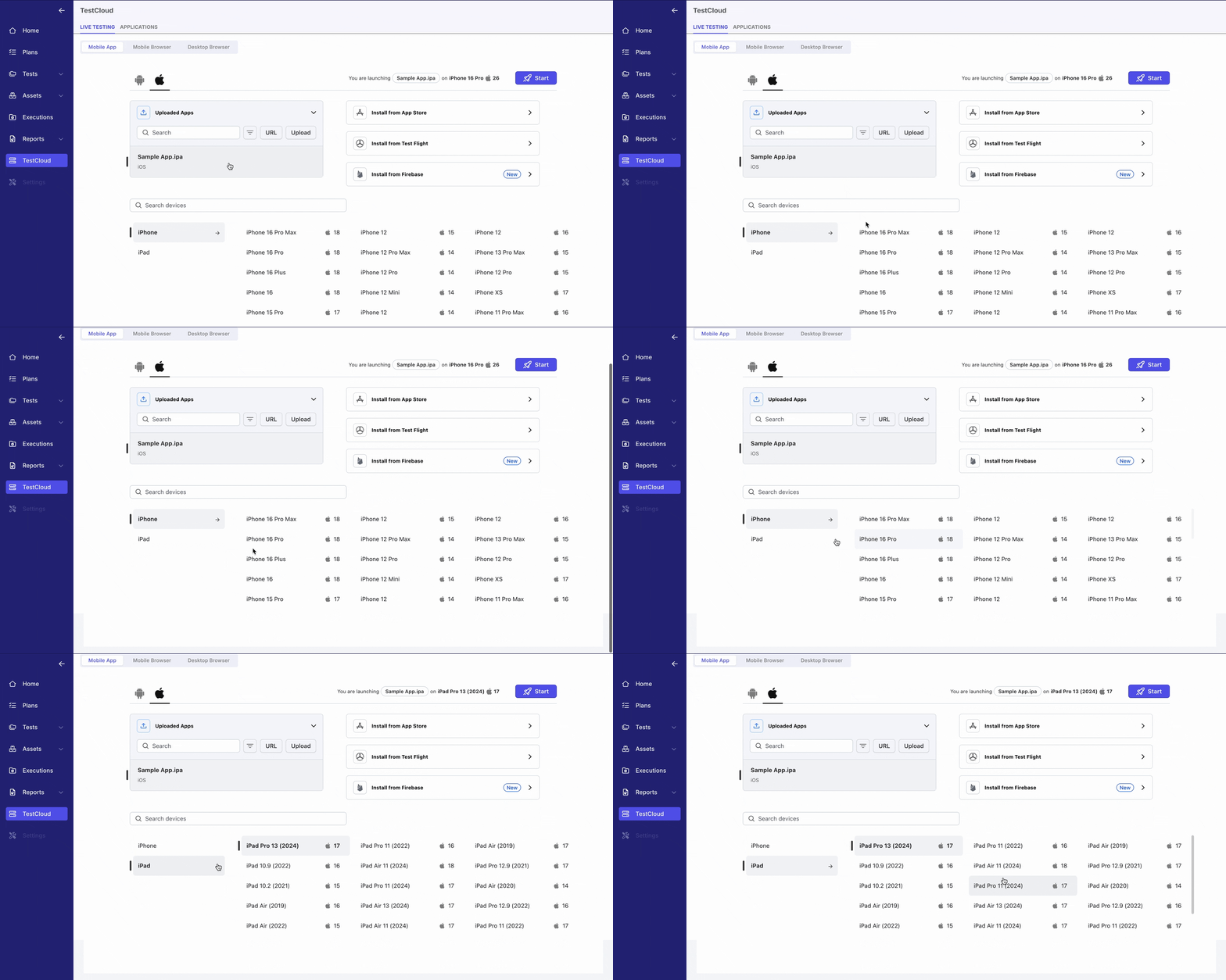
If you’re tired of maintaining device labs, TestCloud gives you instant execution environments. You can run test suites on thousands of browser-device-OS combinations without touching a single VM or emulator.
- 3,000+ real-world environments: From Chrome and Safari to Android and iOS device models.
- Flexible parallel execution: Slash regression runtime even on huge suites.
- Seamless integration: Trigger cloud runs directly from Katalon Studio or TestOps.
Put simply, the Katalon Platform offers one of the broadest and most scalable automation ecosystems available today. Whether you're managing small agile teams or enterprise-wide QA operations, Katalon gives you the tools to accelerate quality without adding complexity.
📝 Ready to see how Katalon fits your testing team? Request a personalized demo and explore the platform in action.
TestComplete advantages
TestComplete has long been positioned as a heavyweight in UI automation, especially for teams that rely heavily on desktop applications.
If your organization maintains large, complex desktop systems or legacy enterprise software that still plays a critical role in daily operations, TestComplete immediately stands out. Its biggest strength is the depth of control it provides across a wide range of application types.
Unlike tools that focus primarily on web automation, TestComplete is intentionally engineered to handle a broad spectrum: Windows desktop apps, web applications, mobile, and hybrid systems. And because it supports multiple scripting languages, you can lean into the languages your engineering team already knows, which helps reduce friction and encourages more flexible test design.
Here are the key areas where TestComplete truly shines:
- Exceptional desktop automation depth: This is where TestComplete dominates. It supports legacy, native, and complex desktop applications with strong object recognition and stable locators that remain reliable over time.
- Robust object identification engine: TestComplete’s object mapping system allows granular control of UI elements. Its ability to scan and interact with nested, dynamic, and non-standard controls is a major advantage for enterprise-grade testing.
- Multi-language scripting flexibility: Whether your team prefers JavaScript, Python, VBScript, or JScript, TestComplete allows you to build automation in the language that fits your workflow and existing frameworks.
- Powerful debugging and troubleshooting tools: Features like call stack viewing, breakpoints, visual logs, and detailed snapshots make debugging highly intuitive
- Data-driven and keyword-driven testing built in: Teams can easily scale up test coverage using reusable assets without reinventing workflows for every new suite.
- Strong integration within the SmartBear ecosystem: If you’re using Zephyr, QAComplete, or ReadyAPI, TestComplete slides into your existing pipeline neatly, forming a cohesive toolchain.
- Hybrid UI testing capabilities: TestComplete can automate desktop and web flows together, which is invaluable for applications that mix local clients with browser-based interfaces.
To highlight its diverse strengths in a compact format, here’s a quick summary of where TestComplete provides standout value:
| Area | Advantage |
|---|---|
| Desktop automation | Deep object-level control and robust support for legacy and native applications |
| Scripting flexibility | Supports multiple programming languages for custom frameworks |
| Debugging tools | Advanced debugging features streamline root-cause investigation |
| Ecosystem integration | Works seamlessly with SmartBear tools like QAComplete, Zephyr, and ReadyAPI |
| Reusable assets | Keyword-driven and data-driven testing accelerate large-scale suite development |
When viewed as a whole, TestComplete becomes especially compelling for enterprises running mission-critical desktop systems or for teams that want precise, script-driven control over their automation framework. It offers a degree of depth and flexibility that coding-oriented teams often appreciate, particularly when their QA workflows need room to evolve with technical complexity.
Katalon gaps you should know
Even though Katalon delivers a strong, cohesive automation ecosystem, it still carries a few limitations you should factor into your evaluation. These aren’t red flags as much as areas where you’ll want to set clear expectations.
Let’s unpack the areas where Katalon may feel restrictive for certain enterprise setups.
- Advanced customization often requires scripting expertise: While the platform is flexible, engineering teams building complex workflows may eventually rely on Java or Groovy. For organizations moving from fully no-code tools, this shift can extend onboarding time.
- Structured vs. Open-Source: While Katalon is highly flexible, teams that prefer assembling and maintaining a fully decoupled, build-your-own open-source stack (e.g., Selenium + TestNG + Jenkins) may find the platform’s cohesive, unified structure less customizable.
- Onboarding the Full Ecosystem: With Studio, TestOps, and TestCloud all playing distinct roles, new users may need initial guidance to fully grasp how each component fits into the unified workflow.
- License planning increases in complexity at large scale: As teams grow, deciding how many Engine, Studio, and TestCloud seats you need becomes an operational process, especially for procurement-driven enterprises.
- Limited flexibility for niche or legacy test requirements: Although Katalon covers a wide range of platforms, highly specialized enterprise legacy systems may still require custom scripting or integration workarounds.
To help you visualize how these gaps translate into real operational considerations, here’s a quick breakdown:
| Area | Limitation |
|---|---|
| Customization | May require scripting for advanced workflows or specialized frameworks |
| Adoption | New users may need guidance across Studio, TestOps, and TestCloud |
| Ecosystem fit | Less flexible for teams preferring open-source, build-your-own stacks |
| Scaling licenses | Requires careful planning to match roles, usage, and execution volume |
| Legacy systems | Older or highly bespoke applications may need manual extensions |
Overall, none of these gaps diminish Katalon’s strengths, but they do shape how you roll it out internally. The more clarity your team has around these boundaries, the easier it is to design a path that fully leverages Katalon’s capabilities without surprises down the line.
TestComplete gaps you should know
TestComplete brings plenty of power to the table, especially for teams that rely on heavy desktop automation. However, with that power comes a set of trade-offs that matter quite a bit in modern enterprise environments. Some of these gaps appear only when you scale your automation efforts significantly, while others surface the moment you try to onboard non-technical contributors.
Here are the areas where TestComplete can introduce friction or operational overhead:
- Scripting-first approach increases dependency on technical talent: Although TestComplete offers keyword-driven testing, most enterprise teams eventually rely on scripting to unlock the platform’s full capabilities. This makes it harder for non-technical testers to stay productive without engineer support.
- Desktop-focused strengths don’t always translate well to the web: While TestComplete does support web automation, its tooling and stability tend to shine far more in desktop environments.
- Significant Infrastructure Overhead: As a client-side, installed solution, TestComplete places the full burden of managing machines, licenses, upgrades, and execution nodes directly onto your internal infrastructure team. This increases Total Cost of Ownership (TCO) and operational complexity compared to more cloud-centric platforms.
- Cumbersome Distributed Execution: Scaling tests in parallel across environments often requires extensive setup and hardware planning, as the platform was not built for cloud-native execution.
- Higher maintenance burden for large suites: The deeper your scripts become, the more you’ll rely on careful structuring and regular refactoring. Without this discipline, suites can become brittle quickly.
- Steeper learning curve for new team members: Engineers may adapt quickly, but newer QA staff or manual testers often need weeks to become comfortable with TestComplete’s scripting workflows and UI object manipulation.
To help you visualize where these gaps matter most, here’s a quick breakdown of the practical impact:
| Area | Gap |
|---|---|
| Test authoring | Scripting-heavy workflows limit non-technical contributor involvement |
| Platform focus | Web automation support is functional but less stable than desktop automation |
| Infrastructure | Local installations require ongoing hardware and environment management |
| Scaling | Distributed execution demands additional setup and maintenance |
| Maintenance | Large suites become harder to sustain without consistent refactoring |
| Onboarding | New QA members face a steep learning curve before becoming productive |
For engineering-heavy teams with strong scripting expertise, these gaps may not feel too restrictive. But if your QA organization includes a mix of technical and non-technical contributors—or if you’re aiming to scale automation fast without extra infrastructure—these limitations become important factors in your decision-making.
Katalon vs TestComplete: Side-by-side comparison
When you look at Katalon and TestComplete side by side, the contrast becomes much clearer. Both tools aim to support enterprise automation at scale, yet they come from very different design philosophies. Katalon focuses on providing a unified, cloud-ready platform with AI layered throughout the lifecycle, while TestComplete leans heavily into deep control, scripting flexibility, and exceptional desktop automation.
If your QA organization needs to support a wide range of applications—from modern web and mobile to legacy desktop systems—both tools can deliver value. The difference lies in how they help you get there and who on your team can be productive with them. To make your evaluation easier, we’ve broken the comparison into the categories that matter most for enterprise teams evaluating long-term automation strategy.
| Category | Katalon | TestComplete |
|---|---|---|
| Test creation | Hybrid low-code plus scripting; strong built-in frameworks for web, mobile, API, and desktop | Scripting-heavy with rich support for JavaScript, Python, VBScript; strong for desktop UI flows |
| Platform coverage | Unified automation across modern web, mobile, APIs, and desktop apps | Best-in-class desktop automation; web support present but less robust for complex modern UIs |
| AI capabilities | AI-powered locator healing and TrueTest for regression intelligence | Minimal AI assistance; relies primarily on scripting and manual maintenance |
| Execution scalability | TestCloud enables distributed, parallel, and cloud-native execution across 3,000+ environments | Local or on-prem execution; scaling requires additional hardware and configuration |
| Analytics & reporting | Deep dashboards in TestOps: trends, flaky test detection, test health, and coverage insights | Functional reporting; fewer advanced analytics and lifecycle insights compared to Katalon |
| Scripting flexibility | Supports customization but maintains a structured, guided environment | Highly flexible for engineers; ideal for building custom frameworks and granular automation flows |
| Team fit | Great for mixed-skill teams; easier onboarding for non-technical testers | Ideal for engineering-heavy teams with strong scripting expertise |
| Best for | Organizations seeking unified automation, AI-enhanced workflows, and scalable cloud execution | Enterprises with mission-critical desktop applications and a preference for script-driven control |
What this comparison makes clear is that the “better” tool depends entirely on the shape of your environment. If you want a platform that removes infrastructure overhead, brings AI into everyday testing, and supports modern application stacks, Katalon is the stronger fit. But if your automation roadmap revolves around large, complex desktop systems and you have the engineering muscle to support scripting-heavy frameworks, TestComplete offers capabilities that few tools can match.
|
