.svg)



When you’re scaling test automation across different teams, tools, and release cycles, the biggest question isn’t just what to automate, it’s where automation should live. That’s exactly why Katalon and BrowserStack so often enter the same conversation. They sit at two very different layers of the QA stack, yet both play a critical role in helping you deliver high-quality software at speed.
Katalon gives you a unified platform to build, organize, and analyze automated tests. BrowserStack, on the other hand, ensures those tests run reliably across thousands of real browsers and devices without the burden of maintaining infrastructure. Understanding how these tools complement each other (and where they differ) helps you make smarter decisions about your testing architecture.
In this guide, we’ll walk you through:
- Where Katalon provides advantages for full end-to-end automation
- Where BrowserStack excels as a scalable execution environment
- The key limitations each tool brings to an enterprise workflow
- A clean, side-by-side comparison to help you choose the right fit
Let’s dive in!
Katalon advantages you should know

When we compare Katalon to BrowserStack, we’re really comparing two fundamentally different layers of the QA stack. That’s exactly why Katalon’s advantages stand out so clearly.
Katalon is not just a place to run tests, it’s the platform where your entire testing lifecycle begins. If you’re looking to unify creation, execution, reporting, and analytics under one roof, Katalon gives you a structure that removes a massive amount of operational drag.
You’ll notice this especially as your team grows. Instead of juggling multiple frameworks and dashboards, Katalon centralizes everything. Your test assets, your execution history, your quality metrics, your governance rules, everything. This level of consolidation is often the turning point for enterprises trying to scale automation without losing speed.
Here are the advantages that consistently resonate with QA teams:
- Complete end-to-end testing platform: Katalon covers web UI, API, mobile, and desktop automation in a single ecosystem. BrowserStack, by design, focuses on device and browser execution rather than test creation.
- Faster onboarding and productivity: Built-in frameworks, reusable keywords, and an intuitive IDE help testers ramp up quickly without constructing a framework from scratch.
- AI-powered automation support: Features like self-healing locators and AI-generated test suggestions significantly reduce maintenance overhead, especially in rapidly evolving applications.
- Centralized analytics through TestOps: You get dashboards, coverage views, flaky-test detection, and requirement traceability in one place, so your teams can track quality with clarity.
- Scalable cloud execution with TestCloud: Katalon gives you a cloud execution layer built into the platform itself, removing the friction normally associated with configuring external grids.
- Designed for mixed-skill QA teams: Whether you’re onboarding manual testers, empowering SDETs, or aligning distributed teams, Katalon supports a hybrid workflow that keeps everyone productive.
To help illustrate how much functional ground Katalon covers compared to execution-only tools, here’s a concise snapshot:
| Testing capability | Katalon coverage |
|---|---|
| Web and mobile UI automation | Full creation, execution, validation, and maintenance workflows |
| API testing | Assertions, chaining, environments, data-driven flows, and CI integration |
| Analytics and reporting | Dashboards, trend insights, requirement maps, and flaky-test detection |
| Cloud execution | Native execution grid with parallelization and device/browser distribution |
AI that does the heavy lifting for you
Katalon is also one of the first platforms to embed AI directly into the testing lifecycle. The AI-driven capabilities simplify maintenance and expand your coverage without adding more manual work.
- Automatic test maintenance: AI detects locator changes and helps you fix test objects before they break.
- TrueTest for AI-generated regression testing: TrueTest analyzes real user behavior in production and generates regression tests automatically.
- Smart analytics in TestOps: Identify flaky tests, detect hidden risks, and pinpoint failure patterns faster.
TestOps: Visibility and control at enterprise scale
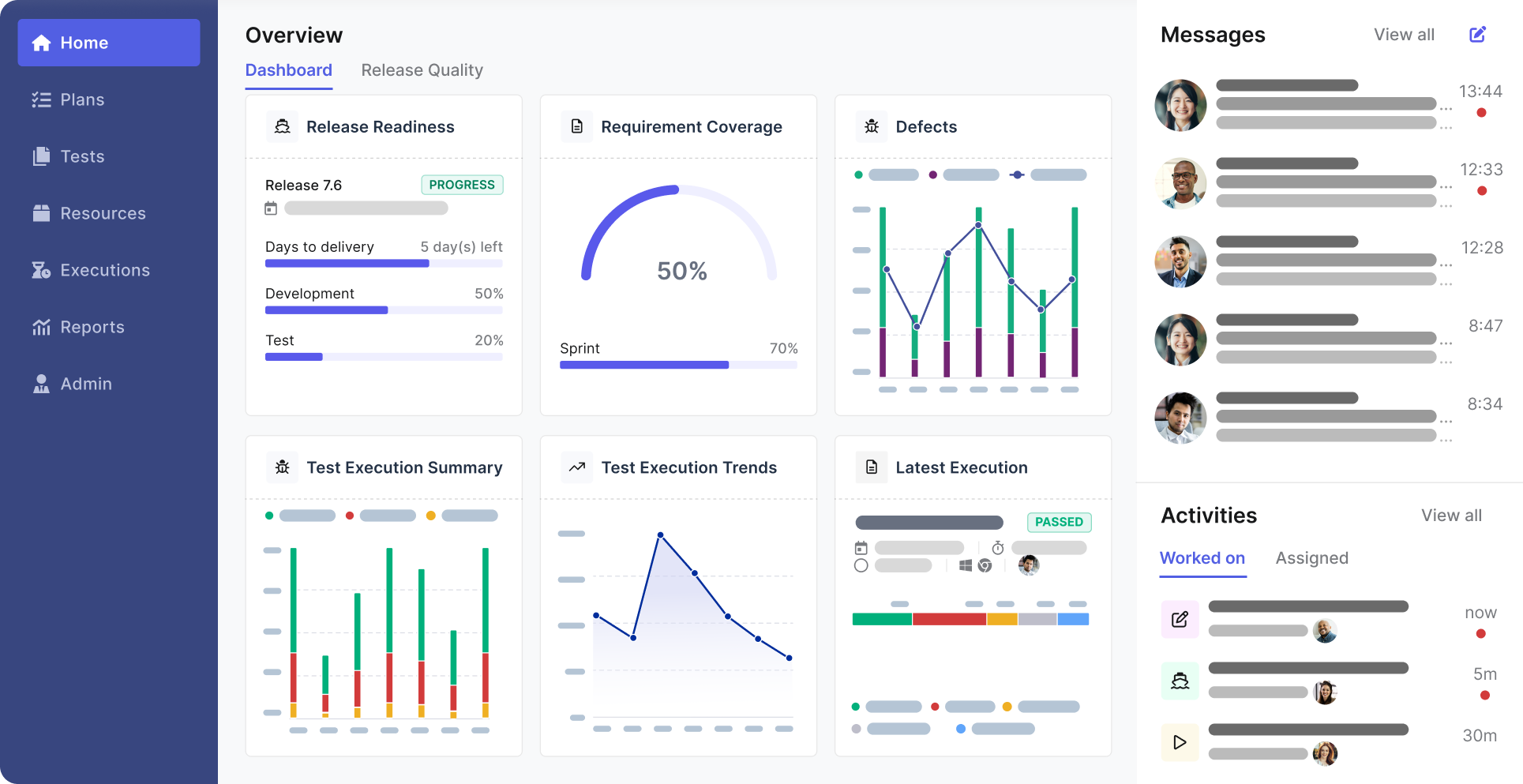
If you’ve ever struggled to keep track of hundreds or thousands of tests, TestOps will feel like a relief. It centralizes your entire testing operation so you can monitor quality trends, orchestrate executions, and maintain traceability across manual, automated, and AI-generated tests.
- End-to-end test management: Store, organize, and track every test case in one place.
- Real-time dashboards: View coverage, pass/fail rates, flaky test analytics, and requirement traceability.
- Execution orchestration: Schedule runs in CI, nightly builds, or custom event triggers.
TestCloud: On-demand execution without infrastructure overhead
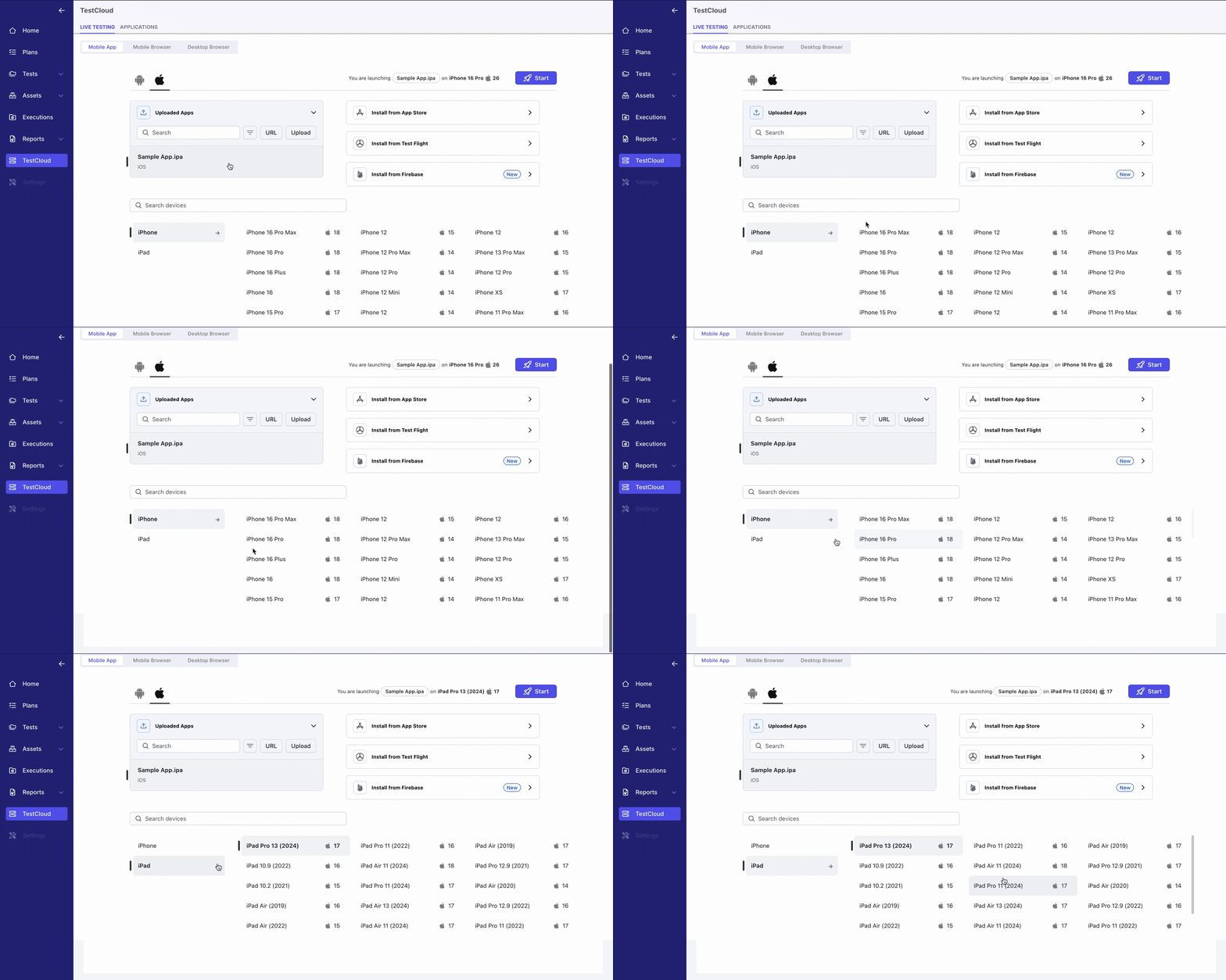
If you’re tired of maintaining device labs, TestCloud gives you instant execution environments. You can run test suites on thousands of browser-device-OS combinations without touching a single VM or emulator.
- 3,000+ real-world environments: From Chrome and Safari to Android and iOS device models.
- Flexible parallel execution: Slash regression runtime even on huge suites.
- Seamless integration: Trigger cloud runs directly from Katalon Studio or TestOps.
Put simply, the Katalon Platform offers one of the broadest and most scalable automation ecosystems available today. Whether you're managing small agile teams or enterprise-wide QA operations, Katalon gives you the tools to accelerate quality without adding complexity.
📝 Ready to see how Katalon fits your testing team? Request a personalized demo and explore the platform in action.
BrowserStack advantages
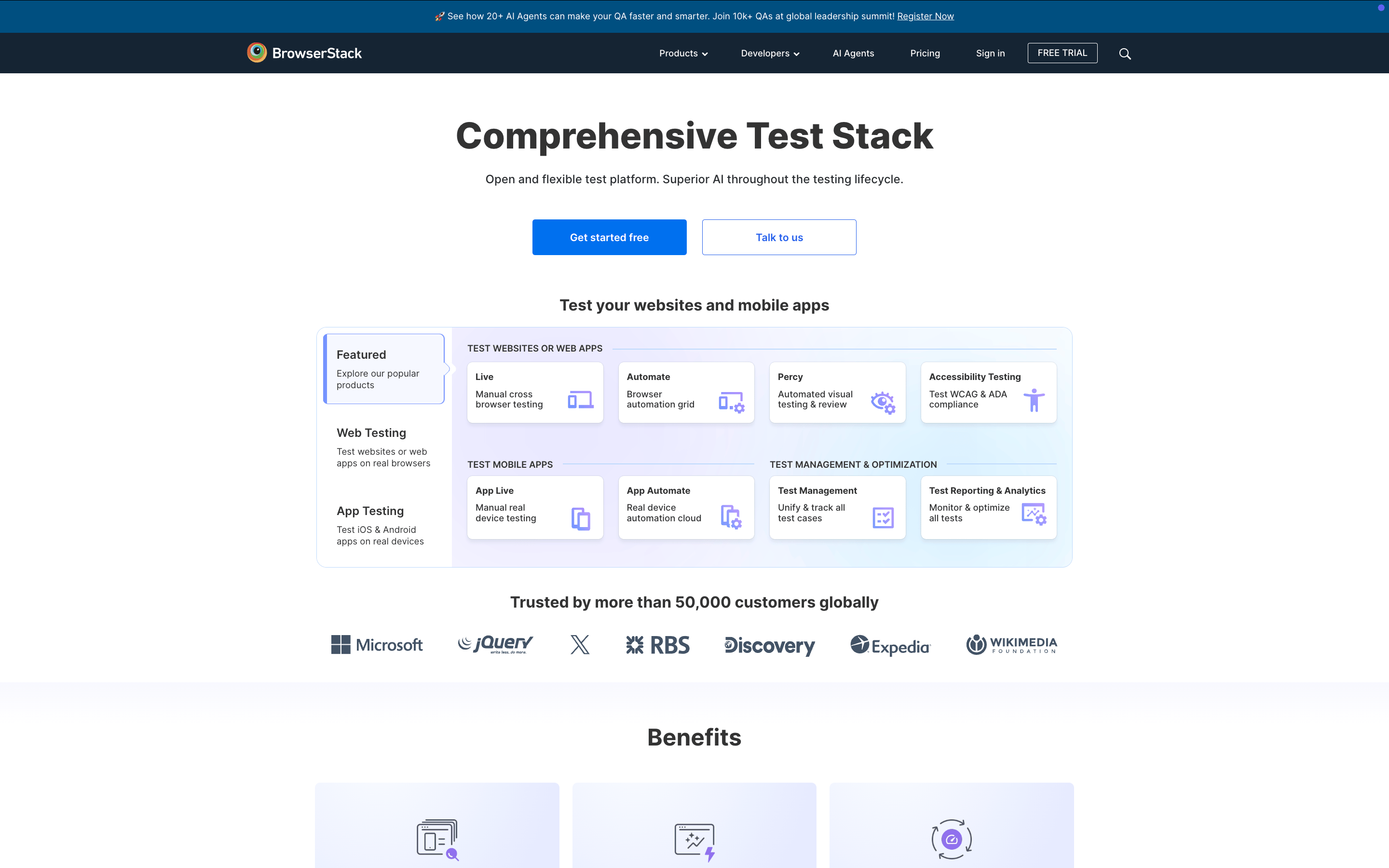
BrowserStack has become one of the most trusted names in the testing ecosystem because it tackles a problem every QA team faces: how do you test across the sheer variety of real browsers, devices, operating systems, and network conditions your users experience? Instead of investing in physical device labs and endless maintenance, BrowserStack gives you instant access to a massive cloud of real environments, ready the moment you need them.
If your team is scaling test coverage or supporting multiple platforms, this reliability becomes a game-changer. You no longer guess how your app behaves on specific iOS versions or obscure Android devices; you validate directly on real hardware. And for enterprise teams juggling multiple squads and pipelines, that level of certainty is priceless.
Here are the advantages that stand out most for modern QA organizations:
- Unmatched device and browser coverage: With thousands of real devices, operating systems, and browser versions, BrowserStack removes the burden of maintaining an internal device fleet. Your tests run exactly where your users are.
- Real-device testing for mobile apps: You can upload your .apk or .ipa files and immediately run tests on actual phones, not emulators or simulators, which makes mobile regression cycles dramatically more accurate.
- Smooth integration with your automation frameworks: Whether you're using Selenium, Playwright, Appium, Cypress, or Katalon, BrowserStack plugs directly into your pipeline so your existing tests can run at cloud scale.
- Enterprise-grade security and compliance: Role-based access, secure tunnels, SSO, IP whitelisting, and SOC2 compliance give enterprises the confidence to run sensitive test scenarios in the cloud.
- Easy debugging with rich artifacts: Session videos, screenshots, logs, console outputs, and device insights help accelerate triage, especially when troubleshooting cross-platform issues.
- Minimal infrastructure overhead: No servers to maintain, no VMs to configure, no devices to update. BrowserStack handles all the operational complexity behind the scenes.
- Live testing for exploratory workflows: Beyond automation, BrowserStack also supports manual, on-demand testing so product teams, designers, and stakeholders can validate real-world behavior instantly.
To help put this into perspective, here’s a simple snapshot of BrowserStack’s primary strengths compared to local or in-house device labs:
| Capability | BrowserStack advantage |
|---|---|
| Device coverage | Thousands of real devices instantly available without maintenance |
| Browser diversity | Comprehensive browser/OS/version combinations ready for automated and live testing |
| Infrastructure cost | No in-house device lab needed; infrastructure fully managed by BrowserStack |
| Debugging speed | Video recordings, logs, and screenshots accelerate root-cause analysis |
At its core, BrowserStack excels not by competing with test creation platforms like Katalon, but by supercharging them. It gives you the execution power and environment fidelity you need to validate behavior across real-world devices without drowning your team in hardware upkeep. For any organization serious about cross-platform confidence, BrowserStack becomes an essential pillar of the testing ecosystem.
Katalon gaps you should know
Even though Katalon offers a powerful, end-to-end testing ecosystem, it’s only fair that we acknowledge the moments where your team might feel some friction. These aren’t deal-stoppers, but they’re nuances worth keeping in mind as you evaluate how Katalon fits into your broader QA architecture — especially when BrowserStack sits at the execution layer and doesn’t have the same expectations around authoring or orchestration.
Here are the gaps most teams should be aware of:
- Best when used as a full ecosystem: Studio, TestOps, and TestCloud are designed to work together. While you can adopt them independently, the platform delivers its strongest value when all layers are in play, which may not align with teams wanting modular adoption.
- Advanced debugging expectations: Engineers who want deep, IDE-level debugging hooks may feel limited at times. Katalon offers logs, snapshots, and traceability, but not the low-level introspection available in custom-built automation stacks.
- More prescriptive workflows: Katalon’s structure greatly benefits cross-functional QA teams, but organizations that pride themselves on homegrown, flexible automation frameworks may experience friction adapting to opinionated patterns.
These gaps don’t diminish Katalon’s strength, they simply reinforce its identity. It’s a comprehensive testing platform that unifies your automation strategy. But for teams that want a bare-metal, code-first toolkit or prefer building frameworks internally, Katalon may feel more structured than necessary. Knowing this upfront helps you adopt the platform with the right expectations.
BrowserStack gaps
BrowserStack solves a very specific and painful problem for QA teams: maintaining reliable access to real devices and browsers. However, because it is fundamentally an execution platform rather than a full test automation solution, there are natural gaps you’ll feel once you start relying on it day to day. These gaps don’t make BrowserStack a weak product, but they do shape how you should position it inside your overall testing strategy.
Let’s walk through the most important limitations you should keep in mind as you compare it with a platform like Katalon.
- No built-in test authoring framework: BrowserStack doesn’t provide its own way to design or structure automated tests. You still need a separate framework or platform (such as Katalon, Selenium-based frameworks, or Cypress) to create and manage your test logic.
- Limited test management and analytics: While you get useful run-level insights, BrowserStack does not act as a central test management hub. It doesn’t track requirements, test cases, or coverage in the same way a dedicated test platform does.
- Cost scales with usage and concurrency: As teams add more suites, more parallel sessions, and more environments, subscription and usage costs can increase quickly. For large enterprises, this needs active monitoring and budgeting.
- Network and latency sensitivity: Because everything runs in the cloud, unstable network conditions or high latency between your CI environment and BrowserStack can occasionally impact execution speed and reliability.
- Dependency on external frameworks for advanced workflows: Features such as AI-assisted maintenance, complex data-driven scenarios, or cross-layer reporting must come from your automation framework, not BrowserStack itself.
- Learning curve for optimal configuration: While it’s easy to get started, squeezing the most value out of BrowserStack
To make these trade-offs easier to see, here’s a quick summary of where teams often feel the gaps most strongly:
| Area | What’s missing by design | Impact on your team |
|---|---|---|
| Test creation | No native authoring, no test case modeling | You must rely on external frameworks or platforms to design and organize tests |
| Reporting & governance | No end-to-end coverage analytics or requirement traceability | Harder to answer leadership questions about overall quality trends from BrowserStack alone |
| Cost structure | Pricing tied to concurrency, team size, and usage | Requires ongoing cost management as automation scales across teams |
| Execution dependency | Runs entirely over the network in BrowserStack’s cloud | Test stability can be influenced by network conditions and external system health |
In short, BrowserStack is excellent at what it is built for: providing fast, reliable access to real devices and browsers. It’s not intended to replace a full-featured automation platform like Katalon. The strongest QA strategies typically treat BrowserStack as the execution backbone and pair it with a platform that handles test design, management, AI assistance, and analytics at scale.
Katalon vs BrowserStack: Side-by-side comparison
When we place Katalon and BrowserStack next to each other, the first thing that becomes obvious is this: they solve two very different pieces of the quality puzzle.
Katalon focuses on the creation, management, and analysis of automated tests. BrowserStack focuses on executing those tests across thousands of real browsers and devices. Together, they form a powerful testing stack, but only if you understand where each one shines.
To help you see the distinctions clearly, here’s a structured comparison table that lays out capabilities, strengths, and ideal use cases side by side. Think of it as your quick decision guide whenever your team evaluates how these two tools should fit into your QA workflow.
| Category | Katalon | BrowserStack |
|---|---|---|
| Primary purpose | Test authoring, orchestration, analytics, and maintenance | Cloud execution on real browsers and real devices |
| Test types supported | UI, API, mobile, desktop, and data-driven workflows | Web and mobile execution environments; no test authoring |
| Automation experience | Low-code + full-code support, reusable assets, AI assistance | Runs existing automation written in external tools or frameworks |
| Execution scale | Parallel execution via TestCloud and local/remote environments | Massive execution grid of real devices, OSs, and browsers |
| Reporting & analytics | Central dashboards, traceability, flaky-test detection, insights | Session-level artifacts (video, logs, screenshots); no end-to-end analytics |
| Skill requirements | Supports mixed-skill teams across QA and engineering | Requires external automation frameworks and scripting skills |
| Best for | Organizations needing a unified automation+management platform | Teams needing reliable, scalable real-device execution |
When you step back and look at this comparison, an important pattern emerges: Katalon and BrowserStack don’t replace each other, they reinforce each other. Katalon handles the strategic layer of automation, from test design to analytics, while BrowserStack amplifies your execution coverage with unparalleled environment diversity.
If you’re building an enterprise-grade testing ecosystem, the real power comes from pairing them. Katalon gives you the brains of the operation; BrowserStack gives you the muscle. Together, they help you deliver higher-quality releases in less time, with fewer blind spots along the way.

|
