.svg)



When teams begin evaluating enterprise automation platforms, the comparison between Katalon and ACCELQ almost always comes up. Both promise faster automation, reduced maintenance, and a friendlier experience for non-technical testers, but they take fundamentally different paths to get there.
Katalon gives you a unified ecosystem for building, organizing, and scaling automation across UI, API, mobile, and desktop applications. ACCELQ, on the other hand, leans heavily into its cloud-native, codeless approach, making automation creation feel more like modeling business workflows than writing scripts.
In this guide, we’ll help you see the distinctions clearly. You’ll discover:
- Where Katalon delivers advantages for cross-functional QA and engineering teams
- Where ACCELQ stands out with its modeling-driven automation approach
- The key gaps that matter when choosing between both tools
- A side-by-side comparison to help you make a confident decision
Let’s dive in!
Katalon advantages as a comprehensive testing platform

Katalon stands out as a unified, purpose-built automation platform that supports you across every layer of the testing lifecycle.
What makes it especially compelling when compared to ACCELQ is how it blends low-code simplicity with the depth and flexibility enterprise engineering teams expect.
With Katalon, you’re essentially getting a full ecosystem designed to help teams build, maintain, execute, and scale automation without fragmentation.
Here are the strengths that matter most for enterprise QA teams:
- End-to-end automation in one platform: Katalon supports UI, API, mobile, and desktop automation natively, giving you a single tool to cover functional testing across your entire application stack.
- Low-code when you want it, full-code when you need it: Manual testers can work visually, while automation engineers can extend tests using Groovy, Java, or custom libraries. You’re never locked into one style.
- AI-driven maintenance and productivity: Self-healing locators, intelligent suggestions, and automated regression capabilities reduce the heavy maintenance burden large suites typically suffer from.
- Integrated TestOps for centralized insights: Real-time dashboards, historical trends, requirement traceability, and flaky-test detection help you understand quality at scale — something scripting-only or codeless-only tools can’t fully deliver.
- Native cloud execution with TestCloud: Instead of configuring external device grids, Katalon gives you plug-and-play cloud execution for browsers, devices, and OS versions right inside the platform.
- Enterprise-ready workflows: Role-based access, audit trails, parallel execution, CI/CD integrations, and environment orchestration help teams operate with consistency and control.
- Designed for collaboration: Mixed-skill teams can share object repositories, test suites, data sets, and execution analytics without switching tools — keeping everyone aligned and productive.
To visualize the breadth of coverage, here’s a quick snapshot of Katalon’s core automation capabilities:
| Testing area | Katalon capability |
|---|---|
| Web UI | Record-playback, low-code authoring, scripting, reusable keywords, AI maintenance |
| API | REST, SOAP, GraphQL support, chaining, assertions, test data parameterization |
| Mobile | Native and hybrid app automation via Appium, device cloud execution |
| Desktop | Built-in WinAppDriver support for legacy and enterprise desktop apps |
| Analytics | Trends, coverage insights, flaky-test analysis, test suite optimization |
AI that does the heavy lifting for you
Katalon is also one of the first platforms to embed AI directly into the testing lifecycle. The AI-driven capabilities simplify maintenance and expand your coverage without adding more manual work.
- Automatic test maintenance: AI detects locator changes and helps you fix test objects before they break.
- TrueTest for AI-generated regression testing: TrueTest analyzes real user behavior in production and generates regression tests automatically.
- Smart analytics in TestOps: Identify flaky tests, detect hidden risks, and pinpoint failure patterns faster.
TestOps: Visibility and control at enterprise scale
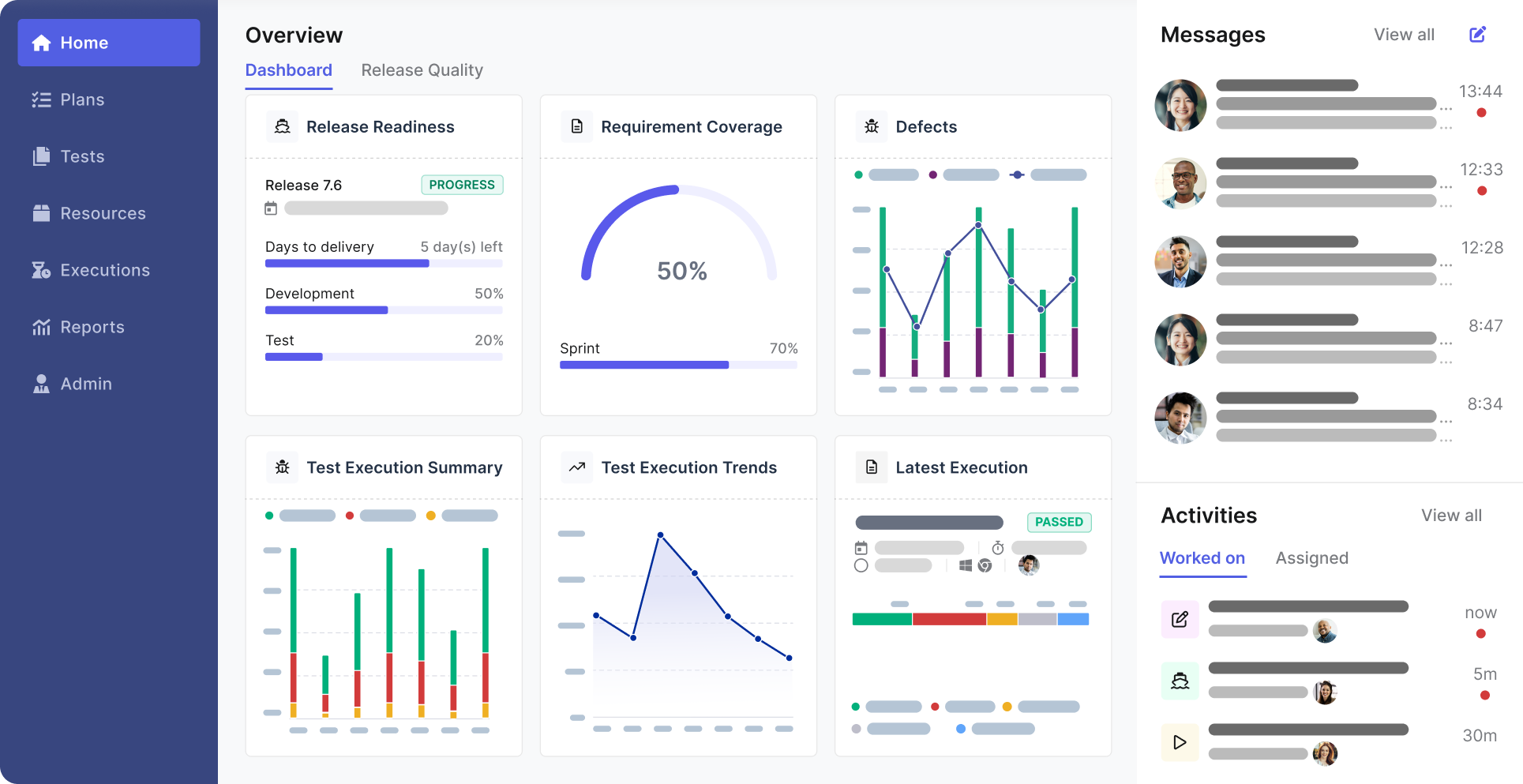
If you’ve ever struggled to keep track of hundreds or thousands of tests, TestOps will feel like a relief. It centralizes your entire testing operation so you can monitor quality trends, orchestrate executions, and maintain traceability across manual, automated, and AI-generated tests.
- End-to-end test management: Store, organize, and track every test case in one place.
- Real-time dashboards: View coverage, pass/fail rates, flaky test analytics, and requirement traceability.
- Execution orchestration: Schedule runs in CI, nightly builds, or custom event triggers.
TestCloud: On-demand execution without infrastructure overhead
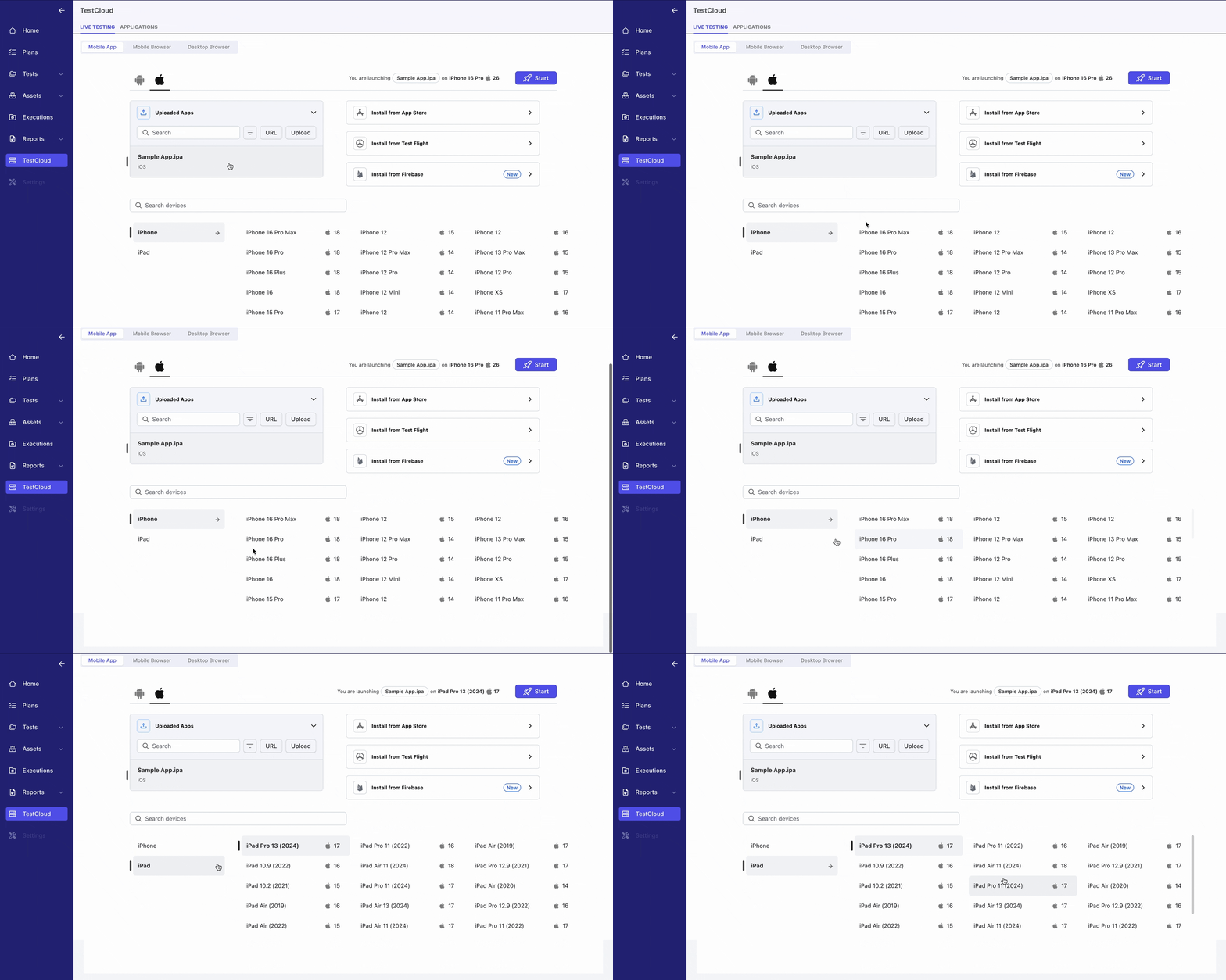
If you’re tired of maintaining device labs, TestCloud gives you instant execution environments. You can run test suites on thousands of browser-device-OS combinations without touching a single VM or emulator.
- 3,000+ real-world environments: From Chrome and Safari to Android and iOS device models.
- Flexible parallel execution: Slash regression runtime even on huge suites.
- Seamless integration: Trigger cloud runs directly from Katalon Studio or TestOps.
Put simply, the Katalon Platform offers one of the broadest and most scalable automation ecosystems available today. Whether you're managing small agile teams or enterprise-wide QA operations, Katalon gives you the tools to accelerate quality without adding complexity.
📝 Ready to see how Katalon fits your testing team? Request a personalized demo and explore the platform in action.
ACCELQ advantages
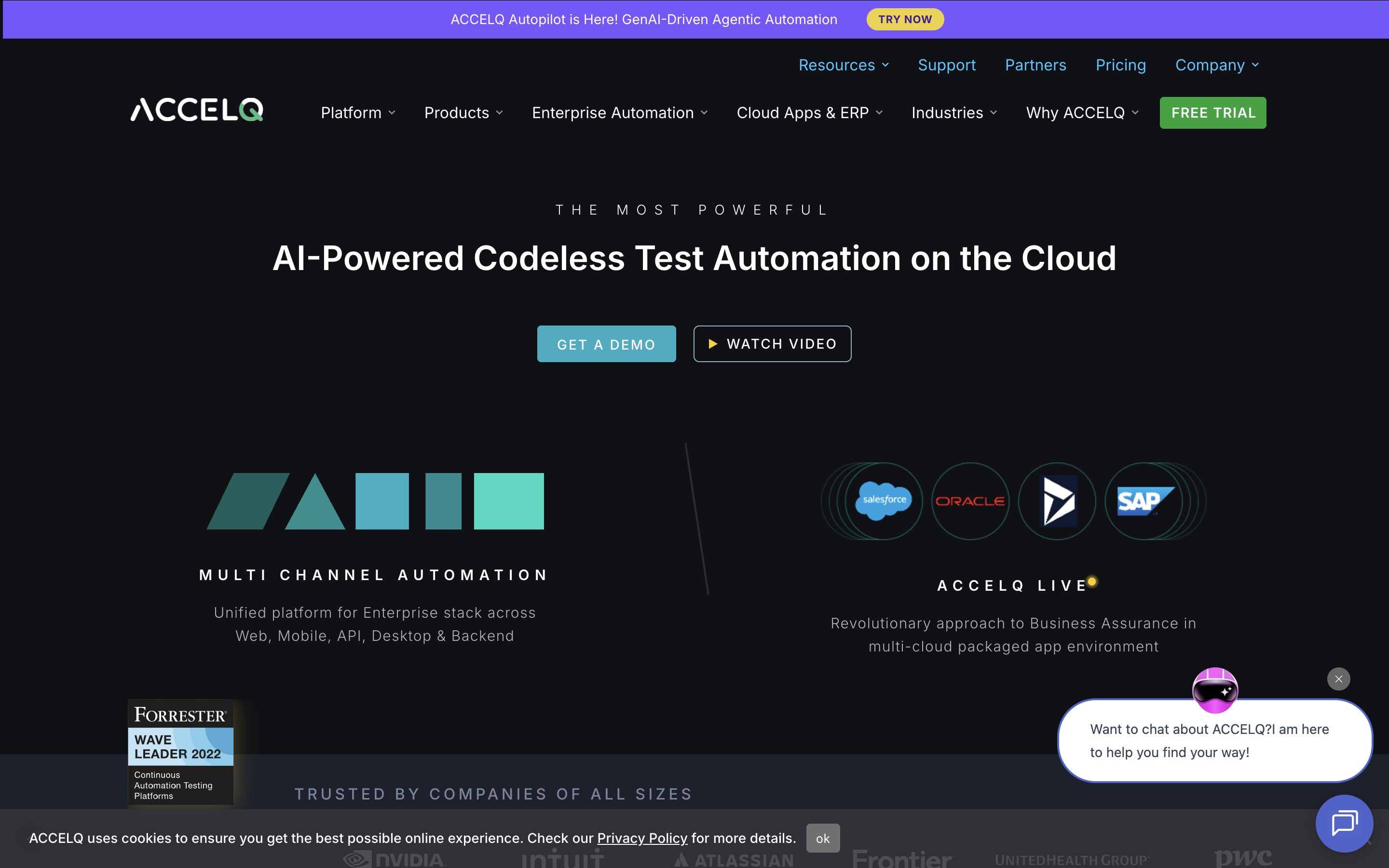
ACCELQ has carved out a strong position in the automation market by focusing on a very specific promise: bringing codeless, business-friendly automation to the cloud without sacrificing depth.
While Katalon blends low-code with scripting flexibility, ACCELQ leans fully into natural-language modeling and reusable workflows, a direction that resonates with teams that want fast onboarding and minimal technical overhead.
Because ACCELQ abstracts so much of the underlying framework complexity, many QA teams find that they can build automation faster, share test logic more effectively, and streamline cross-team collaboration without managing scripts or infrastructure. This becomes especially useful in organizations where business analysts, product owners, and manual testers need to take an active role in test creation.
Here are the advantages that stand out most for ACCELQ users:
- Powerful codeless automation engine: ACCELQ’s natural-language modeling lets teams create test flows using business terminology rather than code. This helps non-technical testers contribute meaningfully without relying on automation engineers.
- Cloud-native from the ground up: All authoring, execution, and reporting workflows happen in the cloud. There’s no local setup, no dependency management, and no infrastructure to maintain — which accelerates onboarding for distributed teams.
- Reusable action libraries: ACCELQ’s modular action-based design allows you to build reusable components that represent business processes. This architecture helps reduce duplication and speeds up long-term maintenance.
- Strong support for complex enterprise applications: The platform has specific strengths around Salesforce, SAP, mainframes, and packaged applications, thanks to specialized accelerators and domain-focused automation templates.
- Integrated API, web, and mobile testing: While ACCELQ positions itself primarily as a codeless platform, it still supports multi-layer testing across channels, allowing you to centralize functional automation under one conceptual model.
For quick clarity, here’s a snapshot of the areas where ACCELQ tends to shine most:
| Strength area | Why it stands out |
|---|---|
| Codeless automation | Natural-language authoring and modeling reduce technical barriers |
| Cloud-native platform | Zero setup and centralized collaboration streamline operations |
| Reusable business actions | Speeds up long-term maintenance and supports modular automation |
| Enterprise app support | Prebuilt accelerators for Salesforce, SAP, and mainframes simplify complex automation |
ACCELQ ultimately excels when teams prioritize ease of use, business-aligned automation, and cloud-first workflows. If your organization leans heavily toward non-technical authors or operates across complex enterprise systems, ACCELQ offers an intuitive path to scaling automation quickly and collaboratively.
Katalon gaps teams should know
As with any platform that tries to balance low-code simplicity and engineering-level extensibility, there are natural trade-offs. These gaps don’t diminish its strengths; they simply highlight where certain teams may feel friction depending on how deeply they prefer to customize their automation workflows.
As you assess how Katalon aligns with your organization, here are the limitations worth keeping in mind:
- Some teams may want full custom frameworks: Because Katalon provides opinionated structures out of the box, engineering-heavy teams used to building frameworks from scratch may find the platform more constraining than code-only toolchains. However, always note that Katalon does allow teams to customize scripts.
- Best suited as a complete ecosystem: While each component (Studio, TestOps, TestCloud) can be used independently, Katalon’s real value emerges when the entire ecosystem is adopted. Teams seeking highly modular, mix-and-match architectures may prefer a more granular toolchain.
- Debugging expectations may differ from traditional IDEs: Developers accustomed to deep, step-through debugging inside a pure code IDE may feel limited compared to debugging flows in platforms like IntelliJ or VS Code.
Ultimately, these gaps reflect the trade-off that comes with any structured platform: you gain speed, consistency, and maintainability, but you sacrifice some of the raw flexibility of build-it-yourself frameworks. For most enterprise QA teams, that trade-off is favorable — but it’s still important to understand it clearly before choosing your foundation.
ACCELQ gaps teams should know
While ACCELQ brings a refreshing, highly abstracted approach to automation, there are several areas where teams often encounter friction.
Because ACCELQ hides much of the underlying framework, you’ll notice that the trade-offs lean heavily toward limitations in flexibility, extensibility, and ecosystem breadth. Teams moving from script-based tools sometimes find themselves boxed in by the very abstraction that makes the platform easy to adopt.
Here are the gaps most frequently reported by users and enterprise QA teams:
- Limited scripting extensibility: ACCELQ’s codeless design is its strength, but it also limits how deeply you can customize test logic or integrate custom frameworks. Teams that rely on advanced scripting patterns may feel constrained.
- Higher learning curve for complex modeling: Simpler test flows are easy to build, but once you expand into multi-layered, conditional, or data-heavy scenarios, the visual modeling approach becomes harder to manage at scale.
- Dependence on ACCELQ-specific concepts: Because ACCELQ uses a proprietary modeling language and action architecture, skills developed on the platform are not easily transferable to other automation tools or frameworks.
- Less flexibility for hybrid teams: Organizations that mix technical engineers with non-technical testers may find the platform limiting, since engineers can’t drop into raw code to optimize or troubleshoot complex flows.
- Narrower ecosystem and community: Compared to broader industry tools, the ACCELQ community is smaller. This means fewer tutorials, third-party plugins, example repositories, and peer-to-peer knowledge resources.
To make these gaps easier to digest, here’s a concise comparison of the platform’s main limitations:
| Gap area | Where teams feel the pain |
|---|---|
| Scripting limitations | Hard to extend automation logic beyond the platform’s visual model |
| Model complexity | Large flows become visually dense and harder to maintain |
| Proprietary ecosystem | Less portability of skills and limited third-party integrations |
| Debug depth | Reduced transparency into how actions translate to actual automation |
Ultimately, ACCELQ is strongest when simplicity and accessibility are the priorities. But for engineering-driven teams, or teams that expect high degrees of customization, these gaps can create friction over time.
Katalon vs ACCELQ: Side-by-side comparison
When you put Katalon and ACCELQ next to each other, you’re essentially comparing two very different philosophies of test automation. One gives you a blended low-code plus full-code environment that scales comfortably with both technical and non-technical teams. The other leans into a highly abstracted, model-driven approach that removes complexity for beginners but can feel limiting once your automation estate becomes more sophisticated.
To help you see the contrasts clearly, we’ve mapped out how both platforms perform across the dimensions that matter most to enterprise QA leaders.
| Category | Katalon | ACCELQ |
|---|---|---|
| Automation approach | Hybrid testing model with low-code, full-code, and built-in frameworks. | Fully model-based and codeless, optimized for visually driven workflows. |
| Supported testing types | Web, API, mobile, desktop, data-driven, BDD, and packaged apps. | Primarily web, API, and packaged enterprise apps like Salesforce. |
| Scalability | Highly scalable with TestCloud, CI/CD orchestration, and flexible execution options. | Scales well for simple use cases but becomes heavier to maintain as logic grows. |
| Customization | Deep customization with scripting, plugins, keywords, and reusable components. | More restricted; relies on platform-prescribed modeling patterns. |
| Maintenance efficiency | Self-healing, smart locators, reusable artifacts, and analytics help reduce upkeep. | Auto-updates work well for simple flows, but complex models require hands-on adjustments. |
| Learning curve | Approachable for beginners; provides room for engineers to grow deeper. | Fast for simple tests but steeper once advanced modeling begins. |
| Ecosystem & community | Large ecosystem, active community, and extensive learning resources. | Smaller ecosystem with limited third-party support and fewer tutorials. |
When we zoom out, the distinction becomes clearer. Katalon is engineered for teams who want flexibility, extended control, and room to evolve. ACCELQ, in contrast, focuses on abstracting complexity for organizations that value simplicity and rapid onboarding above all else.
Ultimately, the “better” choice depends on where your team sits on the spectrum between ease and control. This comparison should help you see not just what each tool does, but how each one shapes the way your QA organization works day to day.

|
