


The main Applitools alternatives are Percy and Chromatic for hosted visual review; Sauce Labs Visual Testing for teams already on Sauce Labs; Playwright, BackstopJS, and Argos for free or low-cost screenshot checks; and Katalon Studio with Katalon Visual Testing for AI layout and content comparison inside a full test automation stack. The right pick depends on whether you test components or full pages, how much noise your UI produces, and whether you want visual checks to live next to your functional tests.
This guide compares 12 tools with prices and features checked on each vendor's site as of November 2026.
What Applitools offers today
Applitools is known for Applitools Eyes, a Visual AI engine that Applitools says compares screenshots the way a person would and is designed to skip rendering noise such as antialiasing. Its Ultrafast Grid renders a captured snapshot across browsers and viewports. As of November 2026, its pricing page lists three tiers:
- Starter: $667 a month, paid annually, with unlimited users and 100,000 component checkpoints or 1,000 page checkpoints. It includes Visual AI, cross-browser and device testing, Storybook and Figma integrations, a Visual AI MCP server, and accessibility testing.
- Professional: priced through sales, starting at 150 active pages or 1,500 components with unlimited executions. It adds Applitools Autonomous (AI-driven functional tests written from plain-English prompts), codeless API testing, and test data generation.
- Enterprise: priced through sales, starting at 350 active pages, with private cloud, SSO, and real iOS and Android devices as an add-on.
There is a free trial but no free plan. So Applitools now covers functional testing on its higher tiers, and its entry price is public.
Why teams look for an Applitools alternative
Teams that switch usually do so for one of these reasons:
- Entry cost. $667 a month is a big step for a small team that only needs a few hundred visual checks, especially when free tiers elsewhere cover 5,000 screenshots a month.
- Separate tool, separate workflow. Eyes adds an SDK and a review dashboard next to your existing framework. Some teams prefer visual checks inside the tool that already runs their functional tests.
- Component-only needs. Teams that test Storybook components may find a Storybook-first tool simpler.
- Open-source preference. Engineering-heavy teams often want baselines in Git and no vendor dependency, and accept more tuning work in return. For a wider list, see our guide to visual regression testing tools.
How to choose an Applitools alternative
Start with four questions:
- What do you test: components, full pages, or native mobile screens? Chromatic, Loki, and Argos lean toward components and Storybook. Katalon Visual Testing, Percy, and Sauce Labs Visual Testing cover full pages and mobile.
- How noisy is your UI? Pure pixel diffing flags 1-pixel shifts, font rendering differences, and dynamic content. Look for AI or layout-aware comparison, ignore regions, and sensitivity settings if your pages change often.
- Where should visual checks run? If you want them in the same test runs as your functional checks, pick a tool that plugs into your existing framework or automation platform.
- Who reviews the diffs? Hosted tools give designers and product managers an approval UI. Open-source libraries usually leave review to the engineer reading the CI report.
One more note: Lost Pixel, a popular open-source option, is being sunset as its team joins Figma, and its GitHub repository is archived (as of November 2026). We left it off this list.
Applitools alternatives at a glance
Prices and plans as of November 2026, from each vendor's site.
Tool | Type | Comparison approach | Free option | Paid entry |
|---|---|---|---|---|
Katalon Studio with Katalon Visual Testing | Automation platform plus visual testing in Katalon True | Pixel, AI layout-based, and AI text/content-based, with ignored zones | Studio Free plan and 30-day trial | Studio Professional $1,800 per seat per year; Visual Testing available on registration, limits by tier |
Percy (BrowserStack) | Hosted visual review | Percy Visual Engine (computer vision that filters anti-aliasing noise), Intelli Ignore, and a Visual Review Agent on paid plans | 5,000 screenshots a month | $199 a month, billed annually |
Chromatic | Hosted visual review, Storybook-first | Pixel diffs, with TurboSnap to snapshot only changed stories | 5,000 snapshots a month (Chrome only) | $179 a month (Starter) |
Sauce Labs Visual Testing | Visual testing on the Sauce Labs cloud | Pixel diffs that ignore antialiasing, plus DOM diffs and selective diffing | Free trial | 500 snapshots a month in plans from $149 a month, billed annually |
Argos | Hosted visual review | Screenshot diffs with flaky detection | 5,000 screenshots a month | From $100 a month, usage-based |
Playwright toHaveScreenshot | Built into an open-source framework | Pixel diffs (pixelmatch) | Free, Apache 2.0 | None |
BackstopJS | Open-source framework | Pixel diffs | Free, MIT | None |
Loki | Open-source, Storybook | Pixel diffs with selectable engines | Free, MIT | None |
Resemble.js | Open-source library | Pixel diffs | Free, MIT | None |
mabl | Agentic test automation platform | Visual tests against a baseline and AI visual assertions (visual change detection on browser test steps retired May 2026) | Free trial | Through sales |
Tricentis Testim | AI-assisted test automation | Visual validation steps in web tests | Community plan | Through Tricentis |
Ghost Inspector | No-code browser testing | Screenshot comparison | Free trial (14 days) | $109 a month, billed annually (Starter) |
1. Katalon Studio with Katalon Visual Testing

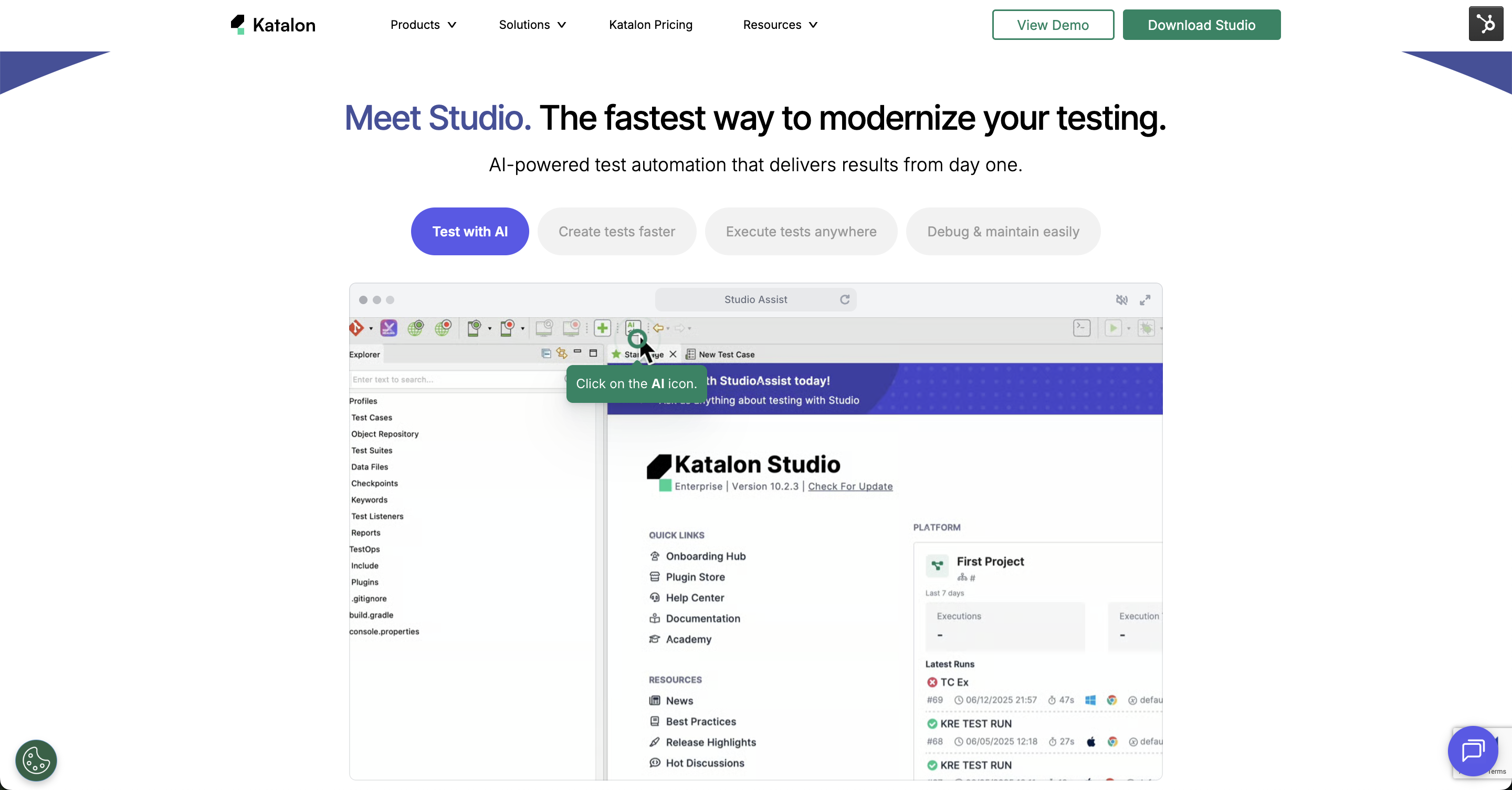
Katalon Visual Testing is the part of Katalon TestOps, in Katalon True, that compares UI screenshots between runs. Katalon Studio captures the screenshots. If you want visual checks to live inside the same tests that already cover your functional flows, Katalon Visual Testing does that inside your automation platform.
How it works: you add takeScreenshotAsCheckpoint steps to WebUI or Mobile test cases in Katalon Studio. When the test suite runs and the results upload to Katalon True, the first run builds a baseline collection and later runs are compared against it. You can also run the tests from GitHub through the Katalon True GitHub integration.
Key features:
- Three comparison methods: pixel-based, AI layout-based (it detects and matches zones between the checkpoint and the baseline, then highlights layout changes), and AI text/content-based (it extracts and compares text regardless of font family, size, or color).
- Ignored zones for dynamic areas such as dates, ads, or carousels, plus pixel sensitivity settings.
- Baseline collections that are generated automatically during a run, and can be updated by uploading or deleting images.
- Visual and functional results in the same test runs, across web and mobile.
- Katalon Studio covers web, mobile, API, and Windows desktop testing with no-code, low-code, or full-code authoring.
- Katalon AI Assistant generates scripts from natural language, explains scripts, and helps fix failures (Professional and Enterprise).
If you want to keep Applitools Eyes for visual checks and change only your authoring tool, Katalon Studio can also run Applitools Eyes checks through the Applitools plugin from Katalon Store. You need your own Applitools account and API key for that.
Pros:
- Visual checks run inside your existing Katalon Studio tests, with no separate visual SDK.
- AI layout and text comparison help you separate real layout or wording changes from 1-pixel shifts that pure pixel diffing flags.
- One place for test cases, runs, and visual results in Katalon TestOps.
Cons:
- Visual Testing needs Katalon True: Studio alone captures checkpoints but does not compare them.
- It works on screenshots from WebUI and Mobile tests, not on Storybook stories, so component-library teams may prefer Chromatic or Argos.
- Several Studio features are on paid plans: parallel execution, AI self-healing, and Windows desktop testing need Professional or Enterprise, and CI runs need the Katalon Runtime Engine (KRE) add-on and a paid plan.
Pricing: Katalon Studio has a Free plan and a 30-day free trial. Studio Professional costs $1,800 per seat per year (about $150 a month), billed annually, and Enterprise is custom. KRE and TestCloud are add-ons. Visual Testing is available when you register for Katalon True, including on a trial; your tier sets how many test results you can store. Ask Katalon which tier fits your checkpoint volume. More details are on the Katalon Visual Testing page.
2. Percy (BrowserStack)
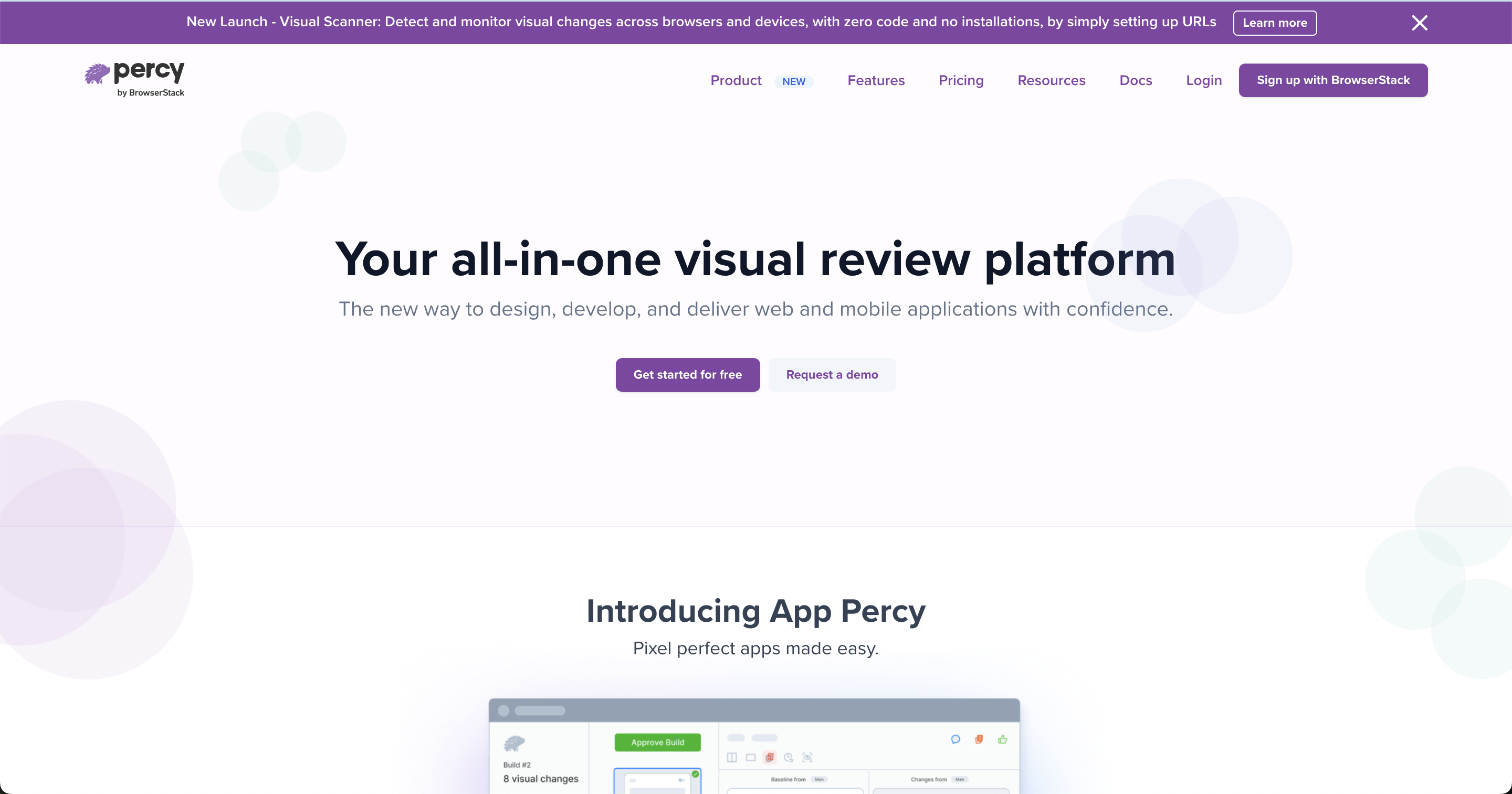
Percy is BrowserStack's visual testing and review platform. It captures snapshots on every build, renders them across browsers and widths, and shows the changes in a review UI tied to your pull requests.
Key features:
- SDKs for frameworks such as Cypress, Playwright, Selenium, and Storybook.
- Percy Visual Engine, which uses computer vision to filter anti-aliasing and rendering noise from diffs.
- Visual Review Agent on paid plans, which highlights meaningful changes, and Intelli Ignore for dynamic content.
- Branching and merging of baselines that follows a Git-style workflow.
- Jira, Slack, and Figma integrations.
Pros:
- A generous free tier for small projects.
- A good fit if your team already runs tests on BrowserStack.
- Designers and product managers can approve changes without reading code.
Cons:
- Percy's engine filters rendering noise and the Visual Review Agent summarizes changes, but it does not offer layout- or text-level comparison modes like Applitools Eyes or Katalon Visual Testing's AI methods.
- It covers visual checks only; functional tests still need another framework.
Pricing (as of November 2026): a free plan with 5,000 screenshots a month. Desktop costs $199 a month and Desktop & Mobile $599 a month, both billed annually, for 10,000 and 25,000 screenshots. If you are weighing BrowserStack as a whole, see our BrowserStack alternatives guide.
3. Chromatic
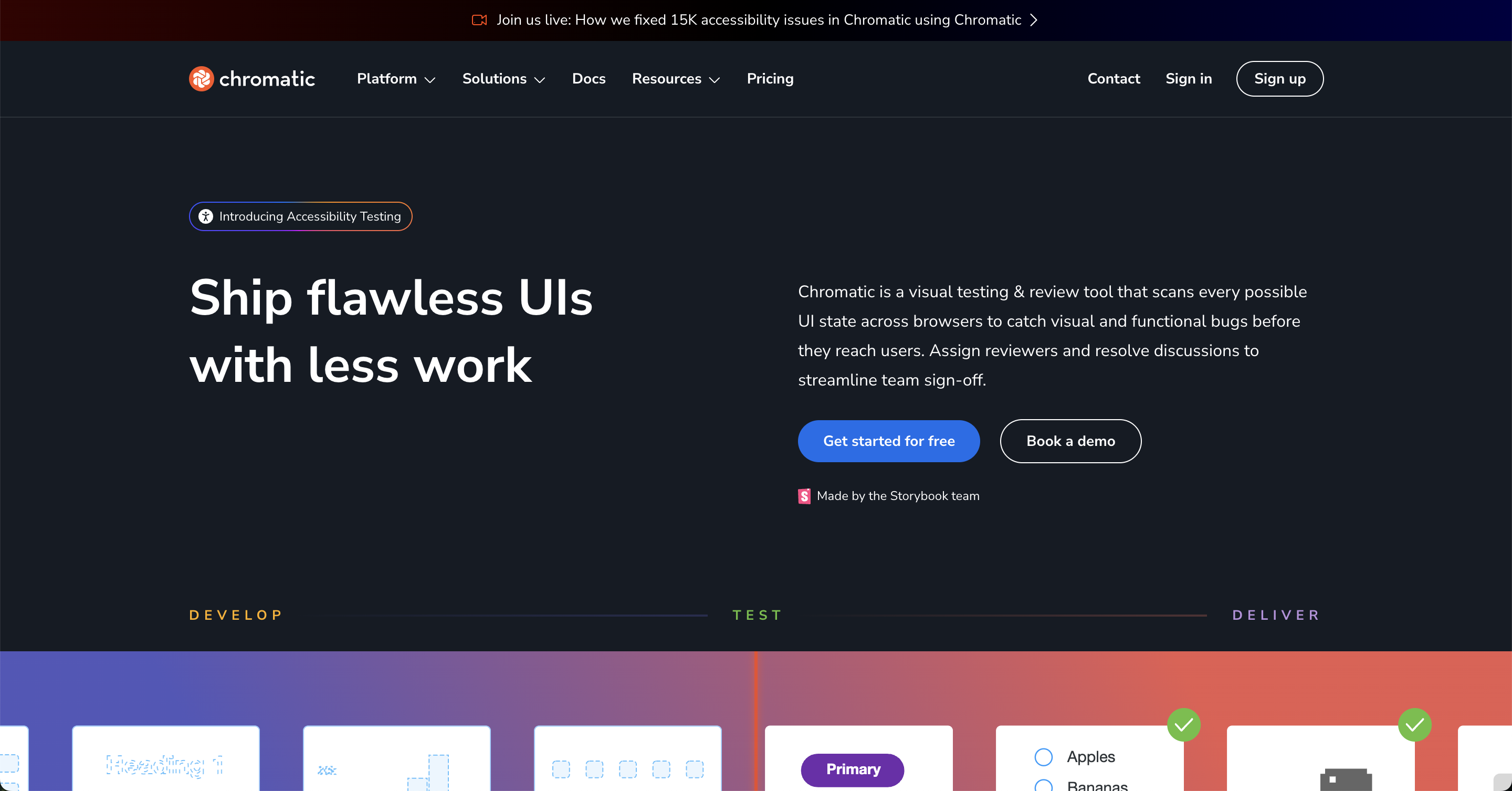
Chromatic comes from the Storybook maintainers. It snapshots your component stories, and also Playwright and Cypress tests, then puts the changes in a review workflow attached to pull requests.
Key features:
- Snapshots of every story across browsers and viewports.
- TurboSnap, which only snapshots stories affected by a code change.
- Ignore regions, a review UI with comments and approvals, and pull request status checks.
- Interaction tests in the same workflow.
Pros:
- Very little setup if you already use Storybook.
- A clear review flow for designers and front-end engineers.
Cons:
- Strongest at the component level; full end-to-end page flows need Playwright or Cypress tests behind it.
- Costs scale with snapshot count, browsers, and viewports.
Pricing (as of November 2026): a free plan with 5,000 snapshots a month (Chrome only), Starter at $179 a month for 35,000 snapshots, and Pro at $399 a month for 85,000.
4. Sauce Labs Visual Testing
Sauce Labs Visual Testing (Sauce Visual) is the visual testing product from Sauce Labs. It replaced Screener, which Sauce Labs shut down. You add snapshot statements to existing tests, and Sauce Visual compares each snapshot with an approved baseline inside Sauce Labs infrastructure.
Key features:
- Snapshots for web, mobile web, and native iOS and Android apps.
- DOM diffs that show which element changed, not only which pixels.
- Selectable diffing engines. The Balanced engine detects single-pixel changes while ignoring antialiasing and small color inaccuracies.
- Selective diffing: with a DOM capture, you can ignore content, position, size, structure, or style changes for a whole snapshot or for chosen elements.
- A review workflow to accept or reject changes and evolve baselines, plus Storybook support (beta as of November 2026).
Pros:
- No extra grid to maintain if you already run tests on Sauce Labs.
- DOM diffs make it easier to trace a visual change to its cause.
- SDKs for frameworks including Playwright, Cypress, WebdriverIO, and Nightwatch, plus Java, C#, Python, and Espresso.
Cons:
- No AI-based layout comparison like Applitools Eyes or Katalon Visual Testing's AI layout method; structure-aware checks rely on DOM capture.
- Standalone visual pricing goes through sales.
Pricing (as of November 2026): Virtual Device Cloud ($149 a month) and Real Device Cloud ($199 a month), both billed annually, include 500 visual snapshots a month. Larger volumes go through Sauce Labs sales.
5. Argos
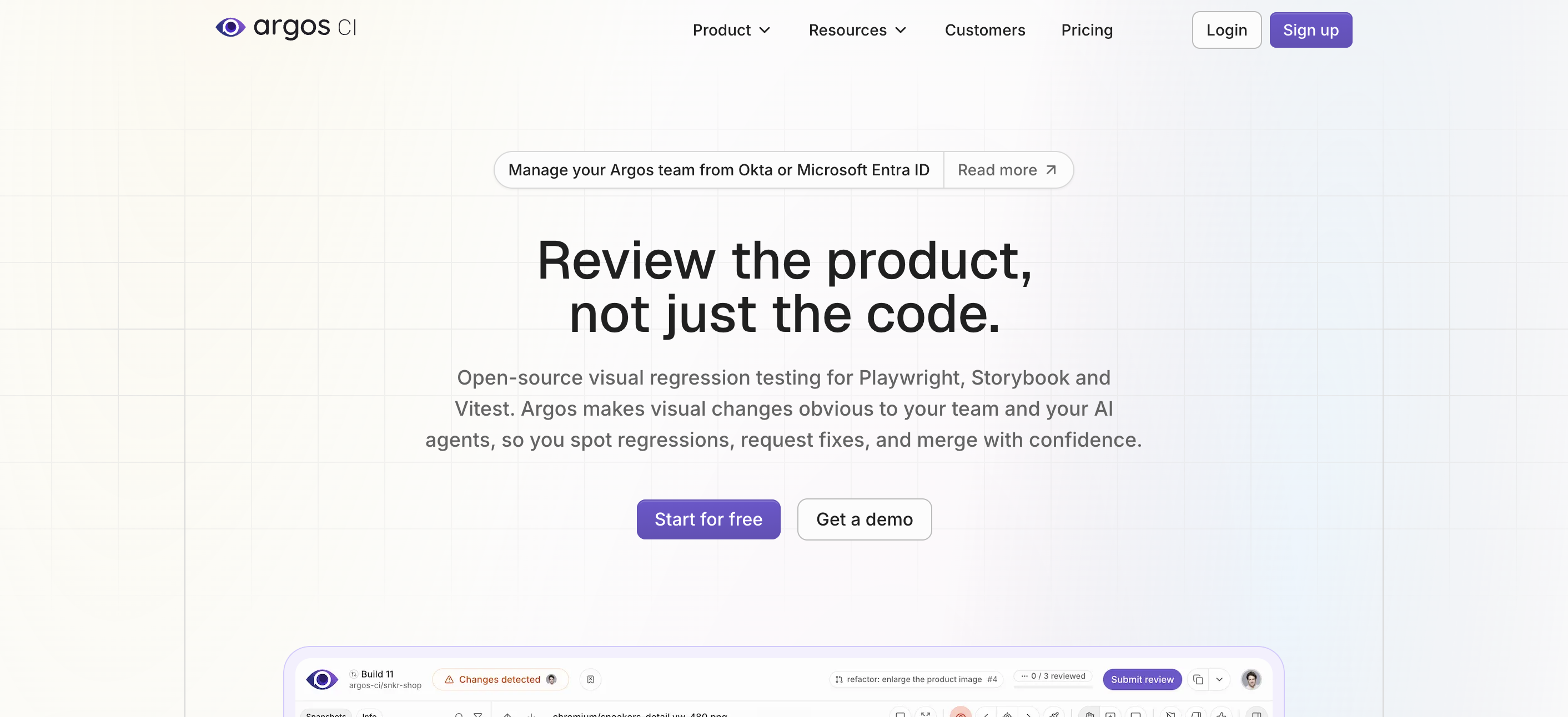
Argos is a hosted visual review service that compares the screenshots your tests already produce and posts the result to GitHub or GitLab.
Key features:
- Visual and snapshot comparison for screenshots, Storybook, and static deployments.
- Flaky detection and debugging tools.
- GitHub and GitLab integration, Slack notifications on the Pro plan, and Microsoft Teams and Discord automations.
- A CLI and REST API.
Pros:
- A free Hobby plan for individual developers.
- Usage-based pricing that stays low for small suites.
Cons:
- Comparison is screenshot-based, without layout-level AI.
- Team collaboration features start on the paid plan.
Pricing (as of November 2026): Hobby is free for up to 5,000 screenshots a month. Pro starts at $100 a month, billed monthly by usage, with 35,000 screenshots included.
6. Playwright
If you already write tests in Playwright, you may not need a separate visual tool for basic checks. Playwright Test has a built-in screenshot assertion that stores a baseline on the first run and compares against it on every run after:
await expect(page).toHaveScreenshot('checkout.png', { maxDiffPixels: 100 });Key features:
- Screenshot assertions for whole pages or single elements, with diff thresholds and masks for dynamic areas.
- Chromium, Firefox, and WebKit.
- Functional and visual assertions in the same test.
Pros:
- Free and open source under Apache 2.0.
- No new tool, SDK, or dashboard to adopt.
Cons:
- Comparison uses pixelmatch, so small rendering differences can fail a test unless you tune thresholds.
- Baselines are named per browser and operating system, and rendering varies by host, so you need to generate baselines in the same environment that runs the tests (often a Docker image in CI).
- There is no hosted review or approval UI; you review diffs in the HTML report.
Pricing: free. CI infrastructure is your own cost.
7. BackstopJS
BackstopJS is an open-source visual regression framework. You describe scenarios (URLs, viewports, and interactions) in a JSON config, and it captures screenshots with headless Chrome and compares them with your references.
Key features:
- Scenario config for URLs, viewports, selectors, and hide or remove rules.
- Scripting through Playwright or Puppeteer for logins and interactions.
- An HTML report with side-by-side diffs and a scrubber.
- A CLI that fits into any CI system.
Pros:
- Free under the MIT license; the repository still receives commits, though the latest npm release is from September 2024 (as of November 2026).
- Full control over thresholds, viewports, and where baselines are stored.
Cons:
- Pixel diffing, so dynamic content needs careful hide rules.
- No hosted review UI, and mobile app testing is out of scope.
Pricing: free and open source. Hosting and CI are your cost.
8. Loki
Loki is an open-source visual regression tool for Storybook. It captures each story and compares it with a reference image, locally or in CI.
Key features:
- Story-by-story screenshots in headless Chrome, with Docker support for consistent rendering.
- Configurable diffing engines and viewport presets.
- iOS simulator and Android emulator targets for React Native stories.
Pros:
- Free under the MIT license, with low setup overhead for Storybook projects.
- Reference images live in your repository.
Cons:
- Component-level only; not built for full-page flows.
- No review dashboard, and the latest release is from August 2024, though the repository still receives commits (as of November 2026).
Pricing: free and open source.
9. Resemble.js
Resemble.js is a JavaScript image comparison library. It is a building block rather than a tool: you feed it two screenshots and it returns a mismatch percentage and a diff image.
Key features:
- Options to ignore antialiasing or colors, scale images, and exclude regions.
- Runs in the browser or in Node.js.
Pros:
- Free under the MIT license and small.
- Useful for custom visual checks inside an existing framework.
Cons:
- You build baseline storage, review, and reporting yourself.
- The repository's last update on GitHub was in February 2024 (as of November 2026).
Pricing: free and open source.
10. mabl
mabl positions itself as an agentic testing platform for web, mobile, API, and performance testing, with AI auto-healing and cross-browser runs in its cloud. It shows up in many "AI testing tools like Applitools" searches because teams compare it with Applitools Autonomous rather than with Eyes.
Pros:
- Low-code authoring with code extensibility, and one platform for several test types.
- Cloud execution with no infrastructure to manage.
Cons:
- As of November 2026, mabl has retired visual change detection on browser test steps (May 21, 2026). It still offers standard visual tests against a baseline, plus generative AI visual assertions on element screenshots, which are capped at 30 per test and can vary between runs.
- Pricing goes through sales.
Pricing (as of November 2026): free trial, then plans through mabl sales. For more options in this group, see our mabl alternatives guide.
11. Tricentis Testim
Testim is an AI-assisted test automation tool, now part of Tricentis, for web apps, with a separate Testim Mobile product. It uses smart locators to keep tests stable when the UI changes, and supports visual validation steps inside web tests.
Pros:
- Record-and-edit authoring with JavaScript for custom logic.
- AI-based locators that reduce breakage from small DOM changes.
Cons:
- Visual validation is a step inside functional tests, not a dedicated visual AI comparison engine.
- Paid plans go through Tricentis sales.
Pricing: a free Community plan; paid plans through Tricentis.
12. Ghost Inspector
Ghost Inspector is a no-code browser testing and monitoring service. You record tests with a Chrome extension, schedule them, and compare screenshots between runs.
Pros:
- Quick setup for non-developers, with scheduling and alerts built in.
- Screenshot comparison on every run without extra tooling.
Cons:
- Web only, with basic logic for branching and loops.
- Comparison is screenshot-based, without layout-level AI.
Pricing (as of November 2026): a 14-day free trial, no free plan. Starter costs $109 a month billed annually ($125 monthly), with higher tiers for more runs and team members.
Which Applitools alternative should you pick?
- Stay on Applitools if you rely on its Visual AI, Figma comparisons, and unlimited users, and either Starter's 1,000 page or 100,000 component checkpoints cover you or you need Autonomous functional tests on Professional.
- Pick Katalon Studio with Katalon Visual Testing if you want AI layout and content comparison inside the same tests that cover your web and mobile functional flows, with test management in Katalon TestOps.
- Pick Percy or Sauce Labs Visual Testing if your team already runs on BrowserStack or Sauce Labs and wants visual review in the same account.
- Pick Chromatic, Argos, or Loki if you mainly test Storybook components.
- Pick Playwright toHaveScreenshot or BackstopJS if you want free, code-first checks and can manage baselines and noise yourself.
- Pick mabl or Tricentis Testim if your main need is AI-assisted functional test automation and visual checks are secondary; confirm the visual checks you need in a trial.
Whichever you choose, run a two-week pilot on your noisiest pages and count false positives. That number tells you more than any feature list.
Frequently asked questions
It depends on your stack. Percy and Chromatic suit teams that want hosted visual review, Playwright and BackstopJS suit teams that want free code-first checks, and Katalon Studio with Katalon Visual Testing suits teams that want AI layout and content comparison inside their existing functional tests. Pilot two options on your noisiest pages first.
Yes. Playwright's toHaveScreenshot assertion, BackstopJS, Loki, and Resemble.js are free and open source. Percy, Chromatic, and Argos also offer free tiers of about 5,000 screenshots a month as of November 2026. The open-source tools use pixel diffing, so expect to tune thresholds and ignore regions for dynamic content.
As of November 2026, Applitools Starter costs $667 a month, paid annually, with unlimited users and 100,000 component or 1,000 page checkpoints. Professional and Enterprise are priced through sales and add AI functional testing, codeless API testing, and private cloud options. Applitools offers a free trial but no free plan.
Yes. Katalon Visual Testing, part of Katalon TestOps in Katalon True, compares screenshots captured by Katalon Studio tests. It offers pixel, AI layout-based, and AI text-based comparison, plus ignored zones for dynamic areas. Baselines build automatically during test runs, so visual checks sit next to your web and mobile functional tests.
Percy suits teams that want a free tier, BrowserStack integration, and pull request reviews, and its paid plans add a Visual Review Agent on top of its Percy Visual Engine. Applitools Eyes compares screenshots with its own Visual AI and covers functional testing on higher tiers. Compare false positives on your own pages before deciding between them.
Yes. Katalon Studio can run Applitools Eyes checks through an integration plugin, which helps teams that want to keep Applitools for visual checks but change their authoring tool. You need your own Applitools account and API key, plus the Applitools plugin from Katalon Store. Katalon also has its own Visual Testing in Katalon True if you prefer one vendor.


Test everything. Ship with confidence.
From generating test cases to spotting failures, Katalon's AI works across your entire pipeline, automatically.
